What Is an Overhead Camshaft? Cam Placement, Valve Actuation and Timing
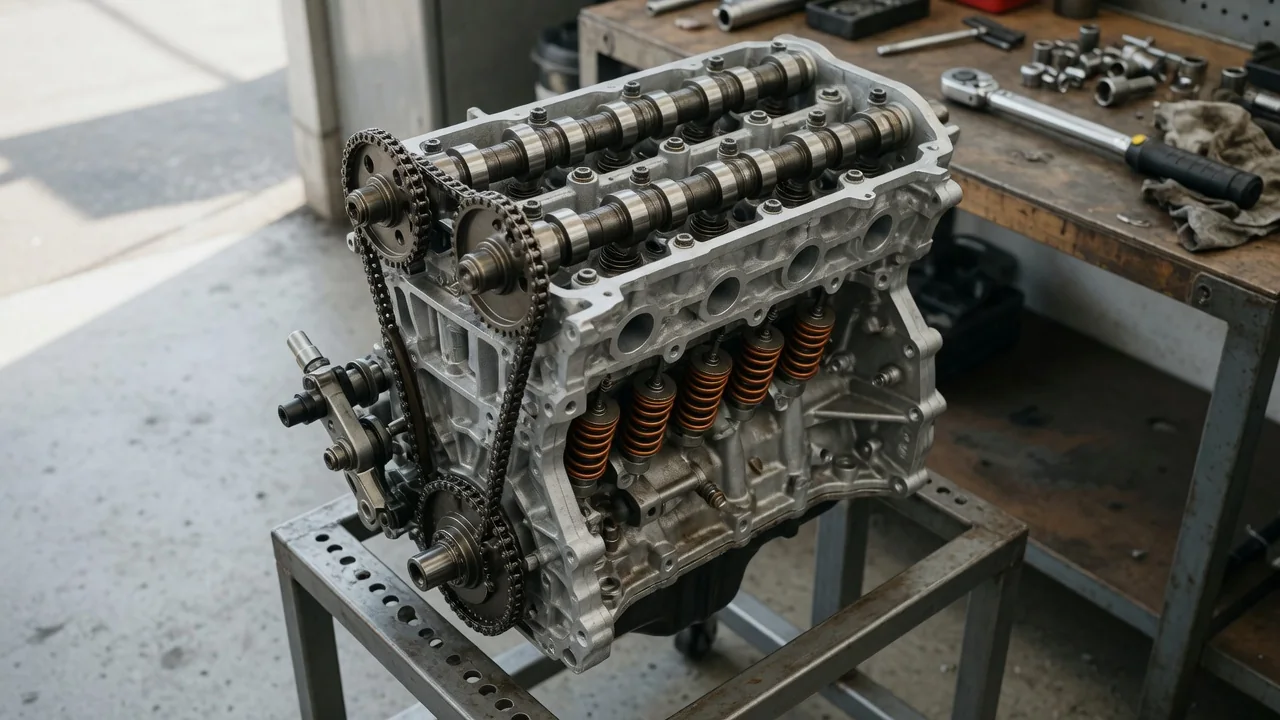
An overhead camshaft is a camshaft mounted in the cylinder head, above the combustion chambers, instead of low in the engine block. In an overhead camshaft engine, the cam sits close to the valves it operates, so fewer parts stand between each cam lobe and its valve. The sections below explain where the camshaft is placed, how it opens and closes the valves, how it stays synchronized with the crankshaft, and what the design means in everyday ownership.
Cam Placement: Where an Overhead Camshaft Sits
A four-stroke piston engine with poppet valves needs a camshaft: a rotating shaft with eccentric lobes that push the valves open at precise moments. What separates engine designs is where that shaft lives. In a cam-in-block, or pushrod, engine the camshaft sits in the block near the crankshaft, and pushrods carry its motion up to rocker arms in the cylinder head. An overhead camshaft (OHC) engine moves the camshaft into the cylinder head itself, above or beside the valves, so pushrods are not needed. Pushrod engines are often called overhead valve (OHV) engines because their valves are also in the head; the distinction between the two designs is the location of the cam, not the valves.
Overhead cam engines come in two main layouts. A single overhead camshaft (SOHC) design uses one camshaft per cylinder head to operate both intake and exhaust valves, typically through rocker arms. A dual overhead camshaft (DOHC) design uses two camshafts per head, one dedicated to the intake valves and one to the exhaust valves. Since V-type and horizontally opposed engines have two cylinder heads, a DOHC version of those engines carries four camshafts in total. Having a separate camshaft for each valve row makes it easier to fit several valves per cylinder, commonly four, and to position them for efficient airflow.
Valve Actuation: How the Cam Moves the Valves
As the camshaft rotates, each lobe moves against a follower. While the follower rides on the round base circle of the lobe, the valve stays closed. When the raised portion of the lobe comes around, it pushes the follower and opens the valve. The valve spring then closes the valve as the lobe rotates away and keeps the follower in contact with the cam. The lobe profile determines lift, meaning how far the valve opens, and duration, meaning how long it stays open relative to crankshaft rotation.
Overhead cam engines transfer lobe motion to the valve in a few common ways. With direct-acting bucket tappets, the lobe presses on a cup-shaped tappet sitting on top of the valve stem, a compact and stiff arrangement often found in DOHC heads. With finger followers, a short pivoting lever sits between the cam and the valve, frequently fitted with a roller to reduce friction. Many SOHC engines use rocker arms on a shaft, which let one camshaft reach valves on both sides of the head.
A small amount of clearance, called valve lash, must exist or be managed so the valves can close fully. Some engines use hydraulic lash adjusters that take up clearance automatically using oil pressure; others use mechanical clearance set with shims or adjusting screws. Because an overhead cam removes pushrods and long rocker linkages, the valvetrain generally has less moving mass, which helps the valves follow the cam profile accurately at higher engine speeds.
Timing: Keeping the Camshaft in Step With the Crankshaft
In a four-stroke engine, each valve opens once for every two revolutions of the crankshaft, so the camshaft turns at half crankshaft speed. The drive between the two is built with a 2:1 ratio, and the relationship must be exact, because valve events are tied to piston position. If the cam falls out of step with the crankshaft, the valves open at the wrong point in the cycle.
Because an overhead camshaft sits far from the crankshaft, it needs a longer drive than a cam-in-block design. Most engines use either a toothed timing belt made of reinforced rubber, usually running behind a cover outside the engine, or a timing chain running inside the engine and lubricated by engine oil. Chains rely on tensioners and guides to control slack, while belt systems use tensioners and idler pulleys. Gear-driven cams exist but are less common in passenger cars. Timing marks on the crankshaft and cam sprockets are used during service to restore correct alignment.
Many modern overhead cam engines add variable valve timing. A cam phaser built into the camshaft sprocket can rotate the cam slightly relative to its drive, advancing or retarding valve events while the engine runs, usually controlled by oil pressure routed through a solenoid valve. DOHC engines can phase the intake and exhaust camshafts separately when equipped to do so, and some designs also vary valve lift. Whether a particular engine has these features depends on its design.
Practical Implications and Limits
The timing drive is the part of an overhead cam engine owners most often deal with. Belt-driven engines have a replacement interval set by the manufacturer, and a belt that breaks stops the camshaft immediately. In an interference engine, the valves and pistons occupy the same space at different points in the cycle, so a broken belt or a chain that skips teeth can let them collide and cause serious internal damage; a non-interference engine is less exposed to that outcome. Timing chains are usually intended to last longer, but they can wear and stretch, particularly when oil changes are neglected. Rattling at startup or timing-related diagnostic trouble codes can point toward the chain, tensioner or phasers, though proper diagnosis is needed to confirm the cause.
Oil condition matters more than the term overhead cam suggests. Hydraulic lash adjusters, cam phasers and chain tensioners all depend on clean oil at the right viscosity and pressure, so using the specified oil and following the service schedule helps these parts work as designed. Engines with mechanical valve clearance may also need periodic inspection and adjustment.
The label itself has limits. Knowing that an engine is SOHC or DOHC does not reveal its power, efficiency, reliability or how difficult it is to service. Pushrod engines remain in production and can be more compact in overall height, while DOHC heads are taller, wider and contain more parts, which can make timing work more involved. For any specific engine, the manufacturer's specifications and service procedures, not general descriptions, determine intervals, clearances and repair steps.