How Does a Car EVAP System Work
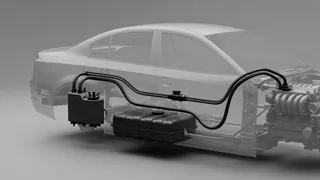
A car’s EVAP system is a closed emissions-control network designed to prevent raw fuel vapor from escaping the tank into the atmosphere. When you ask how a car EVAP system works, the essential answer is that it captures gasoline fumes, stores them temporarily, and later feeds them into the engine to be burned during normal combustion. It operates almost silently and has no direct effect on ordinary acceleration or braking, yet a small leak can trigger a diagnostic light and affect the vehicle’s emissions performance.
Direct answer
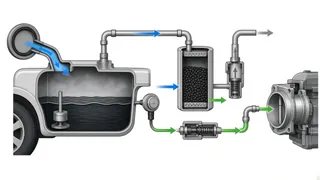
The evaporative emission control system, often called the EVAP system, stops unburned hydrocarbons from leaving the fuel tank and polluting the air. Instead of venting gasoline vapor directly to the atmosphere, the system routes fumes through a vapor line into a charcoal canister. The activated charcoal inside that canister adsorbs and holds the hydrocarbons until driving conditions allow the engine to consume them. This process is important even when the car is parked, because temperature changes and fuel sloshing can create significant vapor pressure.
The essential answer is that the system captures, stores, and purges fuel vapor rather than allowing it to escape. It does this in a loop that includes the tank, the charcoal canister, a vent valve, and a purge valve. Under specific warm-engine and light-load conditions, the powertrain control module opens the purge valve. Intake vacuum then draws stored vapor into the engine, where it mixes with the normal air-fuel charge. The system therefore provides both pollution control and a small recovery of fuel energy.
Purpose and operation
The system begins with fuel vapor forming above the liquid gasoline inside the sealed tank. Because the tank cannot be open to the atmosphere, pressure moves vapor through a vapor line toward the charcoal canister. The canister is typically filled with activated carbon granules that create a large surface area. Vapor molecules cling to those surfaces while clean air passes through a vent valve. This adsorption process is reversible, which is why the canister does not fill up indefinitely and can be purged repeatedly.
During normal driving, the engine control module looks for conditions that will not disturb combustion quality. Once the engine is warm and operating in closed loop, the purge valve opens gradually. Engine vacuum pulls fresh air through the vent valve, across the charcoal, and into the intake manifold. The airflow strips fuel vapor from the carbon and carries it into the cylinders. The module adjusts fuel injection to compensate, so the recovered vapor remains a controlled part of the combustion process rather than a random rich condition.
How to proceed
When a driver needs to inspect or maintain the system, the first step is to understand what any diagnostic result is actually reporting. The vehicle runs a leak test by sealing the system, often using the vent valve, and then applying or monitoring a small pressure change. That test detects leaks, not necessarily failed components. A code related to a large leak, small leak, or purge-flow error means the test result fell outside the expected range. It does not by itself identify a cracked hose, a failed purge valve, or a loose fuel cap.
A practical start is to check the fuel filler cap, because an improperly seated cap is a common source of a small-leak result that the system can detect. After that, visual inspection of accessible vapor lines may show cracks, loose connections, or obvious damage near the canister or intake manifold. If the components are not easily reached, vapor testing with a smoke machine is normally a job for a qualified repair facility. The vehicle-specific service information is necessary before replacing a vent valve, purge valve, or canister, because different designs use different test strategies and electrical control logic.
Understanding a problem
A common observation is an illuminated check-engine light with an EVAP-related code, sometimes accompanied by a fuel odor or difficulty filling the tank. A fuel smell near the rear of the car can indicate vapor escaping before it reaches the canister, while a hiss or pressure release when removing the fuel cap can sometimes be normal. The important distinction is between a symptom that shows vapor is escaping and a test result that only shows the sealed system did not hold pressure as expected. The second may not produce any noticeable smell or driving change.
A purge valve stuck open can cause a vacuum leak into the intake manifold that affects idle quality or fuel trim, even though the leak is not visible as a liquid fuel leak. A vent valve that will not close can prevent the leak test from running correctly. Since these valves are controlled electrically, a wiring or circuit problem can produce the same code as a mechanical valve failure. Troubleshooting therefore starts with the complete fault description and the specific vehicle’s diagnostic routine, not with an immediate parts replacement.