What Is a Car’s EVAP System and How Does It Work?
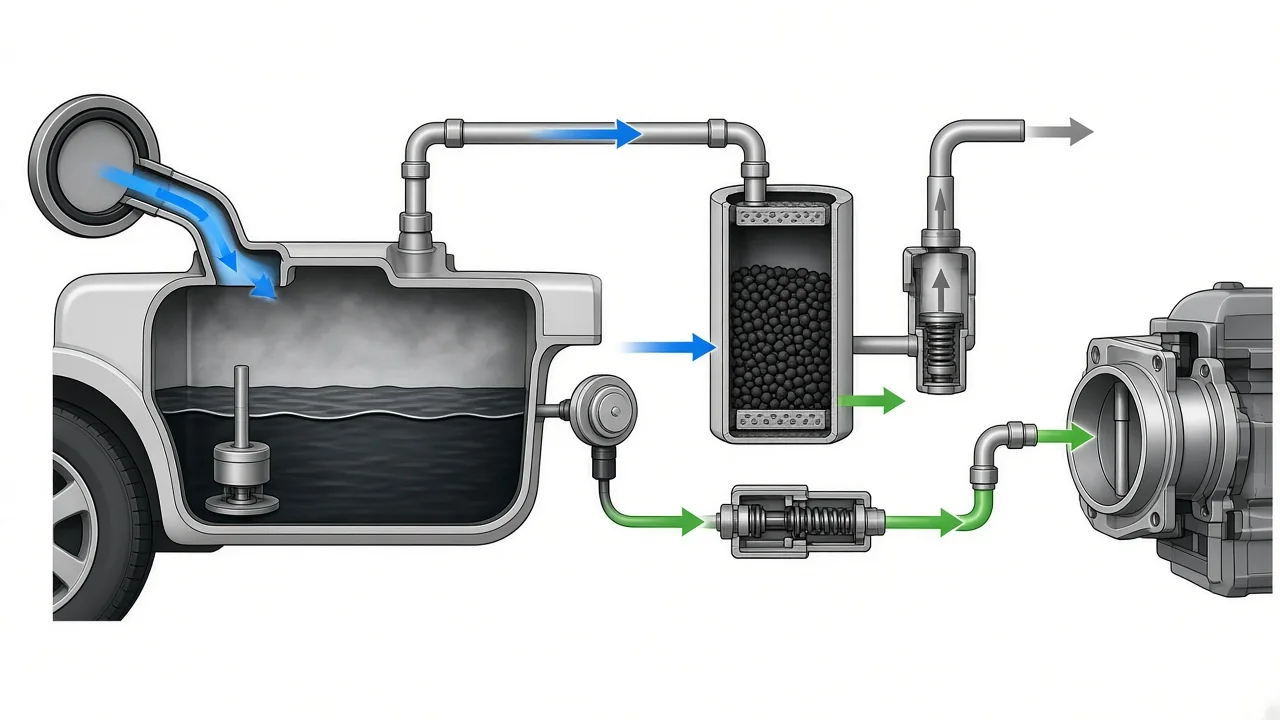
Every gasoline vehicle gives off fuel vapor, even when it sits parked in a driveway. The evap system stops that vapor from drifting into the air. It captures the vapor, stores it, and later sends it to the engine to be burned. Once you know how the parts work together and how the car checks itself for leaks, an EVAP-related check engine light becomes much easier to understand.
What the EVAP System Is
The evap system, short for evaporative emissions control system, is the network that keeps gasoline vapor contained instead of letting it vent to the atmosphere. The system doesn't treat the vapor as waste. It holds the vapor for a while and then routes it into the engine's intake, where it burns along with the regular fuel charge. It works quietly in the background, and most drivers never think about it until a warning light comes on.
Gasoline evaporates easily, so vapor forms whenever fuel sits in the tank. Daytime heat warms the tank while the car is parked, which increases vapor production, and fuel sloshing around during driving adds more. Hoses and valves link the fuel tank, a vapor storage device, and the engine intake. Exact layouts differ a lot between manufacturers and models, so where the parts sit on one car tells you little about another.
Why Capturing Fuel Vapor Matters
Fuel vapor is made up largely of hydrocarbons. When these escape into the air, they react with nitrogen oxides in sunlight and help form ground-level ozone, a major ingredient of smog that irritates lungs and harms plants. Vapor escapes from a parked car as well as a moving one. That means an unsealed fuel system can add to pollution around the clock, not just while the engine runs.
When the system traps vapor and later burns it in the combustion chamber, a potential pollutant becomes a small amount of usable fuel, and the resulting exhaust passes through the catalytic converter. This also explains why EVAP faults are often invisible from the driver's seat. A small leak or a sticking valve may not change power, idle quality, or fuel economy in any obvious way. Even so, the vehicle can still be releasing vapor it was designed to contain.
The Main EVAP Parts and Their Roles
In a typical layout, a vapor line runs from the fuel tank to a charcoal canister, which serves as the storage reservoir. A second line leads from the canister toward the engine intake, with a purge valve somewhere along that path. The canister also has a fresh-air side, which a vent valve controls on systems that have one. Valves at the tank and the filler neck connect the rest of the network.
The purge valve is electrically controlled and meters how much vapor the engine draws from the canister, opening only as far as the computer commands. When a vent valve is fitted, it can open the canister to outside air or close it to seal the system for testing. Many designs add a fuel tank pressure sensor or dedicated leak detection hardware. Finally, the fuel cap or a capless filler assembly seals the filler neck, and a worn seal there can compromise the whole system.
How the Charcoal Canister Stores Vapor
Activated charcoal is processed to create a huge number of tiny pores, which gives it a vast internal surface area. As fuel vapor passes through the canister, hydrocarbon molecules cling to those surfaces, a process called adsorption. The charcoal doesn't soak up vapor the way a sponge soaks up water. The vapor attaches to the surfaces temporarily, while air keeps moving toward the vent side with much of its fuel content removed.
The charcoal can only hold so much, so it has to be cleaned out regularly. During purge, engine vacuum pulls fresh air backward through the canister. That airflow draws stored hydrocarbons off the charcoal and carries them to the intake. Liquid gasoline is a different matter, because it can saturate the charcoal and interfere with vapor flow. That is one reason to stop filling at the pump's first automatic shutoff instead of topping off.
How Vapor Moves From the Tank to the Engine
A typical cycle starts in the tank, where vapor builds up as the fuel warms. The vapor travels through a line to the canister and stays there while the car is parked or while the engine is running under conditions that don't suit purging. Later, once the engine is warm and running steadily, the stored vapor is drawn into the intake, mixed with incoming air, and burned in the cylinders like any other fuel.
The engine computer decides when purge happens, so vapor never flows into the engine uncontrolled. The computer weighs factors such as engine temperature and load. It then commands the purge valve to open and adjusts fuel delivery to account for the extra vapor. As vapor leaves the canister, fresh air comes in through the vent path to replace it. Purge timing, valve behavior, and vapor routing all depend on the design, so a specific vehicle may not follow this general pattern exactly.
How EVAP Leak Checks Work, Including NVLD
Modern vehicles check their own EVAP systems for leaks. The computer seals the system and watches how pressure or vacuum behaves under defined conditions: a tight system holds steady, while a leak lets it bleed away. Because the test is sensitive, it runs only when fuel level, temperature, engine-off soak time, and recent driving fall within set ranges. If the monitor hasn't run yet, EVAP readiness shows it as incomplete. That is different from a failed test, which means the monitor actually found a problem.
Natural vacuum leak detection, or NVLD, relies on physics instead of a pump. After the engine shuts off, the fuel in the sealed tank cools and a slight vacuum develops. Some designs use a switch that closes once that vacuum reaches a threshold. Other systems draw engine vacuum into the sealed system or use a dedicated pump to pressurize or evacuate it. Both the hardware and the test logic are specific to each vehicle, so what a result means depends on the design.
What an EVAP Check Engine Light Can Tell You
A trouble code tells you that the computer detected a condition, such as a suspected leak or unexpected purge flow. It doesn't tell you which part to replace. The same code could come from a loose cap, a cracked hose, a sticking valve, or a wiring fault. You might notice a steady check engine light, a fuel odor, or hard starting right after refueling, but faults outside the EVAP system can cause any of these too.
The one check an owner should make is confirming that the fuel cap, if the car has one, is properly secured, then noting any symptoms. Clearing codes resets readiness but repairs nothing. Finding the actual leak requires a professional scan tool, approved leak testing, and definitions specific to your vehicle, because many codes mean different things from one manufacturer to another. If you notice a strong, persistent fuel smell or see fuel leaking, stop in a safe place away from ignition sources and call for help.