How Does a Car Door Latch Hold the Door Shut?
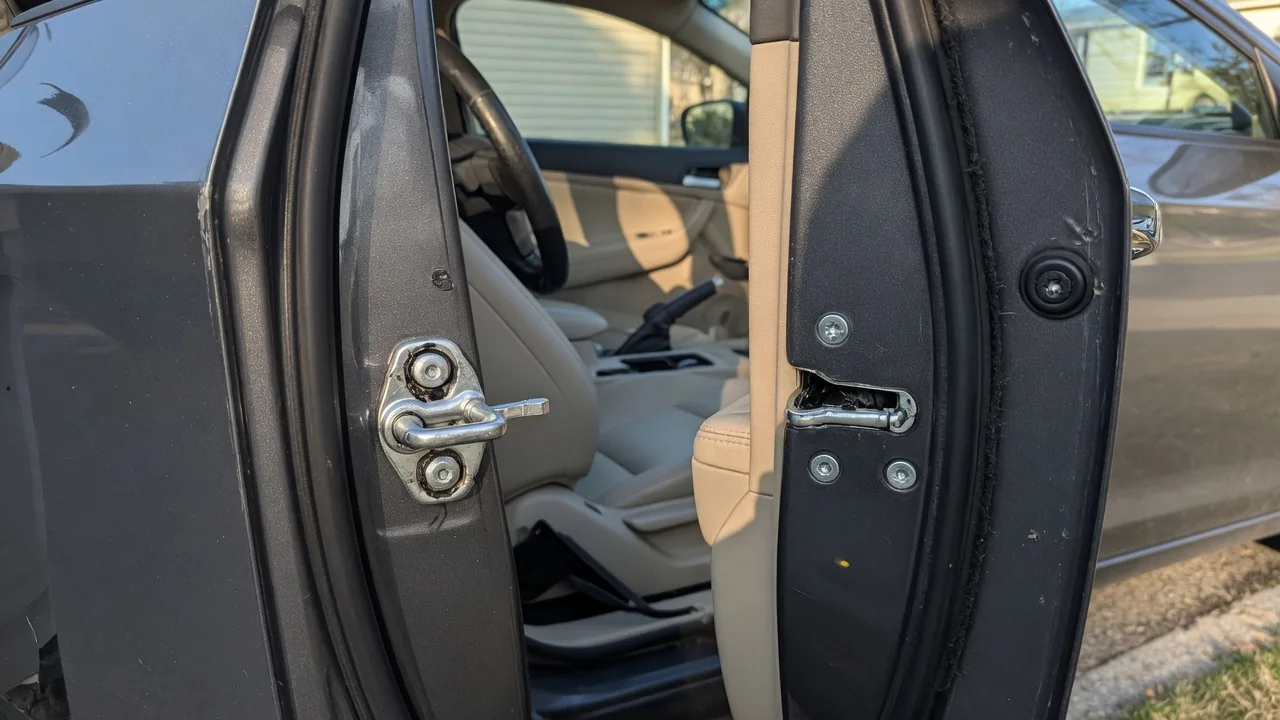
Anyone who has wondered how does a car door latch hold the door shut is really asking about two parts working together: a latch mounted inside the door and a striker fixed to the body. The latch contains a rotating catch that wraps around the striker, and a second piece locks that catch in place until a handle frees it.
Mechanical engagement
The striker is a sturdy loop or pin bolted to the body pillar, and the latch sits in the rear edge of the door. As the door swings closed, the striker enters a slot in the latch and pushes against a fork-shaped rotating catch, sometimes called a rotor or claw. The catch pivots around the striker and closes behind it. A spring-loaded lever called a pawl then drops into a notch on the catch, preventing it from rotating back. The door is now held by steel bearing on steel, not by spring tension.
Most latches have two notches on the catch, giving two holding positions. The first is a partial or safety position that keeps a lightly closed door from swinging open, and the second is the fully closed position where the door sits flush and the weather seal is compressed. That compressed seal pushes outward on the door, which keeps the catch loaded firmly against the striker and reduces rattles. The exact shape of the catch, the striker style and the latch location differ between manufacturers and between front doors, rear doors and liftgates.
Release
Opening the door means lifting the pawl out of its notch. Pulling the inside or outside handle moves a rod or cable that reaches the latch and pivots the pawl away from the catch. Once the pawl clears, the catch is free to rotate, and the outward push from the door seal, helped by a spring inside the latch, turns it open so the striker can slide out of the slot. The handle itself never carries the load that holds the door; it only trips the mechanism.
Locking does not usually clamp the catch harder. Instead, it disconnects or blocks the link between the handle and the pawl, so pulling the handle does nothing. Child safety locks on rear doors work on the same principle, disabling only the inside handle. Many newer vehicles use an electric actuator to move the pawl, with a button or touch sensor replacing the mechanical pull, and some add a powered cinching function that draws the door into the fully closed position. How these features are arranged depends on the vehicle.
Inspection
A great deal can be learned by simply looking. With the door open, the mouth of the latch is visible on the door edge, and the catch inside should be sitting in its open position, ready to receive the striker. The striker on the body should be tight, straight and centered in the path of the latch. Shiny wear marks on one side of the striker, a worn plastic coating or scuffed paint around it suggest the door is meeting it too high, too low or off to one side.
The latch should look clean and lightly lubricated, not caked with dried grease, dirt or rust. Closing the door slowly and watching the gap shows whether it lifts or drops as the latch meets the striker, which points toward alignment or worn hinges and not the latch itself. Handles should return freely after being pulled, with no slack or sticking. Access to the latch internals, rods and cables normally requires removing the door trim, and the layout varies enough that vehicle-specific service information is worth consulting first.
Everyday Use and Observations
In daily driving, a healthy latch announces itself with a solid, single sound and a door that closes with moderate effort. A door that stops at the first notch looks almost shut but sits slightly proud of the body, may let in wind noise and often triggers the door ajar warning or leaves the interior light on. A door that needs a hard slam can indicate a misaligned striker, a stiff latch, or a new or swollen seal resisting compression. Rattles over bumps can mean the catch is not held tightly against the striker.
Weather changes behavior too. In freezing conditions, moisture inside the latch can hold the pawl or catch in place, so the door either refuses to open or bounces back without latching. Dust and old lubricant can produce the same sluggishness in warmer climates. If the catch gets flipped closed while the door is open, the door will hit the striker and rebound; pulling the handle normally resets it. A handle that feels unusually light or loose suggests the rod or cable is no longer moving the pawl properly.
Limits and Next Steps
Understanding the mechanism helps narrow a problem, but it does not confirm which part is at fault. Similar symptoms can come from the latch, the striker position, sagging hinges, a stretched cable, a broken handle or an electrical actuator. A door ajar warning or a stored body control fault points to a circuit or switch signal worth investigating, not proof that the latch has failed, and such codes are often manufacturer-specific, so their meaning should be checked against information for the exact vehicle.
Cleaning and applying a suitable lubricant to a sticky latch is a reasonable first step for many owners. Beyond that, caution is warranted, because the latch and striker are safety components that help keep the door closed in a collision, and doors may also contain side airbag sensors, wiring and window mechanisms. A door that will not stay shut should not be driven on or tied closed as a lasting fix. Having a qualified technician inspect it, and checking whether any recall applies to the vehicle, is the sensible next move.