How Are Car Tires Vulcanized? Curing, Tread Molding and Quality
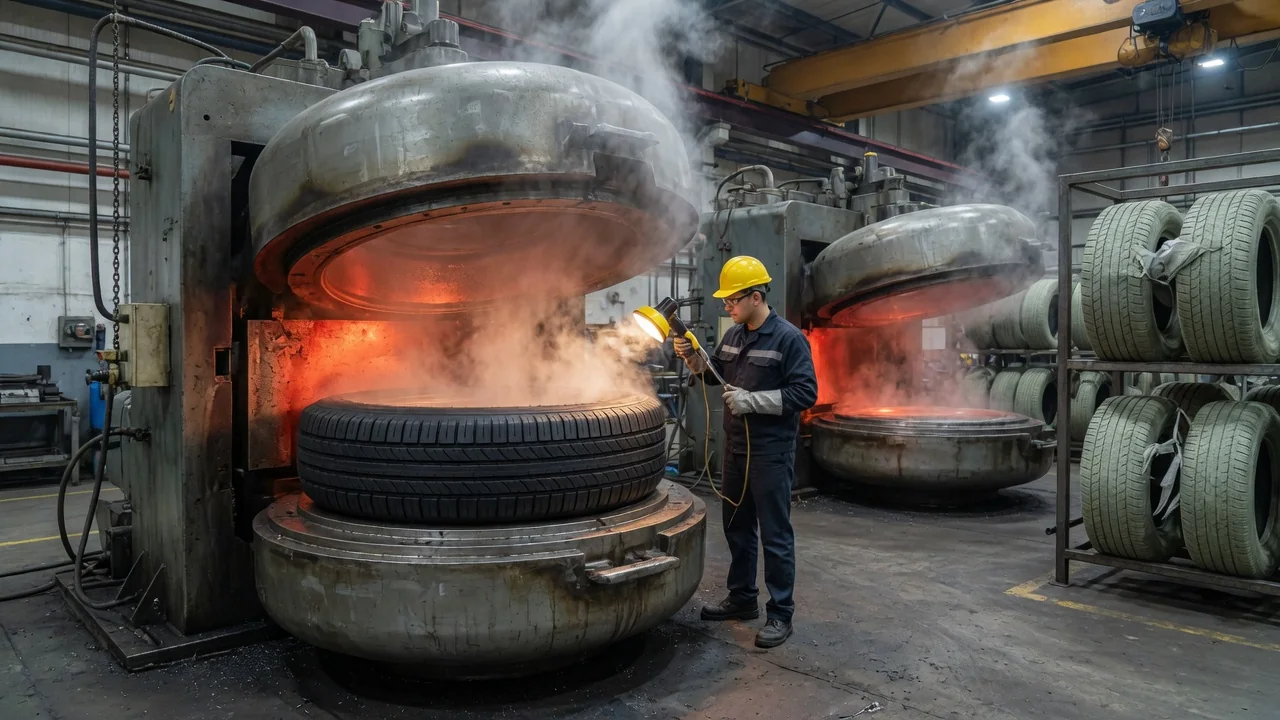
Every new car tire starts as a soft, sticky assembly of rubber compounds, fabric and steel that could not survive a single drive. Vulcanization turns that assembly into a tough, elastic product. The basics of tire vulcanization explain why tires keep their shape, why the tread pattern looks the way it does, and why manufacturers inspect tires after they leave the press. This article explains how car tires are vulcanized, from the chemistry to the finished tread.
Rubber curing
Raw rubber, whether natural or synthetic, is made of long polymer chains that can slide past each other. On its own it softens in heat, stiffens in cold and deforms permanently under load. Vulcanization, also called curing, links those chains together with chemical bridges, most commonly sulfur crosslinks. Once linked, the chains can stretch under force and then return to their original position, which is the elastic behavior a tire needs. The process dates back to the nineteenth century and remains the foundation of tire manufacturing, although modern compounds are far more refined than early vulcanized rubber.
Before curing, rubber is mixed with a recipe of other ingredients. Sulfur provides the crosslinks, accelerators speed up the reaction and make it more controllable, and activators such as zinc oxide and stearic acid help the accelerators work. Reinforcing fillers such as carbon black or silica, along with oils, antioxidants and antiozonants, are added for strength, grip and resistance to aging. Different parts of the tire, including the tread, sidewalls and inner liner, use different compounds, and each must be formulated to cure properly during the same press cycle.
The uncured tire, known as a green tire, is assembled on a building drum from layers: inner liner, body plies, beads, steel belts, sidewalls and tread. It is then loaded into a curing press. Inside the press, a flexible rubber bladder is inflated with a heated medium such as steam, hot water or nitrogen, pushing the tire outward against a heated metal mold. Heat flows in from both the mold and the bladder, while pressure squeezes the layers together and forces out trapped air. Cure time and temperature are set for each tire design, because thick sections heat through more slowly than thin ones.
Tread shape
The tread pattern is not carved after curing; it is formed by the mold during vulcanization. The inner surface of the mold is a negative image of the finished tire, with raised ribs that become grooves and thin metal blades that create sipes. As the bladder presses the soft compound outward, rubber flows into every cavity of the mold, and as crosslinks form, that shape becomes permanent. Sidewall markings, including size, load and speed information and the DOT code, are molded in the same step.
Tire molds are generally either two-piece designs that split around the tire's centerline or segmented designs in which several tread sectors close radially around the tire. Segmented molds are widely used for radial tires because the sectors move straight toward and away from the tread rather than sliding across it, which helps protect detailed blocks and complex sipe shapes when the cured tire is released. The pattern itself, including block geometry, groove layout and pitch sequencing to manage noise, is designed long before the mold is machined.
Air trapped between the green tire and the mold would leave voids or poorly formed tread blocks. Molds therefore include small vents that let air escape. On many tires, rubber flows into these vents and leaves small hair-like nubs, often called vent spews or vent hairs. They are a normal byproduct of curing and wear away quickly in use. Some molds use spring vents or slot vents that reduce or avoid these nubs, which is why not every new tire has them.
Quality
The central quality concern in vulcanization is reaching the right state of cure throughout the tire. Undercured rubber stays weaker and may bond poorly between layers, while overcuring can degrade some properties; with certain compounds, prolonged heating can cause reversion, a partial breakdown of the crosslink network. Because a tire combines thick and thin regions made from different compounds, the cure cycle is a balance designed so that every area reaches an acceptable state. Manufacturers establish these cycles through compound testing and process control rather than by adjusting them tire by tire on the production line.
After the press opens, tires are typically inspected before shipping. Common checks include visual inspection for molding defects, blisters or exposed cords, and uniformity measurement, in which the tire is rotated under load to detect variations in radial and lateral force. Balance is also commonly measured, and many plants use X-ray inspection to examine internal structure such as belt and ply placement. The specific checks and acceptance limits vary by manufacturer and product, and they are generally not published in detail.
Traceability is part of quality as well. The DOT code molded into the sidewall identifies the manufacturing plant and the week and year of production, which allows a tire to be linked to its production period if a problem is discovered later, such as during a recall.
Practical implications and limits
For drivers, vulcanization explains a few everyday facts. A cured tire cannot be melted back into raw rubber and reshaped, so damage to the cord body, belts or bead cannot simply be cured away. Puncture repair works within this limit: a proper repair typically uses a plug-patch installed from the inside, bonded to the inner liner with vulcanizing cement or a chemically curing patch. Such repairs are restricted to the central tread area under the guidelines published by tire makers and industry bodies, while sidewall and shoulder damage generally means the tire must be replaced.
Retreading also depends on curing. Worn casings that pass inspection receive new tread rubber, either as a pre-cured tread strip bonded with a cushion layer and cured in a chamber, or as uncured rubber molded and vulcanized directly onto the casing. Retreading is common for truck tires and much less common for passenger car tires.
Vulcanization does not stop rubber from aging. Oxygen, ozone, heat and sunlight continue to attack the polymer over time, which is why tire age matters even when tread depth looks adequate, and why storing tires away from heat, direct sunlight and ozone sources such as electric motors is commonly recommended. Finally, exact compounds, cure temperatures and press times are proprietary and differ between tire types and manufacturers, so a general explanation describes the mechanism rather than the precise recipe used for any particular tire.