How Are Car Roof Panels Bonded? Joints, Structure and Repair Limits
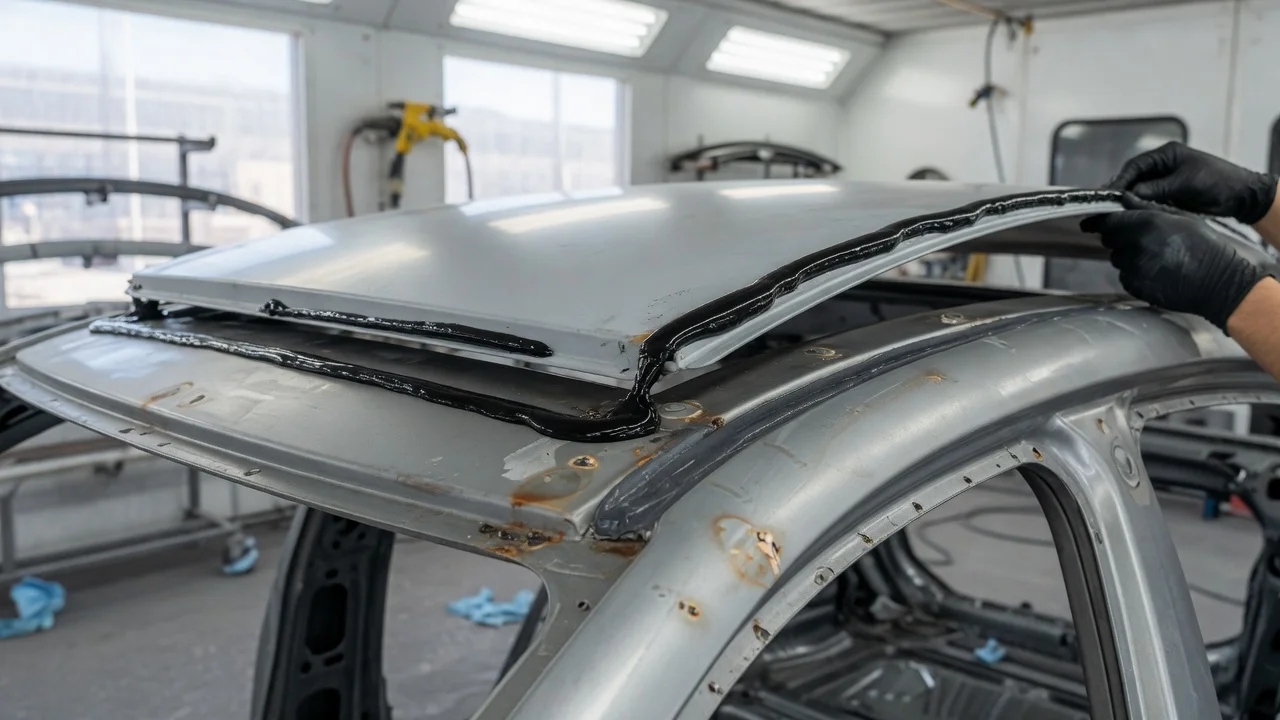
On most modern cars, the roof is not held on by a single method. A typical steel roof skin is joined to the body side frames with welds or brazing, supported underneath by roof bows bonded with flexible adhesive, and sealed along its edges against water. Automotive roof panel adhesive does several different jobs depending on where it sits. Knowing which joint is which explains how the roof contributes to the body and why repairs must follow the manufacturer's procedure.
Joint design: how the roof meets the body
The outer roof panel is usually a large stamped skin whose edges overlap flanges on the body side rails and on the front and rear headers. Along the sides, these flanges commonly sit in a recessed channel, often called a roof ditch, where the skin is attached by resistance spot welds or by a continuous brazed or welded seam, depending on the design. In weld-bonded joints, a structural adhesive is applied between the flanges before spot welding, so the finished joint combines discrete weld points with a continuous adhesive line. The channel is then filled with seam sealer and is often covered by a trim molding.
Underneath the skin, transverse roof bows span the opening between the side rails. The skin is rarely welded to these bows. Instead, a bead of anti-flutter adhesive or expandable mastic is placed on each bow during assembly. Because it is applied before paint, this material is typically designed to cure or expand as the body passes through the paint ovens, filling the gap between bow and skin. Its job is to keep the large, thin panel from vibrating, drumming or flexing in and out, not to carry major loads.
Not every roof follows the steel-skin pattern. Fixed glass and panoramic roof panels are generally bonded into a frame or flange with a urethane adhesive, in a manner similar to windshields. Where a roof panel is made from a different material than the body, such as aluminum or a fiber-reinforced composite, adhesive bonding is often favored because it joins dissimilar materials without fusion welding, spreads load over a wider area and can separate metals that might otherwise corrode against each other. The exact combination of welds, brazing and adhesive varies from vehicle to vehicle.
Structural role of the roof and its bonds
The roof structure as a whole, meaning the side rails, headers, pillars and bows, ties the left and right sides of the body together. That connection contributes to torsional and bending stiffness and to the body's ability to resist crushing in a rollover. Most of that strength lives in the closed-section rails and pillars, which are usually made from thicker or higher-strength steel. The outer skin adds some stiffness through its perimeter joints, but it is generally a closing panel rather than the primary load path.
Adhesive along the perimeter flanges makes the joint behave more like a continuous connection. Compared with spot welds alone, a bonded flange distributes stress along its length, which can improve stiffness and fatigue behavior and reduce noise. The anti-flutter material under the skin plays a different role: it is intentionally flexible, letting the skin and bows move with temperature changes while damping vibration. Seam sealer in the roof channel exists mainly for water and corrosion protection. Treating these three materials as interchangeable is a common misunderstanding, because each has a distinct purpose and its own repair requirements.
For bonded glass roofs, the urethane bead both retains and seals the glass, and in some designs it is part of the engineered body structure. Whether a particular glass or composite roof contributes measurably to stiffness or occupant protection is vehicle-specific and is defined in that manufacturer's documentation.
Repair limits for bonded roof panels
Roof skin replacement is governed by the vehicle manufacturer's body repair information. Some procedures replace the skin at the factory seams by drilling out spot welds and separating the bonded flanges, others allow sectioning at specified locations, and some manufacturers do not permit roof sectioning at all. The repair method must match the published procedure for that exact vehicle, including whether replacement welds, adhesive or a combination of both is required.
Factory joining methods cannot always be reproduced in a body shop. Continuous laser brazing or laser welding, for example, typically depends on production equipment, so repair procedures specify a substitute such as weld-bonding with a two-part structural adhesive, plug welds or rivet-bonding. Only adhesives approved or specified by the manufacturer should be used, and their mixing, open time, clamping and cure conditions must be followed. Heat from welding near a bonded flange can damage the adhesive, and many procedures limit where and how heat may be applied.
Anti-flutter material is replaced with a flexible repair product rather than a rigid structural adhesive, since a stiff bond between skin and bow can cause distortion that reads through the paint. After joining, corrosion protection, seam sealer and cavity wax must be restored. Aluminum and composite roofs add further limits, including dedicated tools, isolation from steel contamination and specific bonding systems. A general-purpose panel adhesive is not a substitute for the one the procedure specifies.
Practical implications and limits for owners
For owners, the most noticeable consequences involve dents, noises, leaks and modifications. Paintless dent repair on a roof can be complicated where the skin is bonded to the bows, because tools cannot easily reach behind those areas and pushing near a bond can break it. A broken anti-flutter bond may show up as a soft spot, a drumming sound or a rattle over rough roads rather than as visible damage.
Water appearing at the headliner or along the front pillars can come from cracked roof-ditch sealer, a failed glass roof bead or clogged sunroof drains. The actual source should be identified before any sealant is added, since covering a symptom can trap water against metal. Drilling into the roof for racks, antennas or aftermarket sunroofs can cut through bonded areas or bows and break corrosion protection, so manufacturer-provided mounting points are the safer choice.
After a collision involving the roof or pillars, it is reasonable to ask the repair facility which manufacturer procedure it will follow and how factory joints will be replaced. Exterior appearance alone does not show whether bonds were restored correctly. These are general patterns; the exact construction and permitted repairs for any vehicle are defined only in its own service and body repair information.