HalGuard Automotive Fire Extinguishers: What to Check Before You Buy
The short answer
A HalGuard extinguisher can suit a car, truck or track vehicle if four things line up: the agent on the label is right for vehicle fires, the UL rating meets your needs or any rule you must follow, the size fits where you can mount it, and the bracket holds it firmly within reach of the driver. The brand name alone does not settle any of these points. Read the label and product listing for the exact model you are considering, because ratings, capacities and mounting hardware can differ between models in the same line.
Two conditions change the answer. If your vehicle is subject to a regulation, such as a sanctioning body's rulebook for racing or federal rules for commercial motor vehicles, the minimum rating and mounting method come from that rule, not from preference. If your vehicle is a battery-electric or hybrid model, a handheld extinguisher is not a reliable tool against a high-voltage battery fire, and evacuation matters more than the extinguisher you carry.
Confirm the extinguishing agent
The HalGuard name points to a halocarbon clean agent, a gaseous or vaporizing chemical that interrupts combustion and evaporates without leaving powder behind. Do not rely on the name; the label should state the agent by name. This matters because the agent determines what kinds of fires the unit is rated for, how much residue it leaves on an engine bay or interior, and how effective a given size is.
Factor | Clean agent (halocarbon) | Dry chemical; Residue | Little or none; evaporates | Fine powder that spreads and can be corrosive to some components; Cleanup after use | Minimal | Thorough cleaning of engine bay, electrical parts and interior; Effectiveness per unit of size | Generally lower; a larger unit may be needed for the same rating | Generally higher for its size; Typical cost | Usually higher | Usually lower; Visibility during discharge | Less obscuring | Powder cloud can reduce visibility in a cabin
The main reason drivers choose a clean agent is to avoid powder damage and cleanup on engines, wiring and interiors, especially in show cars, race cars and vehicles with expensive electronics. The trade-off is that you usually pay more and may need a bigger cylinder to reach the same fire rating as a dry chemical unit.
Read the UL rating, not just the capacity
Capacity in pounds tells you how much agent is inside, but the UL classification tells you what the unit can actually put out. The letters describe fire classes: B covers flammable liquids such as fuel and oil, C means the agent is safe to use on energized electrical equipment, and A covers ordinary combustibles such as upholstery, carpet and cardboard. The number in front of a letter indicates relative fire-fighting capacity within that class; a higher number means more capability.
For vehicles, B and C ratings are the core requirement because fuel, oil and wiring are the most common sources of vehicle fires. An A rating adds coverage for interior materials. Compare models by their full rating rather than by weight alone, since two units of similar size can carry different ratings.
Check any rules that apply to your vehicle
Commercial motor vehicles: US federal rules set minimum extinguisher ratings for many trucks and buses, with a higher requirement for vehicles hauling placarded hazardous materials. Check the current regulation and confirm the HalGuard model's rating meets it. Motorsport: sanctioning bodies often specify minimum agent amount, approved agent types, metal mounting brackets and quick-release hardware. Rules vary by organization, class and year, so check your current rulebook before buying. Fleet or employer policy: some companies set their own extinguisher standards that may be stricter than legal minimums. Personal vehicles: in most cases there is no requirement, so the choice is driven by risk, budget and space.
Match size and mounting to the vehicle
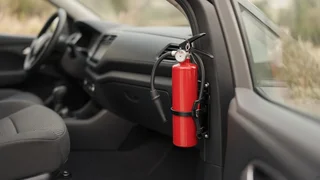
An extinguisher is only useful if you can reach it quickly and it stays put in a crash. A loose cylinder in the cabin can become a projectile, and one buried under cargo will not help in an emergency. Before choosing a size, decide where it will go and measure that space.
Bracket type: a metal bracket with a strap or quick-release clamp holds the cylinder more securely than a plastic clip. Check whether the bracket is included or sold separately. Mounting location: common choices include the seat base, floor in front of the passenger seat, a roll bar in a track car, or a dedicated bracket in a truck cab or cargo area. Each vehicle's layout differs, so confirm clearance for seat travel, pedals and airbags. Mounting surface: avoid drilling into areas where fuel lines, brake lines or wiring run underneath. Some seat-rail brackets avoid drilling but are vehicle-specific; confirm fitment for your exact model, year and seat type. Reach: the driver should be able to release it without unbuckling into an awkward position or moving cargo. Size trade-off: a larger cylinder gives more discharge time and often a higher rating but is harder to place in small cars and motorcycles.
Consider temperature and the cabin environment
Vehicle interiors can get very hot in summer sun and very cold in winter. Extinguishers have a rated operating temperature range printed on the label. Confirm that range suits where you live and where you will mount the unit, and avoid placing it in direct sunlight on a dashboard or rear deck.
Plan for inspection and service
Pressure gauge: a gauge lets you confirm at a glance that the unit is charged. Check it regularly. Rechargeable or disposable: rechargeable units with metal valves can be refilled by a fire equipment service after use; disposable units are replaced. Clean agent refills may not be available everywhere, so check local service options. Physical condition: look for dents, corrosion, a damaged hose or nozzle, and a missing pin or tamper seal. Periodic testing: pressurized cylinders require periodic hydrostatic testing and internal maintenance at intervals stated on the label or in applicable standards. After any use: even a short discharge can leave the unit unable to hold pressure. Recharge or replace it.
Know the limits during a vehicle fire
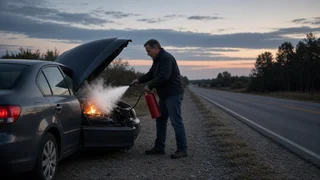
A handheld extinguisher is meant for a small fire caught early, such as a minor fuel or electrical fire in the engine bay. Your safety comes first: stop in a safe spot, switch off the engine, get everyone out and away from the vehicle, and call 911. Only attempt to fight a fire if it is small, you have a clear escape path, and you are not putting yourself between the fire and traffic.
If the fire is under the hood, avoid fully opening it, because a sudden rush of air can make it flare. Discharging through a gap at the edge of the hood or through the grille is generally safer. If flames reach the passenger compartment, fuel tank area or a high-voltage battery, move away and leave it to firefighters. Battery fires in electric and hybrid vehicles can reignite and can require far more water than any portable extinguisher provides.
Pre-purchase checklist
The agent is named on the label and suits vehicle fires. The UL rating includes B and C, plus A if you want coverage for interior materials. The rating meets any rule that applies to your vehicle or event. The cylinder fits a reachable mounting spot in your vehicle. A sturdy metal bracket is included or available for that model. The operating temperature range matches your climate. It has a pressure gauge, and you know whether it is rechargeable. You have a plan for inspection, servicing and replacement.