Flashing Check Engine Light: What to Do Immediately
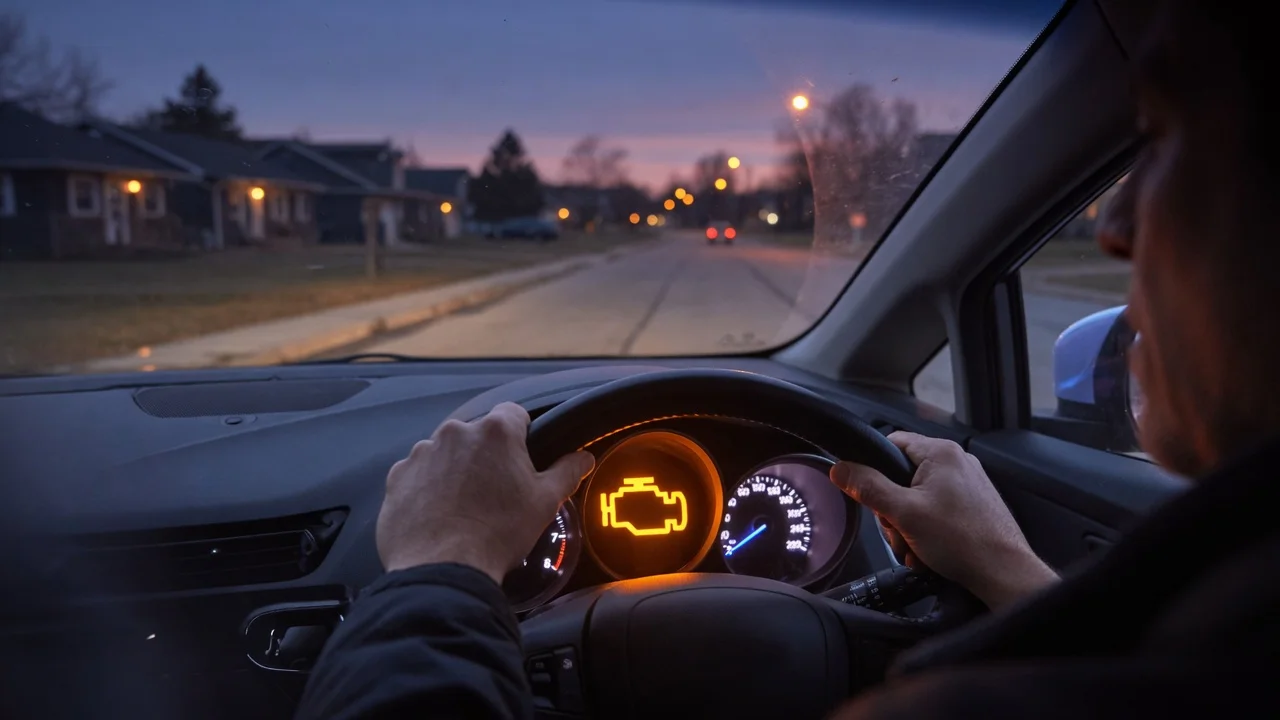
What a flashing check engine light means
A flashing, or blinking, check engine light is an urgent warning. On most modern cars it means the engine is misfiring badly enough that unburned fuel may be reaching the catalytic converter, where it can overheat and destroy the converter. Ease off the accelerator at once, get out of traffic when it is safe, and do not keep driving at speed. A steady (solid) check engine light is a stored emissions-related fault that usually still allows a short, careful trip to a shop. A flashing light is treated as a stop-soon event, not a reminder to book service later.
This guidance applies to gasoline engines with a malfunction indicator lamp (MIL), the official name for the check engine light, on vehicles that use onboard diagnostics. OBD-II has been required on most light vehicles sold for the U.S. market from the 1996 model year. Diesel, hybrid, and some later powertrains can flash the same lamp for related but not identical reasons; the owner’s manual for that model year and powertrain is the authority if it conflicts with general practice. A flashing oil-pressure, temperature, or battery lamp is a different warning and is not covered here.
Why the lamp flashes instead of staying on
The engine control module (ECM or ECU) turns the check engine light on when it detects a fault that can raise emissions. It watches sensors and the way the engine actually runs. A misfire is often inferred from uneven crankshaft speed: one cylinder fails to produce a normal power pulse, so the rotating assembly stutters. When the misfire rate is high enough that raw fuel can leave the cylinder, the module flashes the lamp rather than holding it steady.
Unburned fuel that reaches a hot catalytic converter can ignite inside it. Converter temperatures can then rise far above normal operating range and melt or crack the ceramic substrate. That damage is expensive and can leave the engine running poorly even after the original misfire is fixed. The flash is the module’s way of saying the converter is at immediate risk, not merely that an emissions monitor has failed a test.
What to do in the first minutes
The goal is to cut engine load, protect the converter, and decide whether the engine can idle or must be shut off. Exact idle speeds, tow ratings, and limp-mode behavior are model-specific; follow the owner’s manual if it gives a flashing-MIL procedure. Typical immediate actions:
Lift off the accelerator. Do not floor it, hold high rpm, or continue towing or climbing a steep grade. Move to a safe shoulder, parking lot, or exit as traffic allows. Hazard lights help other drivers see you. Once stopped, shift to Park (automatic) or Neutral with the parking brake set (manual) and let the engine idle. Watch the lamp. If the light stops flashing and stays on, and the engine idles smoothly with no other warnings, the severe misfire may have eased with load. A short, low-speed trip to a nearby shop can then be reasonable. If the lamp keeps flashing, or the engine shakes, stalls, surges, smells of fuel, or makes unusual noise, shut the engine off. Continuing to idle a hard misfire still feeds fuel into the exhaust. Check for other gauges and lamps: oil pressure, coolant temperature, and charging. A flashing check engine light plus overheating or low oil pressure is a reason to stop and arrange a tow. Do not keep driving at highway speed hoping the light will reset. Clearing the lamp by disconnecting the battery does not fix a misfire and can erase freeze-frame data a technician needs. Have the vehicle scanned for diagnostic trouble codes as soon as you can. Treat codes as a starting point for inspection, not proof that a named part has failed.
A completion check is simple: the engine is off or idling smoothly, you are out of live traffic, you know whether the lamp is still flashing, and you have a plan to scan codes or tow. If you cannot confirm smooth idle and a steady lamp, do not resume a normal drive.
What a flashing light often points to
A flashing MIL is most often a misfire severe enough to threaten the converter. Common OBD-II misfire codes include P0300 (random or multiple-cylinder misfire) and P0301 through P0308 (misfire on a numbered cylinder). Those codes identify a symptom. They do not, by themselves, prove a failed spark plug, coil, or injector. Confirm that the guidance below matches a gasoline spark-ignition engine with OBD misfire monitoring; a flashing lamp on some diesels or after a forced regeneration can have a different meaning.
Observable checks you can do without a scan tool, and what they suggest:
Rough idle, shaking, or a rhythmic stumble that matches engine speed: points toward one or more cylinders not firing. A scan showing a single cylinder code (for example P0303) focuses inspection on that cylinder’s ignition, injector, and compression. The problem started right after refueling: consider wrong fuel (diesel in a gasoline tank, or gasoline in a diesel), a large amount of water or debris in the tank, or running the tank extremely low so the pump ingested air. Stop and do not keep adding fuel of unknown type. Loss of power under load that eases at idle, with the lamp flashing only when you accelerate: consistent with load-related misfire (weak coil, worn plugs, or fuel delivery that cannot keep up). Fuel smell at the tailpipe or around the engine bay: unburned fuel is leaving the engine. Shut down if the smell is strong; a leaking injector or flooded converter is a fire and converter-damage risk. Recent work on plugs, coils, or the intake: a disconnected connector, crossed plug wire (on engines that still use wires), or a vacuum leak after an intake job is a frequent cause and is worth a visual check of what was just touched. Wet weather or deep water: moisture on ignition parts can cause misfire on some designs. If the engine smooths out after drying and the lamp goes from flashing to steady or off, still scan for stored codes before assuming it is finished.
Plausible root causes a shop will sort among include worn or fouled spark plugs, a failed ignition coil or coil-on-plug unit, a clogged or leaking fuel injector, low fuel pressure, a large vacuum leak, a failed crankshaft or camshaft position signal, and, less often, a mechanical problem such as low compression, jumped timing, or a failing head gasket. Replacing the first part on a parts-store printout without testing is a common way to miss the actual fault.
When to stop driving and call for a tow
Stop using the engine and arrange a tow if the lamp keeps flashing after you reduce load, if the engine will not idle smoothly, if it stalls or will not restart, if there is a strong fuel smell, if coolant temperature climbs or oil pressure drops, or if you hear knocking, grinding, or a sudden change in exhaust sound. Those conditions mean continued running can damage the converter, overheat a catalyst already in thermal runaway, or hide a mechanical failure as a simple misfire.
A brief, low-load drive to a nearby repair facility is a reasonable judgment only when the lamp has changed from flashing to steady, the engine runs without shake or stall, no other warning lamps are on, and you can stay off the highway and out of heavy throttle. That is a qualified exception, not a general clearance to finish a trip. Model-year, powertrain, and market differences matter: some vehicles enter a reduced-power mode (limp mode) that limits throttle; others do not. If the owner’s manual says to stop for a flashing MIL, follow that instruction.
What a scan should include, and what it cannot prove
A basic OBD-II scan reads stored and pending codes plus freeze-frame data (engine speed, load, and temperature when the fault set). Misfire counters, if the tool can show them, help tell a single-cylinder problem from a random one. Fuel trims and misfire charts then guide whether ignition, fuel, or air is the more likely side. A code is evidence to investigate that circuit or cylinder. It is not a parts list.
Professional diagnosis is the right next step when you lack a scan tool, when codes return after a simple repair, when multiple systems set codes at once, or when mechanical tests (compression, leak-down, fuel pressure) are needed. Tightening values, spark-plug gaps, coil dwell, and fuel-pressure specifications are vehicle-specific and are not given here; use the service information for that model year, engine, and market. There is no single mileage or minutes-of-flashing figure that is safe for every converter; the conservative action is to stop the severe misfire as soon as you can do so safely.