Diagnose a flashing service engine light
The short answer
On vehicles with standard on-board diagnostics (OBD-II), a flashing engine warning lamp, labelled 'Check Engine', 'Service Engine Soon' or shown as an engine outline, usually means the engine computer has detected an active misfire. A misfire is a cylinder that is not burning its fuel properly. Misfires are serious enough to damage the catalytic converter, the exhaust component that cleans emissions. A flashing lamp is more urgent than a steady one: a steady lamp means a fault has been stored, while a flashing lamp generally means harm may be happening now. The usual advice is to reduce engine load at once and get the vehicle diagnosed before normal driving continues.
One qualification changes the answer. Some vehicles have a separate maintenance reminder, such as a wrench symbol or a 'Maint Reqd' message, that can blink or stay lit when an oil change or scheduled service is due. That reminder is not an engine fault. The owner's manual for your model year and market will show which lamp you are seeing and what its flashing means. No model-specific information was supplied for this guide, so confirm the lamp's definition before acting on the rest of this guidance.
Steady versus flashing: what each indicates
Lamp behaviour | Typical meaning | General urgency; Brief light at start-up, then off | Bulb and system self-check | Normal; Steady on while driving | Fault detected and stored, such as a sensor, emissions or fuel-vapour issue | Diagnose soon; driving is usually possible with care; Flashing while driving | Active misfire severe enough to risk catalytic converter damage | Reduce load immediately; arrange diagnosis promptly; Maintenance symbol or message blinking | Service interval reminder on some models | Follow the manual's service schedule
Exact behaviour varies by manufacturer, model year and powertrain. On some vehicles, for example, the lamp blinks during a key-on test that reports emissions-readiness status. Treat this table as a general pattern, not a specification for any particular vehicle.
When to stop driving
Pull over safely and switch off the engine, then consider a tow rather than driving on, if the flashing lamp comes with any of the following:
The engine shakes, stumbles or loses noticeable power. You smell raw fuel, or a strong sulphur or rotten-egg odour, which can point to an overheating catalytic converter. There is unusual heat, smoke or a burning smell from underneath the vehicle. Other warnings are lit, especially oil pressure, coolant temperature or charging system. The lamp keeps flashing even at gentle, steady throttle.
Sometimes the lamp flashes only under hard acceleration or heavy load and stops when you ease off. If so, driving gently to a nearby repair shop is a common judgment call. Avoid towing, climbing steep grades, carrying heavy loads or accelerating hard until the cause is found.
Read the fault codes first
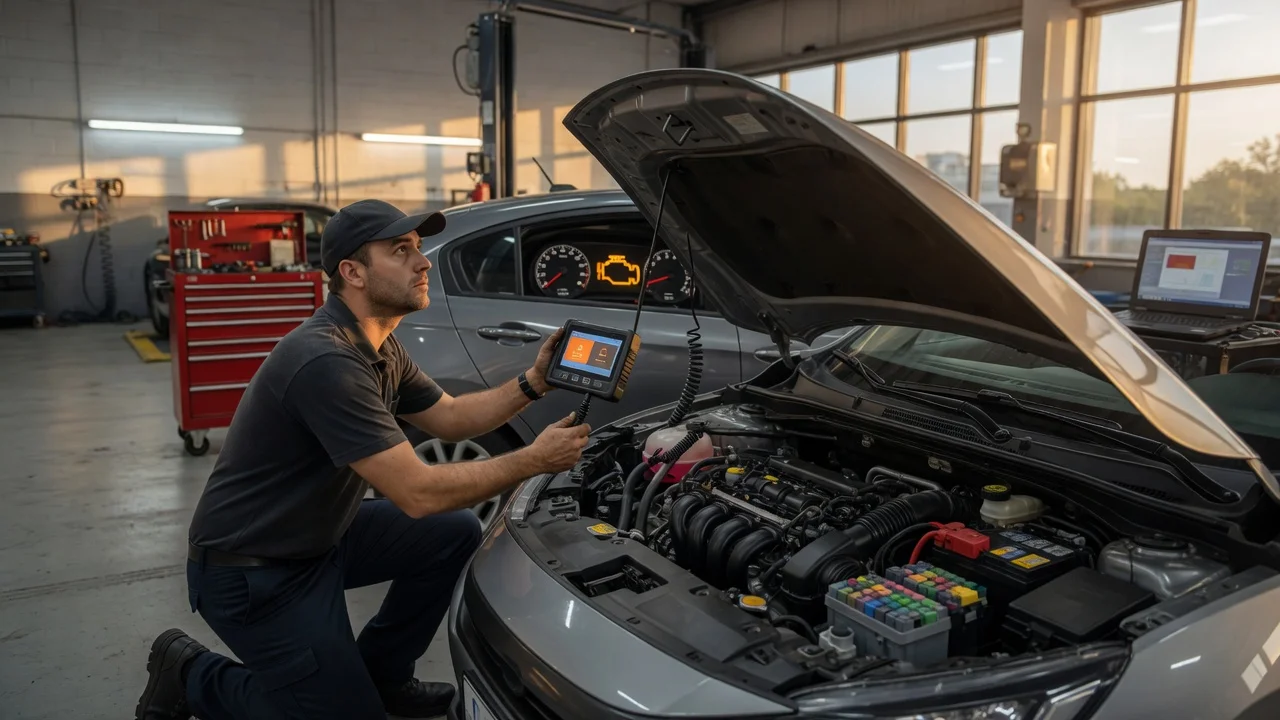
An OBD-II scan tool plugs into the diagnostic port, usually under the dashboard on the driver's side. It reads the stored diagnostic trouble codes (DTCs). Many parts retailers and repair shops will read codes, and inexpensive handheld readers are widely sold. The generic misfire codes are standardised:
P0300: random or multiple-cylinder misfire detected. P0301 to P0312: misfire detected in a specific cylinder; the final digits give the cylinder number, for example P0303 for cylinder 3. Other codes stored alongside, such as fuel trim, oxygen sensor or ignition circuit codes, often point toward the underlying cause.
A code is evidence of where to look, not proof that a particular part has failed. For example, a cylinder-specific misfire code shows which cylinder is affected but not whether the plug, coil, injector or engine mechanicals are to blame. If your tool shows freeze-frame data, note the engine speed, load and temperature recorded when the fault was set, because these conditions help narrow the cause. Do not clear the codes just to turn the lamp off. Clearing them erases useful data, and the problem will remain.
Likely causes and how to tell them apart
Misfires generally come from a problem with spark, fuel, air or compression. These checks help separate the possibilities. The right procedure, and whether you can safely do it yourself, depends on your engine design.
Ignition: spark plugs and coils
Worn or fouled spark plugs and failing ignition coils are common causes of a single-cylinder misfire. On engines with one coil per cylinder, a common check is to swap the suspect cylinder's coil with a neighbouring cylinder's, clear the code, and drive again. If the misfire code moves to the new cylinder, for example from P0302 to P0303, the coil is the likely cause. If the code stays on the original cylinder, look at the plug, the injector or the engine's mechanical condition next. Inspecting the plug can also help: oil fouling, heavy carbon or a cracked insulator each suggest different underlying issues.
Fuel delivery: injectors, pressure and fuel quality
A clogged or failing fuel injector can starve one cylinder. Low fuel pressure, from a weak pump or a restricted filter, tends to cause misfires across several cylinders, often logged as P0300, and lean-running codes may appear too. If the misfire started soon after refuelling, contaminated or poor-quality fuel is worth considering. Checking fuel pressure and testing injectors normally needs specialist gauges or scan-tool functions.
Air: vacuum leaks and intake faults
Unmetered air entering through a cracked vacuum hose, a leaking intake gasket or a faulty valve can make the mixture too lean. This is often worst at idle and can cause random misfires. Listen for hissing with the engine running, and look for split or disconnected hoses. Lean fuel-trim codes alongside a misfire code support this explanation.
Mechanical: compression and valve problems
Suppose a misfire stays on one cylinder after the coil and plug have been checked or swapped. The cause may then be mechanical, such as a burnt valve, a worn piston ring, a head gasket problem or a valvetrain fault. A compression test or leak-down test, which measures how well a cylinder holds pressure, separates these from ignition and fuel causes. This stage generally calls for professional diagnosis. Coolant loss, white exhaust smoke or overheating alongside the misfire make a head gasket problem more likely and are reasons to stop driving.
Sensor and wiring faults
Damaged wiring or connectors at a coil or injector can cause intermittent misfires that come and go with vibration or moisture. The engine computer detects misfires through changes in crankshaft speed. On some vehicles, therefore, a crankshaft sensor or reluctor fault can also produce misfire indications. Model-specific service information is needed to judge this.
When to hand it to a professional
Book a professional diagnosis if any of the following apply:
The lamp flashes with rough running, or any of the stop-driving signs above. Codes point to several cylinders or to fuel pressure. The misfire stays on one cylinder after the coil and plug have been ruled out. You lack the tools or service information for your engine. The vehicle is under warranty, where unauthorised work may affect coverage.
Ask the technician to explain what the codes and test results showed, not only which part was replaced. Fixing the cause of the misfire promptly also protects the catalytic converter, which is usually far more expensive to replace than ignition parts.
Gaps in this guide
This guide does not cover any specific make, model, model year, powertrain or market, and it contains no repair-cost figures or test data. Hybrid, diesel and direct-injection engines can have different warning behaviour and failure patterns. For a precise diagnosis, use the owner's manual and the manufacturer's service information for your vehicle.