Flashing Check Engine Light: What It Means and What to Do
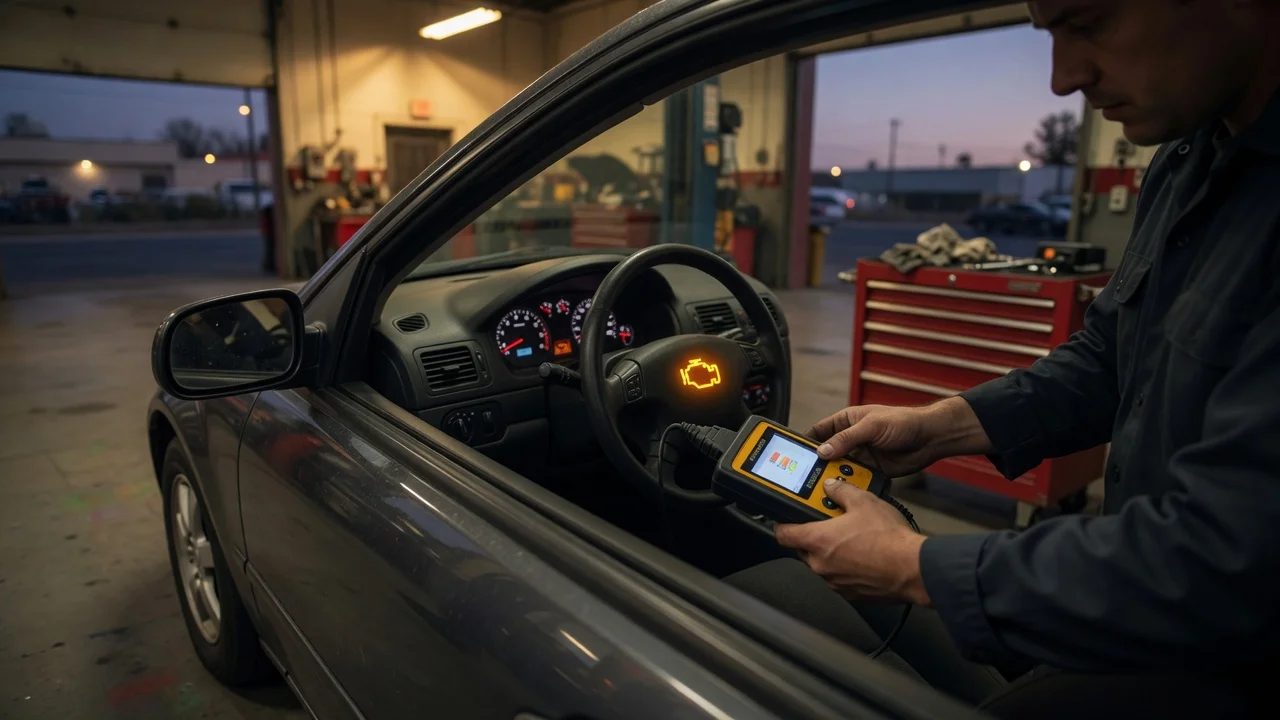
What a flashing check engine light means
A flashing, or blinking, check engine light is the vehicle malfunction indicator lamp (MIL) reporting an active, severe engine misfire. On typical OBD-II gasoline vehicles, that flash is reserved for a misfire rate high enough to overheat and damage the catalytic converter. It is more urgent than a steady check engine light, which usually means an emissions-related fault is stored and needs service soon. Ease off the accelerator, reduce engine load, and arrange diagnosis without delay. If the engine shakes hard, loses power, smells of fuel, smokes, or makes unusual noises, stop driving when it is safe to do so.
This flashing convention applies to most gasoline vehicles sold in the United States from the 1996 model year onward, when OBD-II became required. Diesel, hybrid, plug-in hybrid, and market-specific systems can use the same lamp for different faults, and some manufacturers flash the lamp during dealer tests or after certain resets. The owner's manual for the model year, powertrain, and market is the authority for that vehicle. A fault code is evidence to investigate, not proof that a named part has failed.
How the lamp works
The powertrain control module (PCM) watches crankshaft speed and other sensors to judge whether each cylinder is firing. A misfire is a combustion event that is missing, late, or too weak. Unburned fuel then leaves the cylinder, reaches the catalytic converter, and can burn there. That extra heat can melt the ceramic substrate or coat it in a way that permanently cuts conversion efficiency. The PCM flags that risk before the converter is ruined and before tailpipe emissions climb.
Under OBD-II rules used on those gasoline vehicles, the PCM turns the MIL on steadily for many emissions-related malfunctions and flashes it when the detected misfire is severe enough to threaten the catalyst. The exact misfire percentage that trips a flash is calibrated by the manufacturer for that engine and is not a single public number. Once the misfire rate drops, the lamp may stop flashing and stay on steadily, or it may go out after several good trips if the condition does not return. The stored diagnostic trouble codes and freeze-frame data remain the record of what the PCM saw.
Flashing compared with a steady light
Lamp behavior Typical meaning on OBD-II gasoline vehicles Practical urgency; Steady check engine light A stored or pending emissions-related fault, which may include a milder misfire Plan diagnosis; continued driving is often possible if the engine runs normally and no other warnings are present; Flashing check engine light Active misfire judged severe enough to risk catalytic-converter damage Reduce load immediately; stop if drivability is poor; do not keep driving under heavy throttle; Light off after a recent flash The misfire rate may have fallen, or the condition is intermittent Still have codes and freeze-frame data read; the risk can return under load
Other red or amber lamps for oil pressure, temperature, battery, or brakes are separate systems. A flashing check engine light plus an overheating or low-oil warning changes the decision: shut the engine down when it is safe, because continuing can damage the engine as well as the converter. Hybrid high-voltage warnings also override a plan to drive gently to a shop and call for professional handling.
What can cause a flashing light
The common thread is a misfire that the PCM rates as catalyst-damaging. That misfire can come from ignition, fuel, air, mechanical condition, or wiring. Scan-tool codes in the P0300 family (random or multiple-cylinder misfire) and P0301 through P0308 (cylinder-specific misfire on typical four- to eight-cylinder engines) point to which cylinders the PCM blamed. Those codes identify a pattern to test; they do not by themselves prove a coil, plug, or injector has failed.
Ignition faults: worn, fouled, or incorrectly gapped spark plugs; a failed ignition coil or coil-on-plug unit; damaged plug wires on engines that still use them; moisture in the wells after deep water or a pressure wash. Fuel faults: a clogged, stuck, or leaking injector; low fuel pressure from a weak pump or restricted filter; contaminated or very low fuel; a fuel-trim problem that leaves a cylinder too lean or too rich to fire. Air and sealing faults: a vacuum leak, cracked intake boot, or stuck-open EGR path that leans out one or more cylinders; a heavily contaminated mass-airflow sensor on engines that use one. Mechanical faults: low compression, a burned valve, a jumped timing chain or belt, or a damaged spark-plug thread that leaks compression. These need professional tests. Electrical and control faults: a loose coil or injector connector, chafed wiring, a poor ground, or, less often, a PCM or crankshaft-sensor issue that corrupts misfire detection. Recent work: a connector left unclipped, the wrong heat-range plugs, a coil pack swapped onto the wrong cylinder during testing, or an exhaust leak upstream of an oxygen sensor that skews fuel control.
What to observe before you open the hood
Safe, roadside checks are about what the vehicle is doing, not about replacing parts. Confirm that the lamp is the check engine or malfunction indicator symbol and that it is flashing rather than glowing steadily. Then note conditions you can describe to a technician or that change how soon you stop.
Engine feel: a rhythmic shake at idle, a stumble on acceleration, or a loss of power that tracks the flash usually supports a misfire. A smooth engine with a flashing lamp is less common and still warrants a code read, because some misfires show mainly under load. Load and speed: a light that flashes only when you accelerate or climb, then steadies or goes out when you lift off, fits a load-sensitive misfire. A constant flash at idle is more urgent. Smell, smoke, and sound: a raw-fuel smell, popping from the exhaust, or visible smoke means unburned fuel is leaving the engine. Continuing to drive in that state is the condition most likely to overheat the converter. Temperature and other gauges: a climbing coolant temperature, low oil pressure, or a red oil-pressure lamp means stop. Converter damage is no longer the only risk. Context: whether it began after refueling, after a missed oil or spark-plug service, in heavy rain, after an impact to the underbody, or immediately after repair work. Scan data, if a reader is available: record the stored and pending codes, freeze-frame engine speed, load, coolant temperature, and fuel trims, and whether the misfire counters climb on one cylinder or several. Do not clear the codes before that record exists, or the shop loses the snapshot of the failure.
A visual under-hood look is reasonable only on a cool engine, in a safe location, with the transmission in park or in gear with the parking brake set, and with hybrid high-voltage orange cabling left untouched. Look for unplugged coil or injector connectors, obvious broken vacuum hoses, and oil or coolant in spark-plug wells. Do not probe running ignition leads, open a pressurized fuel rail, or crank the engine with ignition coils removed unless you are trained for that engine. Spark-plug gap, coil resistance, fuel-pressure specifications, and fastener torque are model-specific; use the service information for that vehicle before any measurement or tightening value is applied.
When to stop using the vehicle
Stop at the first safe place and shut the engine off if the light is flashing and any of the following is present: violent shaking, little or no power, a fuel smell in the cabin or around the exhaust, smoke, metallic or knocking noises, a temperature warning, low oil pressure, or a hybrid or electrical-system warning. Those signs mean the misfire is already severe or a second system is failing. Restarting to see whether it clears can dump more fuel into a hot converter.
If the flash is the only warning, the engine still pulls reasonably, and reducing throttle stops the stumble, many owner's manuals still treat the condition as requiring immediate service rather than continued normal driving. How far a gentle drive to a shop is acceptable is not a universal distance; it depends on that manufacturer's instruction and on whether the misfire stays mild with load removed. Towing is the conservative choice when the manual is silent, the engine is rough, or you cannot keep load low in traffic, on grades, or while towing a trailer.
What to do, in order
Keep both hands on the wheel and ease off the accelerator. Do not floor the pedal to catch up with traffic. Heavy throttle raises exhaust temperature and misfire rate together. Turn off extra load you can spare, including air conditioning if it is safe to do so, and avoid passing, towing, and steep climbs. The aim is to lower cylinder pressure and exhaust heat while you decide whether to stop. If drivability is poor or any stop-now sign from the previous section appears, signal, leave the traffic stream, and shut the engine off. Set the parking brake. Do not sit over dry grass with a converter that may already be extremely hot. If the engine smooths when you lift off and the owner's manual allows a short trip to service, drive the lowest-load route to a safe location or repair facility. Stay well below the engine's usual power. Stop if the flash returns with a stumble. Do not keep cycling the ignition to make the lamp go out, and do not clear codes as a repair. Clearing without a fix can erase freeze-frame data and will not protect the converter if the misfire is still there. Have the PCM scanned for stored, pending, and history codes plus freeze-frame. Ask for misfire counts per cylinder if the tool and vehicle support them. Treat P0300 through P030x, ignition, fuel, and air-meter codes as a map for tests, not as an automatic parts list. Repairs that stay within a competent owner's range on a cool, conventional gasoline engine may include replacing visibly damaged connectors, following the manufacturer's spark-plug service if plugs are due and the procedure is documented for that engine, and correcting an obvious unplugged sensor. Stop at the professional boundary for fuel-rail work, timing components, compression or leak-down tests, catalytic-converter replacement, PCM programming, and any orange high-voltage hybrid hardware. Completion check: after the repair, the lamp should no longer flash under the same load that triggered it. Confirm that misfire counters stay at zero on a road test, that no new catalyst-efficiency or oxygen-sensor codes appear, and that any required OBD readiness monitors are allowed to complete. A steadily illuminated lamp after a flash has stopped still needs the remaining codes diagnosed.
After the codes are read
A cylinder-specific misfire code plus a matching ignition-coil or plug finding on that cylinder is a coherent path; swapping a coil to another cylinder and watching the code follow the coil is a standard confirmation on coil-on-plug engines when the service information allows it. A random P0300 with high long-term fuel trims points toward a shared air, fuel-pressure, or mechanical problem rather than one coil. Catalyst codes that appear after a flashing event can mean the converter was already overheated; replacing the converter without fixing the misfire will repeat the failure. Where the evidence is only a code and no confirming test, the next step is measurement of spark, fuel, compression, or waveform, not a parts-cannon replacement.
What this guidance cannot settle
Manufacturer-specific flash patterns, diesel particulate-filter or reductant-system lamps, and some European or commercial vehicles fall outside the generic OBD-II gasoline story above. Exact misfire thresholds, spark-plug type and gap, coil torque, fuel-pressure specifications, and set mileage limits for continued driving are not included here because they vary by model year, engine, and market and must be taken from that vehicle's manual and service information. If the lamp behavior, powertrain, or symptoms do not match a conventional gasoline misfire, treat the flashing light as a reason to stop loading the engine and to get a system-correct diagnosis rather than assuming a spark-plug job will be enough.