Fix Volvo truck climate control problems
A Volvo truck climate control problem can turn a long haul into an uncomfortable and unsafe shift, especially when defrost performance suffers or cab temperatures swing unexpectedly. Drivers often notice weak airflow, incorrect outlet temperatures, or a control panel that ignores commands. Because the system combines electronic controls, vacuum or electric actuators, refrigerant pressure, and coolant flow, the cause may be electrical, mechanical, or thermal. Interpreting the symptom conditions and service history helps narrow the likely fault before parts are replaced.
Essential answer
The essential answer is that no single failure explains every Volvo truck climate control problem, so the repair must follow the observed behavior rather than a fixed part swap. The system manages blower speed, air temperature, mode door position, and compressor operation through a network of sensors and modules. A complaint of warm air on the driver side but cold air on the passenger side suggests a different circuit than a completely dead blower or a panel that will not change modes.
Model year, powertrain variant, and service history matter because Volvo trucks have used different control architectures over time. Some systems rely on engine coolant flowing through a heater core, while cab comfort also depends on the sleeper HVAC unit and auxiliary climate controls. Repair records and any recall applicability can reveal whether a previous repair disturbed a connector, left a blend door misaligned, or introduced a refrigerant charge issue that now appears as poor cooling.
Diagnosing a problem
Begin by separating airflow faults from temperature faults. If the blower runs on every speed but air exits the wrong vents, the mode door actuator, its linkage, or a control signal is suspect. If airflow is weak at all speeds, a restricted cabin filter, debris on the evaporator, or a failing blower motor may be involved. Symptom conditions such as noise level, whether the problem appears only at idle, and whether the sleeper controls behave differently provide useful clues.
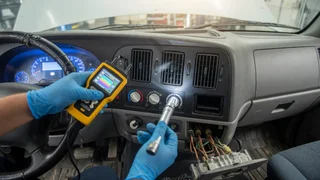
A stored fault code is evidence to interpret, not proof that a component has failed. Manufacturer-dependent codes require vehicle-specific confirmation because the same number can point to different circuits on different chassis. When the system shows an actuator or sensor code, check the related wiring, connector condition, and live data before condemning the part. Stop and seek professional diagnosis if the system blows only hot air under heavy load with the engine temperature rising, because that may indicate a cooling system issue rather than an HVAC fault.