Exhaust Pipe Repair: Assessing Damage and Choosing a Repair
What an exhaust pipe repair can solve
An exhaust pipe repair is a fix to a leaking, cracked, rusted, or separated section of the tubing that carries engine exhaust from the manifold or downpipe to the tailpipe. A localized hole or joint leak in otherwise sound pipe can often be closed with a sleeve clamp or a welded repair. Thin metal around the damage, a split flex joint, a crushed pipe, a broken flange, or rust that runs around the circumference of the pipe usually means that section should be replaced. Damage at the catalytic converter, diesel particulate filter, oxygen sensors, or exhaust manifold is a different job from a mid-pipe or tailpipe repair and changes both the parts and the legal limits on what you can do.
The right choice depends on where the leak sits, how much sound metal remains, the pipe material, and whether emissions parts and hangers are still doing their jobs. Costs, labor times, and exact procedures vary by model year, powertrain, and market, and no price or durability figures are supplied here. Treat the guidance below as a way to match the damage you can see to a repair type, then confirm the parts and inspection rules for your vehicle.
How to assess the damage
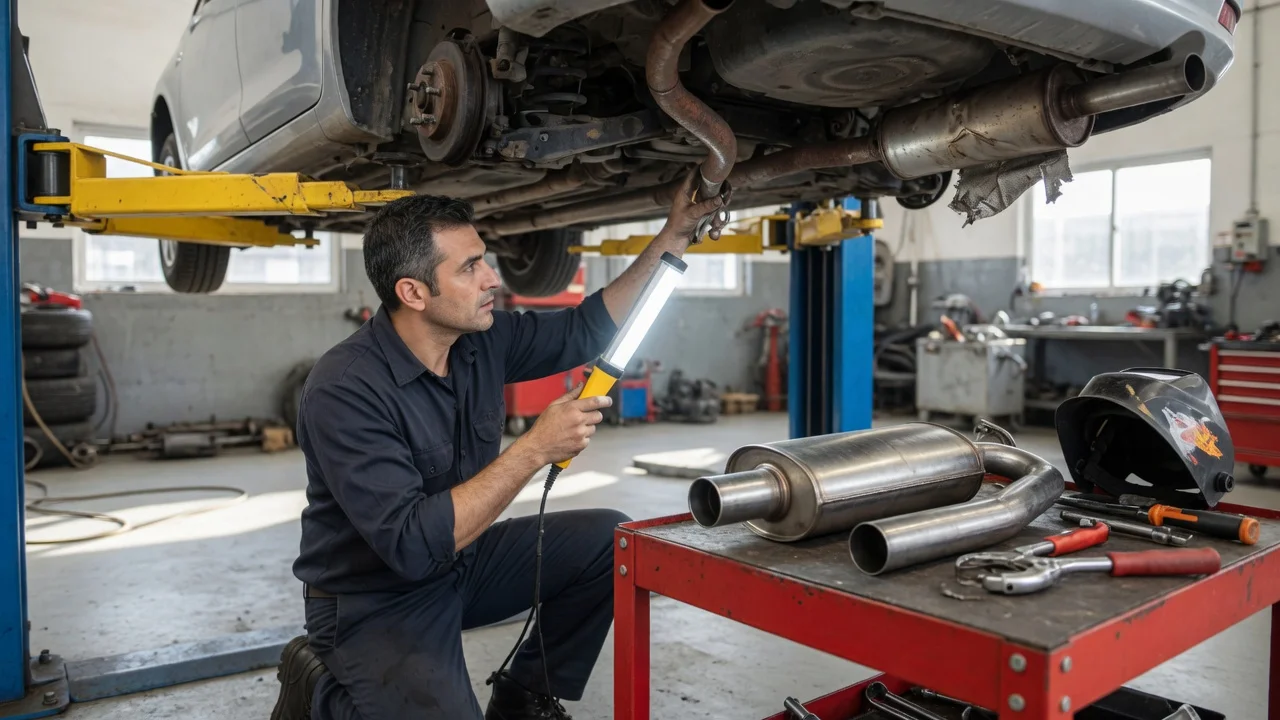
Inspect a cold exhaust from a stable lift or ramps, supporting the vehicle at the manufacturer’s jacking points. Work from the engine back: manifold or header flanges, downpipe, flex pipe or bellows, catalytic converter shell and welds, resonator, muffler, tailpipe, clamps, gaskets, and rubber hangers. A leak often shows as sooty streaks, rust holes, a cracked weld, a shifted joint, or a pipe sitting low because a hanger has broken. A louder note, a ticking sound on cold start, or fumes near the vehicle all point to a leak that you still need to locate by sight.
Surface rust with solid wall thickness: cosmetic; clean and monitor. Pinholes or a short split in straight pipe with firm metal on both sides: clamp sleeve or weld is often enough. Rust that you can crush by hand, or holes in a cluster: the section is spent; replace that length. Separated slip joint or failed band clamp: refit with a new exhaust clamp if the pipe ends are round and intact. Torn flex pipe or collapsed bellows: replace the flex section; wraps on a moving joint do not last. Cracked flange, blown gasket, or broken stud at the manifold or converter: repair the joint with new gasket and hardware, and check the flange for warpage. Dented pipe that kinks flow or rubs the body: reshape only if the wall is undamaged; otherwise cut out and splice. Broken or missing hangers: replace hangers first, because a sagging pipe tears joints and cracks welds. Damage to the converter, filter, or sensor bosses: plan a parts replacement and an emissions-legal repair, not a pipe patch.
A leak ahead of an oxygen sensor can disturb the fuel mixture and turn on a malfunction indicator. A leak anywhere can put carbon monoxide into the cabin if the underbody is open to the interior. Those findings raise the job from a noise fix to a safety and drivability repair. This article does not treat a stored fault code as proof that a given pipe has failed; the code is a reason to inspect the system that set it.
Which repair fits the damage
Compare options on the same criteria: remaining metal, location, permanence, skill and equipment, and whether the fix leaves emissions equipment in place. Shop versus driveway capability matters as much as the hole size. Compatible figures for price, life span, or back-to-back tests are not available here, so the comparison is qualitative.
Option Works best when Main limits; Exhaust wrap, bandage, or heat-rated putty A small hole must be sealed long enough to reach a proper repair; the pipe is round and cool when the product is applied. Temporary. Moving joints, heavy rust, and large gaps shed these products. Follow the product’s heat and surface rules; many are unsuitable near sensors or the converter. Sleeve or band clamp A pinhole, short crack, or open slip joint sits on straight pipe with solid metal for the clamp to bite. Needs round, uncrushed pipe. Will not restore a section that is rusted through around its full diameter. Welded patch or welded-in pipe The remaining steel or stainless can take a weld, and the joint can be reached without overheating nearby parts. Requires the matching process and filler for the alloy. Thin rusted wall will burn through. Heat near the converter, sensors, fuel lines, and underbody coatings needs control. Replace the damaged section Rust, crushing, or a failed flex joint has removed a defined length, while the rest of the system and hangers are sound. Needs correct diameter, length, and alloy, plus a legal path around any emissions part in that span. Replace cat-back or the full system Several sections, the muffler, and hangers have failed together, or the layout is being renewed as a matched assembly. Highest parts cost. Still must keep required emissions hardware for the vehicle’s market and inspection rules. Hangers, gaskets, and flange hardware The pipe wall is intact and the leak or sag is at a joint or mount. Ignores holes in the pipe itself. Warped flanges and broken manifold studs may need machining or a manifold repair.
A clamp or welded sleeve is preferable for a single leak in sound, accessible pipe when you want a lasting joint without buying a full system. Section replacement is preferable when the metal around the leak cannot support a clamp or weld, when the flex pipe has torn, or when a muffler or resonator is holed. A cat-back or complete system is preferable when corrosion or impact has taken out multiple pieces at once. Wrap and putty are a short bridge to one of those repairs. Hanger and gasket work is the first move when the pipe is intact and the system is hanging or seeping only at a flange.
Material, location, and legal limits
Many later systems use stainless tubing; older and some lower-cost systems use aluminized mild steel. A repair has to match that alloy if it is welded, and a mild-steel patch on stainless will corrode at the joint. Pipe diameter, bend layout, and hanger positions are vehicle-specific, including differences by engine, drivetrain, and market. A dual-exit, performance, or commercial exhaust can use different joints and hangers from the standard passenger-car layout on the same chassis.
Catalytic converters, particulate filters, and oxygen sensors are emissions equipment. Removing, emptying, or bypassing them is restricted or prohibited in many jurisdictions, and an inspection can fail a leaking, excessively loud, or incomplete system. Sealers and wraps kept off sensor ports and converter shells protect those parts. Exact inspection thresholds and approved repair methods are local; confirm them for the vehicle’s registration market.
Safety and when to stop using the vehicle
Stop driving and have the vehicle recovered if the pipe is dragging, a section has come apart, or exhaust smell is present inside the cabin. Carbon monoxide is colorless and can build up with a leak under the floor, especially with windows closed. A hot exhaust can ignite debris, undercoating, or a repair bandage that was applied to a running system. Support the pipe before removing a clamp or hanger so a free section cannot drop.
A practical next step
If the leak is a small hole or open joint on firm, round pipe, a quality exhaust clamp or a welded repair at a shop that can weld the alloy is a proportionate fix, with new hangers if the system has been sagging. If the wall is thin, the flex joint is torn, or the muffler is open, budget for a section or cat-back replacement using parts specified for that model year and powertrain. If fumes reach the cabin, the pipe is unsecured, or the damage involves the converter, filter, manifold, or sensors, treat it as a professional diagnosis and repair rather than a roadside patch.
Gaps that still need a vehicle-specific source: typical parts and labor prices in your market, whether your system is stainless or aluminized, torque and clamp specifications, and whether a given leak will fail a local inspection. A parts diagram for the exact generation and engine, plus a shop inspection on a lift, will close those gaps before you buy pipe.