Exhaust Manifold Repair: Assessing Damage and Repair Options
The short answer
Exhaust manifold repair means restoring a sealed path from the cylinder-head ports into the rest of the exhaust. The manifold bolts to the head, collects gas from each cylinder, and feeds a downpipe, turbocharger, or close-coupled catalytic converter. Work can be limited to gaskets and fasteners, can include specialized welding or thread repair, or can require replacing the manifold. The correct choice depends on whether the casting is still sound, what the part is made of, and whether a converter or turbo is built into the same assembly.
A soot-stained flange with an intact body is often a gasket, warped sealing face, or failed stud problem and may be repairable without a new manifold. A crack through a runner or collector, a broken mounting ear, or a manifold that has already been welded and leaked again is usually a replacement case. On many later-model engines the manifold and catalytic converter are one part, so damage to the converter shell or substrate is not a weld-the-manifold job. Turbocharged layouts add heat, expansion, and extra joints at the turbine housing, which changes both diagnosis and parts scope. Exact labor time, fastener design, and whether a manifold is serviceable as a separate piece vary by model year, engine, and market; those details have to be read from the vehicle’s service information rather than assumed.
What failed, and what to check before choosing a repair
A ticking or tapping sound that is loudest at cold idle and fades as the engine warms is a common exhaust leak at the head flange. Metal expansion can close a small gap once the parts are hot. A leak that grows quieter when cold and louder when hot, or that never changes, can still be a manifold crack, a blown gasket, or a failed collector joint. Exhaust odor in the cabin, a heat-soaked smell after shutdown, a rattling heat shield, a misfire-like sound that does not match a spark or injector pattern, and an illuminated malfunction indicator with oxygen-sensor or catalyst-efficiency codes are all consistent with a leak upstream of the sensors. A stored fault code is a reason to inspect the exhaust path; it is not proof that the manifold itself has failed.
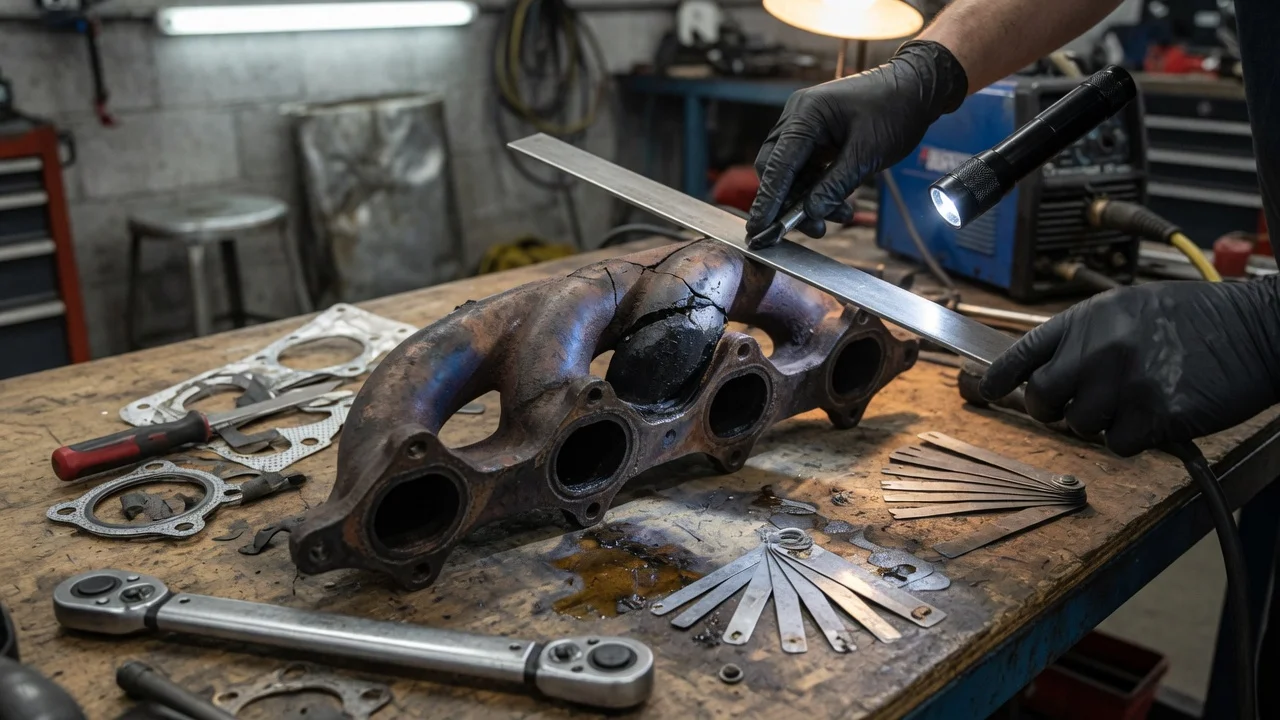
Inspect with the engine cold enough to touch. Look along each runner, the collector, and both flanges for hairline cracks, rust lines, and dry black soot. Soot at a gasket edge points to a sealing-face leak. Soot or a crack mid-runner points to casting failure. Check studs and nuts for stretch, rust-welded threads, broken fasteners left in the head, and uneven clamp load. Confirm the heat shield is present and not cracked at its mounts. On engines with a close-coupled converter, inspect the converter shell and flex or slip joints immediately downstream so a manifold job is not started for a leak that is actually at the next flange. A paper or cardboard strip held near suspected joints (never in the fan or belts) can show a puff of gas; a workshop smoke test or a careful listen with a length of hose is more conclusive. Do not use open flame around a running exhaust.
Cold-start tick that quiets as the engine reaches temperature: often a flange, gasket, or small crack that closes with expansion; still confirm there is no crack in the casting. Tick or blow that stays or worsens when hot: more consistent with a crack that opens under heat, a severely warped flange, or a failed collector or downpipe joint. Cabin exhaust smell, headache, or nausea: treat as a cabin-intrusion risk; stop driving until the leak is found and sealed. Soot at the head flange only, casting intact: start with gasket, hardware, and flange-flatness checks. Visible crack, broken runner, or failed weld repair: plan on replacement of the manifold or manifold-converter assembly. Rattle from the shield with no soot: heat-shield hardware may be the whole job. Malfunction-indicator lamp with upstream oxygen-sensor or catalyst codes: inspect for unmetered air entering at a leak; do not replace sensors or the converter until the leak is ruled in or out. Broken or seized manifold studs in an aluminum head: budget thread repair or helicoil-type inserts as part of the job, independent of whether the manifold is reused.
Park the vehicle and seek professional diagnosis if there is exhaust in the cabin, a glowing or discolored area on the manifold or nearby wiring, a heat shield contacting a fuel, brake, or electrical line, a cracked converter on a manifold-converter assembly, or a leak large enough to change how the engine idles. Carbon monoxide is colorless, and a leak at the head can also overheat nearby harnesses, sensors, and plastic. Until the leak is sealed, avoid enclosed garages and long trips.
Repair options compared
The practical choices are gasket and hardware service, localized metal repair, and replacement. They are not interchangeable. Compare them on seal durability, whether the casting can still hold clamp load, emissions and inspection rules in the vehicle’s market, downtime, and the cost of related parts (studs, gaskets, shields, oxygen sensors, and any integral converter). Published prices and labor hours are configuration-specific and are not restated here; obtain figures for the exact engine, manifold design, and region.
Option Fits when Main limits; Gasket and fastener replacement Casting and flanges are intact; leak is at the head or collector joint; studs can be restored or replaced. Will not seal a cracked runner or a flange that is warped beyond the gasket’s ability to crush evenly. Thread or stud repair in the head Broken or seized fasteners are the reason the joint cannot be torqued. Does not fix a cracked manifold; aluminum heads need correct insert procedure and torque. Welding or brazing the casting A localized crack in a thick cast-iron section, a competent cast-iron weld process, and a manifold that is otherwise unwarped. Cast iron is crack-sensitive under thermal cycling; a repair that looks sealed on the bench can open again in service. Stainless tubular manifolds need a matching weld alloy and still may be cheaper to replace. Integral converters generally cannot be welded as an emissions repair. Heat-shield repair or replacement Rattle or missing shield only; manifold body is sealed. A shield job will not stop an exhaust leak. Manifold replacement (separate casting or tubular part) Cracked, broken, or repeatedly leaking body; warped flange; unavailable or failed weld repair. Requires correct gasket set and hardware; some designs need the vehicle in a service position that adds labor. Manifold-converter assembly replacement Crack, leak, or converter failure on a combined part; local rules require a complete emissions-legal assembly. Higher parts cost; aftermarket converters must meet the emissions standard that applies to that vehicle.
Which option fits which priority
Choose gasket and hardware service when inspection shows an intact casting, even clamp faces, and a leak confined to a joint. That path preserves the original part, restores clamp load, and is the usual first repair on an otherwise sound manifold. Replace stretched or heat-cycled studs and nuts as a set; reusing oxidized hardware is a common reason a new gasket leaks again. Have the head flange and manifold flange checked for flatness if the leak returns immediately after a gasket change.
Choose welding only when a shop experienced with cast iron (or with the manifold’s actual alloy) can access a defined crack, the flanges still seal, and the owner accepts that thermal cycling can reopen the repair. Welding is more plausible on a heavy cast-iron manifold from an older, service-oriented engine layout than on a thin-wall or stainless tubular part. It is a poor fit when the crack reaches a mounting ear, when the part has already been welded, or when a catalytic converter is integral to the casting. There is no single success rate that applies across alloys and crack locations; treat a weld as a conditional repair, not as equivalent to a new part.
Choose replacement when the body is cracked, a runner is broken, the flange cannot be made flat, fasteners have pulled through an ear, or the manifold and converter are one assembly. Replacement is also the cleaner choice when labor to remove the part is high enough that repeating the job after a failed weld would cost more than doing the durable repair once. Match the replacement to the engine’s emissions equipment: a manifold that originally carried a close-coupled catalyst should be replaced with an assembly that meets the same requirement in that market. Aftermarket tubular manifolds that delete or relocate a catalyst can be illegal for road use even if they bolt up.
If the priority is lowest immediate spend and the leak is small, gasket and stud work on a sound casting is the proportionate step. If the priority is not returning for the same leak, replacement of a cracked or converter-integral manifold is the more durable path. If the priority is keeping an original casting on a classic or low-volume engine, a specialist weld plus new hardware can be reasonable after confirming flange flatness. Turbocharged engines should include inspection of the turbine inlet gasket and mounting hardware in the same decision, because a manifold that is sound can still leak at the turbo joint.
What a complete job should include
Whatever path is chosen, the joint only lasts if clamp load is even. That means new gaskets of the specified type (some engines use a multilayer steel gasket; others use a graphited or composite design), new or proven-good studs and nuts, the published tightening sequence, and the correct dry or specified anti-seize condition on the threads. Torque values and whether the fasteners are torque-to-yield are model-specific and should come from the service procedure for that engine. Oxygen sensors in the manifold or collector should be inspected for contamination and damaged wires while the part is off. After reassembly, confirm there is no tick at cold idle, no soot after a short drive-and-cool cycle, and no pending catalyst or oxygen-sensor codes. If a leak remains, stop and recheck flange flatness and fastener stretch rather than adding a second gasket.
Material uncertainty remains around vehicle-specific labor hours, whether a given manifold is sold separately from the converter, campaign or service-bulletin coverage for known cracking patterns, and the long-term hold of any particular weld. Those points require the VIN-level parts catalog and, for a crack, a direct inspection. The next action is to identify the leak site with a cold visual check and a cold-versus-hot listen, then choose gasket service, specialist welding, or replacement from the condition of the casting rather than from the sound alone.