Exhaust Manifold Repair: Assessing Cracks and Repair Options
The essential answer
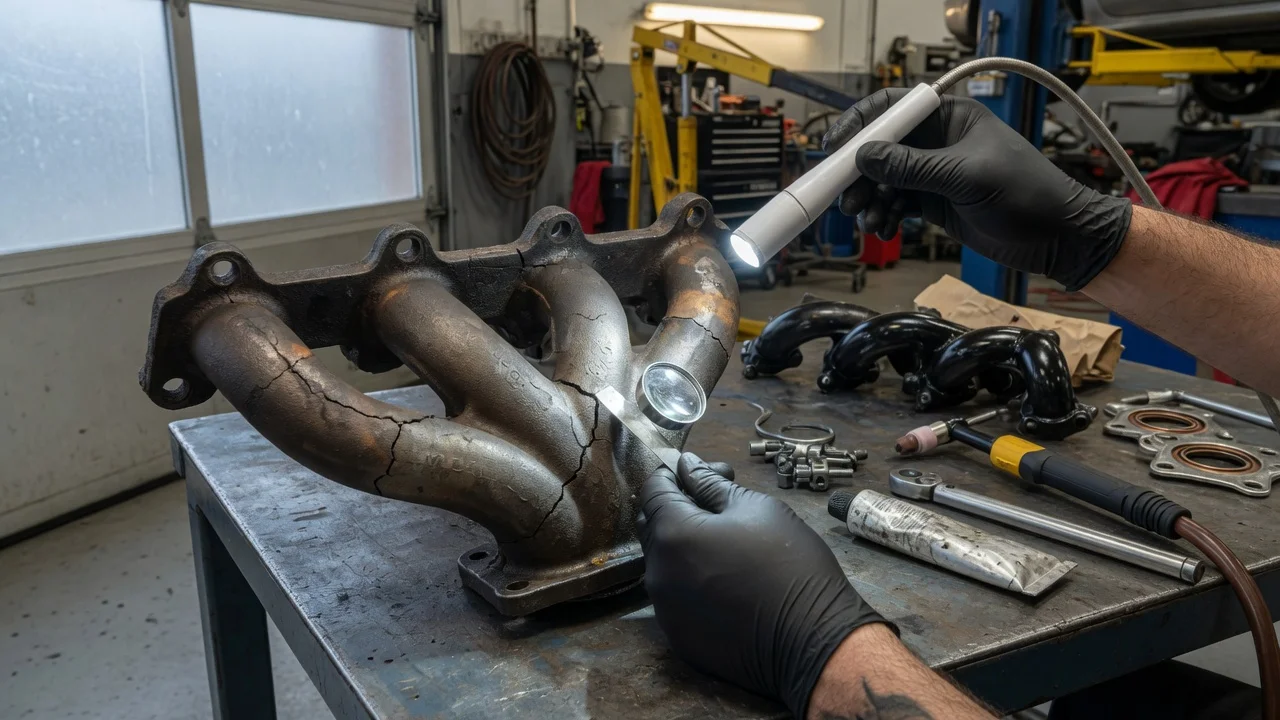
A cracked exhaust manifold can be repaired in some cases, and replacement is the more durable path for most production engines. The workable choice depends on the manifold material, where the crack sits, whether the flange face is still flat, and whether exhaust is leaking only into the engine bay or also into the cabin. Cast-iron manifolds, used on many road-car engines, crack after repeated heating and cooling. A limited crack in a thick, unwarped section of a casting that can be removed is a candidate for specialist welding. A crack through a bolt flange, across a thin runner, or in a manifold that is already warped or missing studs generally calls for a new or remanufactured part. High-temperature putty and wrap can slow a small external leak for a short time while parts are arranged. They leave the casting structurally unchanged.
This guidance covers conventional cast exhaust manifolds and tubular headers that collect cylinder gases and pass them to the downpipe or catalytic converter. It is general ownership advice, not a model-year workshop procedure. Engines with a catalytic converter built into the manifold, seized or broken exhaust studs, or two separate banks on a V-engine change labor, parts cost, and, in some markets, legal replacement rules. Confirm those points for the specific engine, model year, trim and market before choosing weld or replace. Published prices and test claims are comparable only when they refer to the same configuration, market, date and measurement method.
What a crack sounds and looks like
A manifold crack often shows up as a sharp tick or puff that is loudest on a cold start and quiets as the metal expands. Other common signs are an exhaust smell in the engine bay, soot or a dark streak on the manifold or heat shield, a change in idle quality, and a warning lamp. A leak upstream of an oxygen sensor can disturb the sensor reading and store mixture or catalyst-related fault codes. Treat a stored code as a reason to inspect the exhaust path. It is evidence to investigate, not proof by itself that the manifold has failed.
Checks to make next
Work on a cold engine. If you need to look from below, support the vehicle on a level surface with the parking brake set. Stay clear of a hot manifold, and keep the engine out of an enclosed space while you listen.
Listen at idle from a cold start, then again after several minutes of running. A tick that fades as the manifold warms is consistent with a crack that closes slightly with heat. Look for soot trails, rust lines, or hairline marks at port junctions, runner bends, the collector, and the cylinder-head flange. With the engine off and cool, inspect manifold-to-head fasteners and the visible gasket edge. A blown gasket, a loose nut, or a broken stud can leak in the same area a crack would. Check the heat shield for rattles, missing fasteners, or local burn marks that point to a nearby leak. Note whether the odor stays in the bay or also reaches the cabin, especially at idle with fresh-air ventilation selected.
Soot at mid-runner or collector plus a cold-start tick supports a casting crack. Blacking concentrated at the head flange, especially with a loose or missing stud, supports a gasket or fastener failure. A rattling shield with a clean manifold can be a shield or hardware issue. If shields, rust, or tight packaging hide the casting, or a warning lamp is on, have the shields removed and the system inspected. Cabin odor, headache, or nausea after a drive is a stop-use condition: exhaust contains carbon monoxide, which you cannot count on smell alone to flag at dangerous levels.
Look-alikes that mimic a cracked manifold
Several nearby faults produce a similar tick or smell. A failed manifold gasket leaks at the head face and often leaves a sooty stripe along the flange. Broken or stretched studs let the manifold lift under heat and reopen the joint. A cracked downpipe, leaking flex section, or damaged catalytic-converter flange makes noise further back in the system. A loose heat shield ticks with a metallic rattle rather than a pulsing exhaust note. Confirm the leak source before ordering a manifold; replacing a sound casting leaves a gasket or pipe leak untouched.
Repair options compared
Weigh welding, temporary sealant, like-for-like replacement, and a tubular header on durability, access, and the condition of the part. Dollar figures vary too widely by engine, market, catalyst content and seized-stud labor to quote a single price here. Use the criteria below, then get a quote against the casting in front of you.
Option Durability Preferable when Poor fit when; Specialist weld (usually off the engine) Can last on a sound, unwarped casting if the process matches the metal Crack in a thick section of removable cast iron or steel tubing; replacement is scarce or slow Crack through a bolt hole or thin wall; warped flange; multiple cracks; prior weld already failed; High-temperature putty, paste or wrap Short-term leak control only Small external hairline while a part is on order or a shop visit is already booked Any structural crack, flange leak, or cabin odor; Replace manifold (OEM-spec or quality aftermarket) Restores geometry and sealing surface Flange or thin-wall crack, warped face, broken studs, integrated catalyst, or a second failure on the same bank Only if a confirmed leak is elsewhere (gasket, downpipe, shield); Tubular headers as a substitute Depends on fitment, material and sensor placement Original manifold discontinued, or an exhaust change is already planned and emissions rules allow it Treated as a drop-in crack fix without checking bungs, clearance and legality
Welding is the better structural repair when the manifold comes off in one piece, the flange face is still flat, the crack sits in weldable thickness, and a comparable replacement is hard to source. Replacement is the better ownership choice when the crack reaches a flange or thin wall, the gasket face is no longer flat, studs have broken in the head, the manifold includes a catalytic converter that must meet local rules, or you want a predictable seal without depending on weld quality. On a V-engine, replace the leaking bank and inspect the other; both banks see similar heat cycles. Sealant is only a bridge to one of those lasting repairs.
What a sound weld actually requires
Cast iron needs preheat, controlled cooling, and filler suited to iron, often a nickel-bearing rod or wire. The manifold should be off the engine so the crack can be cleaned, opened to a sound root, and welded without the rest of the engine acting as a heat sink. The part has to be supported so it does not twist while it is hot. A clean weld still leaks if the flange is pulled onto a warped face. Aluminum manifolds and stainless tubular headers use different processes; a shop set up only for iron may decline those parts. There is no single published success rate that applies across engines. Outcome tracks the casting quality, crack location, and welder practice. Those variables are a genuine gap unless a shop inspects your part.
Sealants and wraps
Exhaust putty and metallic paste are meant to fill a small external gap after the surface is cleaned of oil, soot and loose scale. They cannot hold a crack that opens and closes with each heat cycle, and they do not restore a broken flange. If you use one as a temporary measure, follow that product’s temperature rating and cure steps, then schedule welding or replacement. Cabin exhaust odor is outside the job these products are built for.
Replacement parts and extra labor
Plan for a new gasket set and, in many jobs, new studs and nuts. Exhaust fasteners seize, and a stud broken in the cylinder head adds extraction or machine time that can exceed the cost of the manifold itself. Some manifolds are sold with a catalytic converter; in markets that regulate replacements, the converter on the new part may need to meet a stated standard. After installation, recheck for leaks at cold idle and after a full heat cycle, and confirm that earlier mixture or catalyst codes do not return once the leak is closed.
When to stop driving
Treat exhaust smell in the cabin, headache or nausea after a drive, a visible broken section, scorched wiring or shields, or a warning lamp with a clear exhaust leak as a reason to stop regular use until the system is sealed.
A faint cold-start tick with odor confined to the engine bay can be driven a short distance to a repair facility. The crack can still grow, so do not postpone the inspection. Idle the engine outdoors only, and keep people and pets away from the tailpipe and the bay while you confirm the leak.
What still has to be confirmed on your vehicle
Labor hours, parts availability, whether the manifold includes a catalyst, fastener torque, and whether a welded repair is accepted under local inspection or emissions rules are vehicle-specific. They belong in the model-year service information or in a quote from a shop that can see the casting. Material (cast iron, stainless, aluminum), engine layout, and market emissions equipment can change both the repair method and the legal replacement part. Those items are flagged here as gaps rather than filled with figures from a different engine or market.