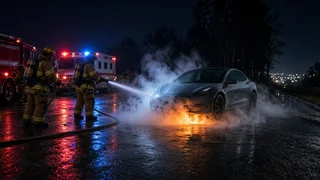
EV Fire: What Happens, How It Differs From a Gas Car Fire, and What to Do
An EV fire is a fire involving an electric vehicle, most seriously one that starts in or spreads to the high-voltage lithium-ion battery pack. If an EV is on fire, the essential answer is simple: stop, get everyone out and well away from the vehicle, and call emergency services. Tell the dispatcher it is an electric vehicle. Do not try to put out a burning battery yourself. A battery fire can burn intensely, give off toxic gases, and reignite hours or even days after it appears to be out. Those traits are the main things that set it apart from a typical gasoline car fire. Not every fire in an electric car is a battery fire. A small fire in the cabin, the tires or the 12-volt electrical system behaves much like the same fire in any other car. The guidance changes once the high-voltage pack is involved or might be. From the outside, a driver usually cannot tell which situation they are facing, so the safe default is to treat any EV fire as a possible battery fire.
How an EV Battery Fire Starts
Every fire needs three things: an ignition source, combustible material and oxygen. In a gasoline car, the combustible material is usually fuel, oil or plastic, and the ignition source is often a hot exhaust part or an electrical fault. A lithium-ion battery is different because it contains its own energy, flammable electrolyte, and, depending on the cell chemistry, materials that can release oxygen as they break down. That is why a battery fire can keep going in conditions that would choke an ordinary fire.
The key process is thermal runaway. When a battery cell is damaged or overheated, it can start a chemical reaction that produces more heat. That heat speeds up the reaction, which produces still more heat. A cell in thermal runaway can vent hot, flammable gases and catch fire. Its heat can then push neighboring cells into the same reaction, so the fire spreads through the pack cell by cell.
Common triggers include:
Physical damage: a collision, road debris or anything else that crushes or punctures the battery pack. Manufacturing defects: flaws inside a cell that can cause an internal short circuit, the basis of several battery-related recalls across the industry. Water intrusion: flooding, especially with saltwater, can corrode components and create short circuits, sometimes with a delayed effect. Electrical faults: problems in charging equipment, wiring or the battery management system. External fire: a fire that starts elsewhere, such as in a garage or a nearby vehicle, can heat the pack enough to start thermal runaway.
How an EV Fire Differs From a Gasoline Car Fire
Whether EVs catch fire more or less often than gasoline vehicles is a common question, and the honest answer is that the data is still limited and published comparisons vary in method and quality. Many analyses suggest EV fires are not more frequent than fires in internal-combustion vehicles. The clearer difference is in how a battery fire behaves once it starts, and that is what matters for safety decisions.
Characteristic | Gasoline vehicle fire | EV high-voltage battery fire; Main fuel | Gasoline, oil, plastics | Battery cells and electrolyte, plus the same plastics and materials; How it spreads | Usually quickly once fuel is involved | Cell to cell through thermal runaway, sometimes in bursts; Suppression | Usually controlled with standard firefighting methods | Often needs large amounts of water applied over a long time to cool the pack; Reignition risk | Lower once extinguished | Significant: stranded energy in damaged cells can restart the fire hours or days later; Smoke and gases | Toxic, as with any vehicle fire | Toxic and potentially including hydrogen fluoride and other hazardous compounds; Added hazard | Fuel leaks | High voltage, venting gas jets, possible flare-ups
The battery is sealed inside a protective enclosure, usually under the floor of the car. That casing protects the cells in normal use, but it also makes it hard for water to reach the cells that are burning. Firefighters often have to cool the pack for an extended period rather than simply knocking down the flames. Some fire departments use specialized tools or tactics for EV fires, and in some cases they let the battery burn under controlled conditions while protecting the surroundings.
Warning Signs of a Battery Problem
Thermal runaway sometimes gives warning before open flames appear. Treat any of these as a reason to pull over safely and get out:
Smoke or vapor coming from underneath the vehicle or around the battery area. A sweet, chemical or unusual burning smell. Hissing, popping or crackling sounds from beneath the car. A battery or high-voltage warning on the dashboard, especially together with any of the signs above. Visible damage to the underside of the car after hitting debris, a curb or a pothole hard.
Vapor coming from a battery pack may be flammable and toxic even before it ignites. Do not approach it to take a closer look.
What to Do if Your EV Catches Fire
Safe evacuation comes first. The vehicle can be replaced; the people inside cannot.
1) Pull over as soon as it is safe, away from buildings, fuel pumps, dry vegetation and other vehicles if you have the choice. 2) Put the vehicle in park and switch it off if you can do so immediately. 3) Get everyone out right away. Do not go back for belongings. 4) Move well away from the vehicle and stay upwind, out of the smoke. 5) Call 911. Say clearly that the vehicle is electric, and give the make and model if you know it. 6) Warn other people to keep back, and keep traffic away from the vehicle if you can do so safely. 7) When firefighters arrive, tell them it is an EV and whether it was charging or had been in a collision or flood.
Know how to open your doors in an emergency before you ever need to. Many EVs use electronic door releases, and some models have a separate mechanical release that is easy to miss. The owner's manual explains where it is on your specific vehicle.
Should You Use a Fire Extinguisher on an EV?
A handheld extinguisher is not a tool for a burning EV battery pack. It cannot cool cells sealed inside the enclosure, and it does not stop thermal runaway. Getting close enough to use one also puts you in the path of toxic gases and possible flare-ups.
A fire extinguisher rating tells you what kind of fire it is designed for. In the US, Class A covers ordinary combustibles such as paper and fabric, Class B covers flammable liquids, and Class C means the agent is safe to use on energized electrical equipment. A multipurpose ABC extinguisher kept in the car may help with a very small fire that has clearly not involved the battery, such as a small cabin or interior fire caught in its first moments, but only if you can use it from a safe position with a clear way out. If the fire grows, involves the underside of the car, or you are unsure, stop and get away. Some products are marketed specifically for lithium-ion battery fires; their effectiveness depends on the product and the size of the battery, and none of them makes it safe for a driver to fight a vehicle battery fire.
Electrical Isolation and High-Voltage Hazards
EVs carry a high-voltage system that is separate from the familiar 12-volt system. High-voltage cables are typically orange. Electrical isolation means disconnecting the high-voltage battery from the rest of the vehicle so the system is not energized. Vehicles are designed to do some of this automatically, for example after a crash, and first responders use manufacturer emergency response information to locate cut points and disable the system.
Drivers should not try to do this themselves after a fire or serious crash. Isolating the system does not remove the energy stored in the cells, and a damaged pack can still hold enough energy to cause shock or reignite. Do not touch orange cables, exposed wiring or damaged battery components.
After the Fire: Reignition and Storage
Once the flames are out, the risk is not over. Damaged cells can hold stranded energy, meaning charge that cannot be safely drained, and they may enter thermal runaway again later. For this reason, a fire-damaged or heavily crash-damaged EV is often monitored after the incident and stored outdoors, away from buildings and other vehicles, rather than parked in a garage or indoor shop.
If you are dealing with towing, insurance or a body shop after an EV fire or a crash that damaged the battery, tell everyone involved that the car is electric and that the battery may be damaged. Do not park it in your own garage or next to your home, even if it looks stable.
Floods and Collisions Deserve Extra Caution
A flooded EV, particularly one exposed to saltwater, can catch fire well after the water has receded. If your EV has been submerged, do not drive it, charge it or park it near structures. Contact your insurer and a qualified service provider and say it was in a flood.
The same applies after a collision that may have struck the underside of the car. A pack can be damaged without obvious signs from above. Have it inspected by a service provider qualified to work on high-voltage systems before you continue using it normally.
Reducing EV Fire Risk as an Owner
Use charging equipment that is certified and installed correctly, and have any home charger installed by a licensed electrician. Avoid damaged charging cables, adapters or extension cords not intended for EV charging. Check for open recalls on your vehicle and have recall repairs done promptly, especially any related to the battery. Follow any charging guidance the manufacturer issues for your model, including temporary limits during a recall. Have the car inspected after any hard impact to the underside, a collision or flood exposure. Keep the area around a home charger clear of stored flammable items. Learn your vehicle's emergency door releases and keep a basic roadside kit in the car.
The Bottom Line
An EV fire is not necessarily more likely than a gasoline car fire, but a battery fire behaves differently. It is driven by thermal runaway, it is hard to extinguish, it can give off toxic gases, and it can reignite long after it seems to be out. For a driver, the right response does not depend on any of those technical details: get everyone out, move away and upwind, call emergency services, and tell them the vehicle is electric. Leave suppression, electrical isolation and post-fire handling to trained responders.