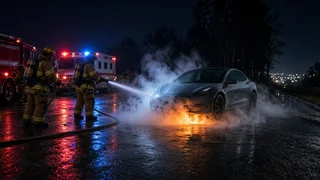
Electric vehicle fires: hazards and roadside response
An EV vehicle fire is most dangerous when the high-voltage battery pack is involved. Lithium-ion cells can overheat in a self-sustaining chain reaction, release toxic and flammable gases, burn intensely, and reignite hours or even days after the flames appear to be out. For a driver or passenger, the response is simple: stop, get everyone out, move well away and upwind, and call 911, telling the dispatcher it is an electric vehicle. Do not try to put out a burning battery yourself. A small fire in the cabin that has not reached the battery is a different situation, and the sections below explain that distinction. This guide covers battery-electric vehicles and, where noted, hybrids and plug-in hybrids, which also carry high-voltage lithium-ion packs. Battery chemistry, pack design, cooling systems and emergency features vary by manufacturer, model and model year, so treat the advice here as general principles rather than instructions for a specific vehicle.
Why EV battery fires behave differently
Every fire needs three things: heat, fuel and oxygen. In a conventional car, the main combustible material is gasoline or diesel, along with plastics, upholstery and tires, and the usual ignition source is a fuel leak meeting a hot surface or an electrical fault. Removing heat or oxygen generally stops the fire.
A lithium-ion battery fire works differently because of thermal runaway. When a cell is damaged, defective, overcharged or overheated, its internal chemistry can begin generating heat faster than it can be shed. That heat breaks down the cell further, producing more heat and flammable gas, and it spreads to neighboring cells. Because the reaction produces its own heat and the cells can release oxygen-bearing compounds as they break down, smothering or a quick blast from an extinguisher does not reliably stop it. The fire continues as long as there are cells left to cascade.
Common triggers include physical damage from a collision or road debris striking the underside of the pack, internal manufacturing defects, charging faults, and prolonged immersion in water, particularly saltwater, which can cause corrosion and short circuits inside the pack.
Characteristic | Typical gasoline vehicle fire | EV battery fire; Primary fuel | Liquid fuel, plastics, tires, interior materials | Battery cells plus the same plastics, tires and interior materials; How it grows | Spreads with available fuel and air | Cascades cell to cell through thermal runaway; Warning before flames | Often fluid leaks, burning smell, smoke from engine bay | Often hissing or popping, chemical smell, white or gray vapor from under the car, battery alerts; Extinguishing | Usually controlled with standard firefighting methods | Typically requires large, sustained amounts of water to cool the pack, or controlled burn-out; Reignition risk | Lower once extinguished | Significant; a pack can reignite hours or days later; Gases | Smoke and combustion products | Smoke plus vented gases that can be toxic and flammable
Whether EVs catch fire more or less often than gasoline vehicles is a separate question from how their fires behave. Frequency comparisons depend on how incidents are counted, the age and mix of vehicles studied, and whether hybrids are grouped with full EVs. This article does not rely on any particular figure. The practical point is that when a battery fire does happen, it is harder to extinguish and needs a different response.
Do EV cars explode?
Videos of EV cars exploding usually show violent venting rather than a true explosion. When cells go into thermal runaway, they can release gas with a loud pop, throw out jet-like flames from the pack, and eject debris. This can happen suddenly and with real force, which is why bystanders and drivers should keep their distance.
There is also a genuine explosion hazard in certain conditions. Gases vented from a battery are flammable, and if they build up in an enclosed space, such as a closed garage, a car interior with the windows up, or under a closed hood, they can ignite all at once. Outdoors, the gas usually disperses or burns as it escapes. Either way, the safe response is the same: get away from the vehicle and stay away.
Warning signs of a battery problem
A battery, high-voltage system or thermal warning on the dashboard, especially if it tells you to stop or leave the vehicle; Hissing, popping, crackling or whistling sounds from beneath the floor; White or gray vapor or smoke coming from under the car or from the wheel wells, which can look like steam; A sharp, sweet or chemical smell that is different from burning plastic or oil; Unusual heat felt through the floor or seats; Sudden loss of power or multiple electrical faults at once
Any of these signs, especially after striking debris or being in a collision, is a reason to stop and get out. Vapor from a battery pack is not harmless steam, and it can precede flames by seconds or by much longer.
What to do at the roadside
Pull over as soon as it is safe, away from buildings, other vehicles, dry grass and fuel pumps if you have any choice. Put the vehicle in park and switch it off. Do not keep driving to reach an exit or service area if you see smoke or get a stop warning. Get everyone out immediately, including pets. Leave belongings behind. Move well away from the vehicle and stay upwind and uphill if possible, so smoke and vented gas blow away from you. Keep others back. Call 911. Give your location and say clearly that the vehicle is electric or a hybrid. Mention the make and model if you know them. Do not open the hood, front trunk or charging port door, and do not try to reach the battery. Do not touch the vehicle, any orange-colored high-voltage cables, or any liquid pooling underneath. When firefighters arrive, tell them the vehicle type, what you saw and heard, and whether anyone is still near it.
Safe evacuation when doors will not open
Many EVs use electronic door handles and latches powered by the 12-volt system. If that system fails, the outside handles may not work and the interior release buttons may be unresponsive. Most vehicles have a mechanical emergency release inside, but its location and operation vary widely: it may be a lever in the door pocket, a pull cable near the window switch, or a release under a trim panel, and rear doors sometimes lack one. Learn where yours is before you need it, and show passengers who ride with you regularly. If no door opens, breaking a side window is a last resort; a laminated windshield or laminated side glass is much harder to break.
Should you use a fire extinguisher?
Not on a battery fire. A portable extinguisher cannot cool a pack that is in thermal runaway, and approaching the vehicle puts you in the path of venting gas and flame. Your priority is getting people out and away.
An extinguisher can still be useful for a small, early fire that clearly is not coming from the battery, such as burning floor mats, a charger cable or a wiring fault inside the cabin, provided everyone is already out and you have a clear escape route. If the fire does not go out immediately, or if you see signs of battery involvement, stop and back away.
In the US, the fire extinguisher rating on the label tells you what types of fire it is designed for. Class A covers ordinary combustibles like fabric and plastic, Class B covers flammable liquids, and Class C means the agent does not conduct electricity and is safe to use on energized electrical equipment. The numbers in front of the letters indicate relative firefighting capacity within each class. A multipurpose ABC dry-chemical extinguisher is a common choice for a car. Some products are marketed specifically for lithium-ion battery fires; their suitability for a full vehicle pack is a different matter from small devices, so do not assume such a label makes it safe to fight an EV battery fire yourself.
How emergency services handle EV fires
Fire departments generally approach EV fires with extra caution. Typical steps include identifying the vehicle as electric, stabilizing it so it cannot roll, and attempting electrical isolation, which means disabling the high-voltage system and the 12-volt system that controls it. Manufacturers publish emergency response guides for first responders that show where to cut or disconnect the system on each model, but isolation does not drain the energy stored in the cells. A damaged pack can stay electrically and thermally hazardous after the vehicle is switched off.
Because flames are often inside a sealed pack under the floor, crews typically need large and sustained volumes of water to cool the cells and stop the cascade. In some cases they may protect the surroundings and let the battery burn out under control. Responders also commonly use thermal imaging to check for hidden heat and remain on scene longer than for a typical car fire.
After the fire: reignition and towing
A battery that has burned or been badly damaged can reignite well after the scene is cleared. This is why responders and tow operators may keep a fire-damaged or crash-damaged EV away from buildings and other vehicles, and why salvage yards often store such vehicles in a separate outdoor area.
Do not park a fire-damaged, flood-damaged or crash-damaged EV in your garage or next to your house. Tell the tow operator the vehicle is electric and describe what happened to it, including any submersion in water. Follow the manufacturer's towing guidance; many EVs should not be towed with the drive wheels on the ground. If you notice smoke, hissing or heat from a damaged EV days later, keep clear and call 911. Contact your insurer and the manufacturer or dealer before attempting to drive, charge or repair a vehicle whose battery may have been damaged.
Reducing the risk
Most of the practical steps owners can take are about avoiding damage to the pack and acting early on warnings. Get the underside inspected after hitting debris, a curb or a deep pothole hard enough to feel it. Take battery and high-voltage warnings seriously rather than driving on. Use charging equipment that is appropriate for your vehicle and installed by a qualified electrician, and avoid damaged cables or adapters. Treat any recall notice involving the battery or charging system as a priority. If your vehicle has been in floodwater, have it evaluated before driving or charging it.
Key points
EV battery fires are driven by thermal runaway, which produces its own heat and resists normal extinguishing. Violent venting with pops and jets of flame is more common than a true explosion, but trapped gases in enclosed spaces can ignite suddenly. If you see warning signs, stop, get everyone out, move far away and upwind, and call 911, stating that the vehicle is electric. Do not fight a battery fire yourself; a portable extinguisher is only for a small fire clearly separate from the battery. Damaged packs can reignite later, so keep a damaged EV away from buildings and inform anyone towing or storing it.