Difference Between 2-Stroke and 4-Stroke Engine Oil
The Short Answer
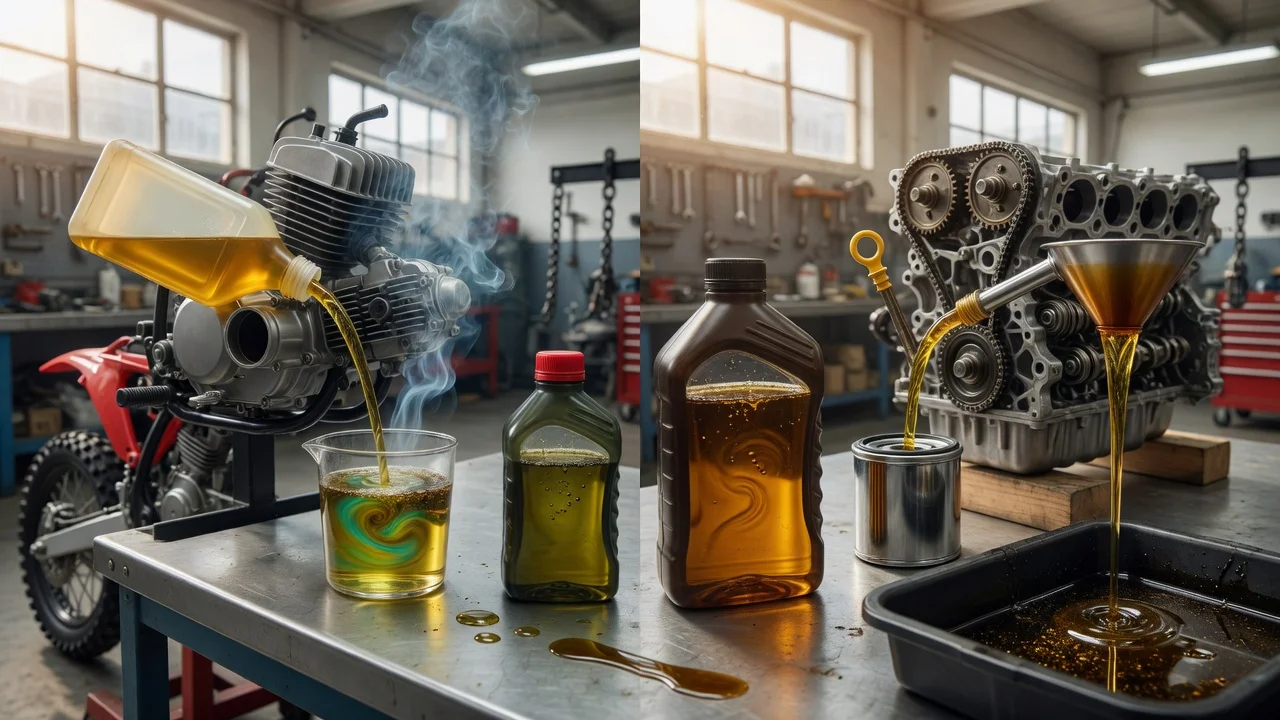
The main difference is what happens to the oil inside the engine. In a 2-stroke engine, the oil is mixed with the fuel, either by the owner or by an oil-injection system, and is burned along with it. It lubricates on a single pass and is then consumed. In a 4-stroke engine, the oil sits in a sump or separate tank, circulates through the engine, returns and is reused until the next oil change.
Because of that, the two oils are formulated for different jobs and are not interchangeable. 2-stroke oil is designed to mix with fuel and burn cleanly with minimal ash and deposits. 4-stroke oil is designed to withstand long periods of heat, pressure and contamination while protecting bearings, the valve train and, in many motorcycles, a clutch and gearbox that share the same oil. Using the wrong type can lead to poor lubrication, excess deposits, smoke, fouled spark plugs or clutch problems.
Why the Engines Need Different Oils
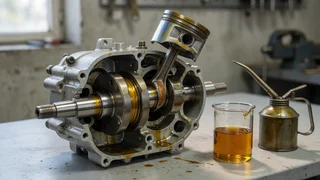
A 2-stroke engine completes a power cycle in two piston strokes, or one crankshaft revolution. In the common crankcase-scavenged design, the fuel-air mixture passes through the crankcase before entering the cylinder, so the crankcase cannot hold a pool of oil. Lubrication instead comes from oil carried in the fuel mixture, which coats the bearings, crankshaft and cylinder walls on its way to the combustion chamber.
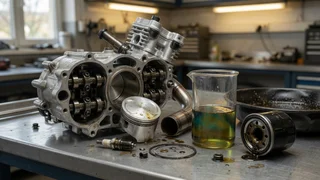
A 4-stroke engine completes a power cycle in four strokes, or two crankshaft revolutions, and uses valves to control intake and exhaust. Its crankcase is sealed off from the intake charge, so it can hold oil that a pump, splash action or both distribute around the engine. That oil must keep working for thousands of kilometres or many operating hours, not just a single combustion cycle.
Key Differences Side by Side
Criterion | 2-stroke engine oil | 4-stroke engine oil; How it is used | Mixed with fuel (premix) or metered in by an injection system | Held in a sump or oil tank and circulated by the engine; What happens to it | Burned during combustion; used up continuously | Reused; drained and replaced at service intervals; Refilling | Added with every tank of fuel or topped up in the injection reservoir | Topped up as needed; fully changed at set intervals; Main design priority | Mixing with fuel, clean burning, low ash and low deposits | Long-term film strength, heat resistance, detergency, wear and oxidation protection; Additive approach | Low-ash or ashless formulas to limit deposits in the combustion chamber and exhaust port | Detergent, dispersant and anti-wear additive packages suited to repeated circulation; Viscosity labelling | Usually not sold with SAE multigrade ratings such as 10W-40 | Sold by SAE viscosity grade, for example 10W-40 or 5W-30; Common performance standards | JASO FB, FC and FD; ISO-L-EGB, EGC and EGD; API TC; NMMA TC-W3 for water-cooled outboards | API service categories such as SN or SP; ACEA for cars; JASO MA, MA1, MA2 or MB for motorcycles; Typical applications | Older and some current motorcycles, scooters, chainsaws, string trimmers, leaf blowers, outboard motors | Cars, most modern motorcycles and scooters, lawn mowers, generators, many outboards
This table compares the oils by design purpose and labelling, not by lab test results. No product test data was supplied for this article, so it does not rank specific brands or claim measured differences in wear, smoke or deposits between individual oils.
Differences That Matter in Practice
Burning versus recirculating
Since 2-stroke oil ends up in the combustion chamber, it has to burn as completely as possible. Ash left behind can build up on pistons, rings, spark plugs and exhaust ports. 4-stroke oils typically contain additives that are useful in a recirculating system but are not intended to be burned in quantity, which is one reason putting 4-stroke oil in a 2-stroke fuel mix is a poor substitute.
Mixing with fuel
2-stroke oil is formulated to blend with petrol and stay mixed. Many products are described as self-mixing or pre-diluted for this reason. 4-stroke oil is not designed to dissolve in fuel and may not mix or atomise in the way a 2-stroke engine needs.
Service life and consumption
With a 2-stroke engine you buy oil continuously, because some is used with every litre of fuel. With a 4-stroke engine you buy oil mainly at oil changes, plus any top-ups between them. That changes how ownership costs build up, although the total depends on the engine, usage and oil price, and no comparative cost figures were supplied here.
Clutches and gearboxes in motorcycles
Many 4-stroke motorcycles use one oil for the engine, gearbox and wet clutch. For these, the JASO MA family of ratings indicates oil suited to wet clutches, while JASO MB indicates lower-friction oil generally intended for scooters with dry or automatic clutches. Some car oils labelled as energy conserving contain friction modifiers that can cause clutch slip in a shared-sump motorcycle. 2-stroke motorcycles usually keep the gearbox oil separate from the oil that lubricates the engine, so the gearbox has its own specified oil.
Can You Use One in Place of the Other?
In general, no. Putting 4-stroke oil in a 2-stroke fuel mix risks incomplete burning, heavier deposits, fouled plugs and potentially inadequate lubrication. Putting 2-stroke oil in a 4-stroke crankcase is also inappropriate, because it is not designed for repeated circulation, long service intervals or the protection demands of a valve train and bearings in a sump-lubricated engine.
If the wrong oil has been added by mistake, the safest step is to stop using the equipment and follow the manufacturer's guidance or ask a qualified technician. Typically that means draining the fuel tank in a 2-stroke or draining and refilling the crankcase in a 4-stroke. The level of risk from a brief run with the wrong oil depends on the engine, the amount and the duration, and no evidence was supplied to quantify it.
Which Oil Should You Choose?
The decision is set by the engine, not by preference. Use 2-stroke oil only in 2-stroke engines and 4-stroke oil only in 4-stroke engines. If you are not sure which type you have, check the owner's manual, the filler caps and labels, or the manufacturer's specifications. A 2-stroke usually has a single fuel filler that calls for a fuel-oil mix or a separate small oil reservoir for an injection system. A 4-stroke usually has an oil filler cap and a dipstick or sight glass on the engine.
For a 2-stroke engine: choose oil carrying the rating the manufacturer specifies, such as JASO FC or FD for many air-cooled land engines, or NMMA TC-W3 for water-cooled outboards. Use the exact fuel-to-oil ratio stated in the manual. Ratios such as 50:1 or 40:1 are common, but they vary by engine, and using the wrong ratio can cause either poor lubrication or excess smoke and deposits. For a 4-stroke car engine: choose the SAE viscosity grade and the API, ACEA or manufacturer approval listed in the owner's manual. For a 4-stroke motorcycle with a wet clutch: choose oil with the specified viscosity and a JASO MA, MA1 or MA2 rating, unless the manual says otherwise. For a 4-stroke scooter with a dry or automatic clutch: follow the manual, which may permit or call for JASO MB oil. For small 4-stroke equipment such as lawn mowers and generators: use the grade the manufacturer recommends, which may vary with operating temperature.
Limits of This Guidance
Oil specifications, mixing ratios and approved ratings differ by manufacturer, model, model year and market, and standards are updated over time. This article explains the general principles and common rating systems; it does not replace the requirements printed in your vehicle or equipment manual, which should take priority whenever the two disagree.