2-Stroke Engine Crankcase Oil: Does the Crankcase Need Oil?
The Short Answer
In most small two-stroke engines, such as those in older motorcycles, scooters, outboard motors, chainsaws and other handheld equipment, you do not fill the crankcase with oil. The crankcase in these engines is part of the intake path, so it cannot hold a pool of oil the way a four-stroke car engine does. Lubrication comes from two-stroke oil that is either mixed into the fuel beforehand (premix) or metered in by a separate oil-injection system.
Two qualifications change that answer. Many two-stroke motorcycles have a separate gearbox compartment that holds its own oil, and some large two-stroke diesel engines do have a conventional oil sump. Which situation applies depends on the specific engine, so the owner's manual or manufacturer specification is the deciding reference.
Why a Typical 2-Stroke Crankcase Stays Dry
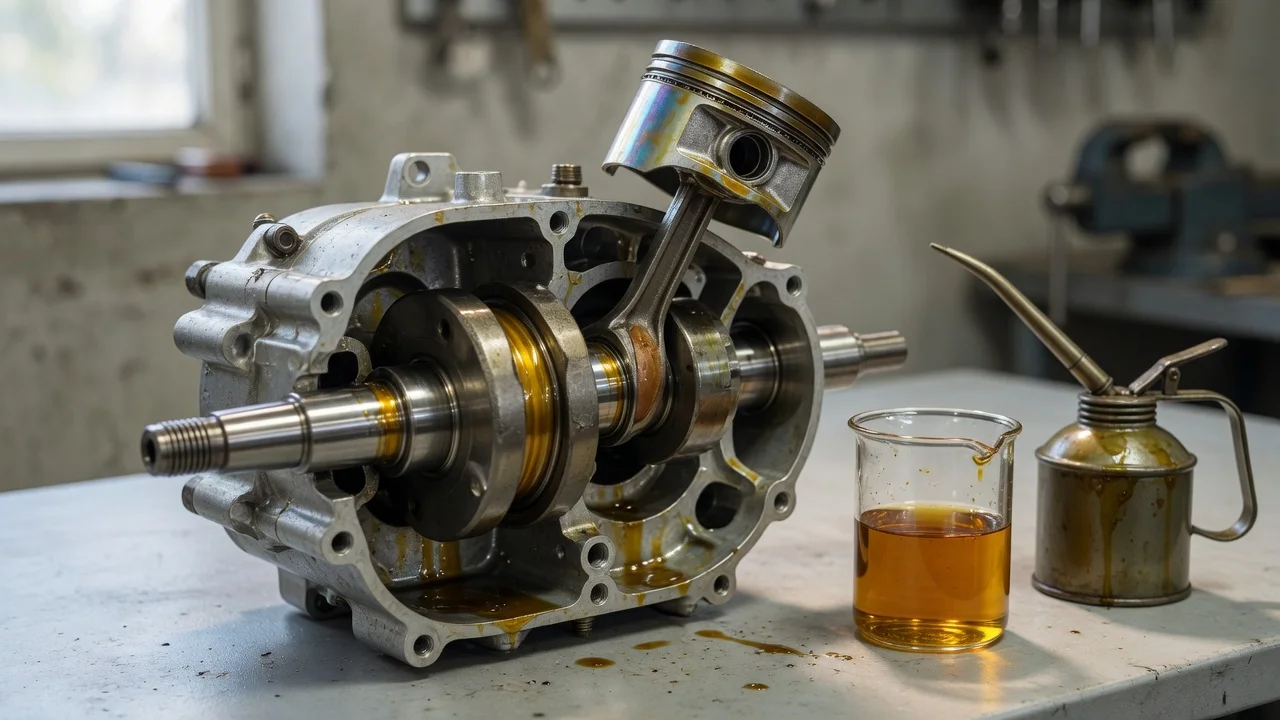
Most small two-strokes use crankcase scavenging. As the piston rises, it draws the fuel-air charge into the sealed crankcase. As the piston descends, it compresses that charge and pushes it through transfer ports into the cylinder. Because the incoming mixture passes through the crankcase on every cycle, an oil bath there would be pulled into the combustion chamber and burned.
Instead, the oil travels with the fuel. Fine oil droplets coat the crankshaft bearings, connecting rod, piston and cylinder wall as the mixture passes through, and the oil is then burned along with the fuel. This total-loss design is why two-stroke engines consume oil continuously and need it replenished with every refuel or oil-tank top-up.
Premix Versus Oil Injection
Premix: two-stroke oil is blended with fuel in a set ratio before it goes into the tank. The correct ratio is set by the engine maker and varies by engine, so it should be taken from the manual rather than assumed. Oil injection: the engine has a separate oil reservoir, and a pump meters two-stroke oil into the intake or engine according to throttle opening or engine speed. The owner keeps the oil tank filled rather than mixing fuel. In either case, the oil is two-stroke oil designed to burn cleanly, not ordinary four-stroke motor oil.
The Exceptions That Do Use Separate Oil
Gearbox oil on two-stroke motorcycles: many two-stroke motorcycles and some scooters have a transmission housed in a compartment sealed off from the crankshaft area. That compartment holds gear or transmission oil, which is changed periodically rather than burned. Owners sometimes call this crankcase oil, but it does not lubricate the crankshaft or piston. The required oil type and capacity are model-specific.
Large two-stroke diesels: some two-stroke diesel engines, including certain truck, locomotive and marine designs, use a blower or turbocharger to scavenge the cylinders instead of compressing the charge in the crankcase. Because the crankcase is not part of the intake path, these engines can and do have a wet sump with circulating crankcase oil. Large marine crosshead engines typically go further, using one oil for the crankcase system and a separate cylinder oil.
Engine type | Oil in crankcase? | Where lubrication comes from; Small crankcase-scavenged 2-stroke (premix) | No | Two-stroke oil mixed into fuel; Small crankcase-scavenged 2-stroke (oil injection) | No | Two-stroke oil from separate tank, pumped into engine; 2-stroke motorcycle with separate gearbox | No, but gearbox has its own oil | Two-stroke oil for engine; gear or transmission oil for gearbox; Blower- or turbo-scavenged 2-stroke diesel | Yes | Circulating oil from a sump, sometimes with separate cylinder oil on large marine engines
Choosing the Right Two-Stroke Oil
Two-stroke oils are labelled against performance standards. For air-cooled land engines, common classifications include the JASO FB, FC and FD grades and the corresponding ISO-L-EGB, EGC and EGD grades, with the later letters generally indicating tighter requirements for cleanliness and smoke. Water-cooled outboard engines commonly call for oil meeting the NMMA TC-W3 standard. Whether a given oil is acceptable depends on what the engine maker specifies, and an outboard oil is not automatically suitable for an air-cooled engine, or the reverse.
Standard four-stroke engine oil should not be used as premix or injection oil. It is formulated to circulate and be retained in a sump, not to mix with fuel and burn, and using it in a two-stroke can lead to deposits and inadequate protection.
What This Guide Cannot Confirm
No specific make, model, year or engine was supplied, so this guide does not state mixing ratios, oil capacities, change intervals or approved oil grades for any particular machine. Those figures differ between manufacturers and even between versions of the same model. Check the owner's manual, the label on the oil filler or tank, or the manufacturer's service information before adding any oil.
Next Step
Identify your engine's lubrication method first. If it is a small premix or oil-injected two-stroke, focus on the correct two-stroke oil and ratio rather than a crankcase fill. If it has a separate gearbox or is a large scavenged diesel, look up the manufacturer's oil specification and capacity for that compartment or sump.