Diagnose fuel filter engine light
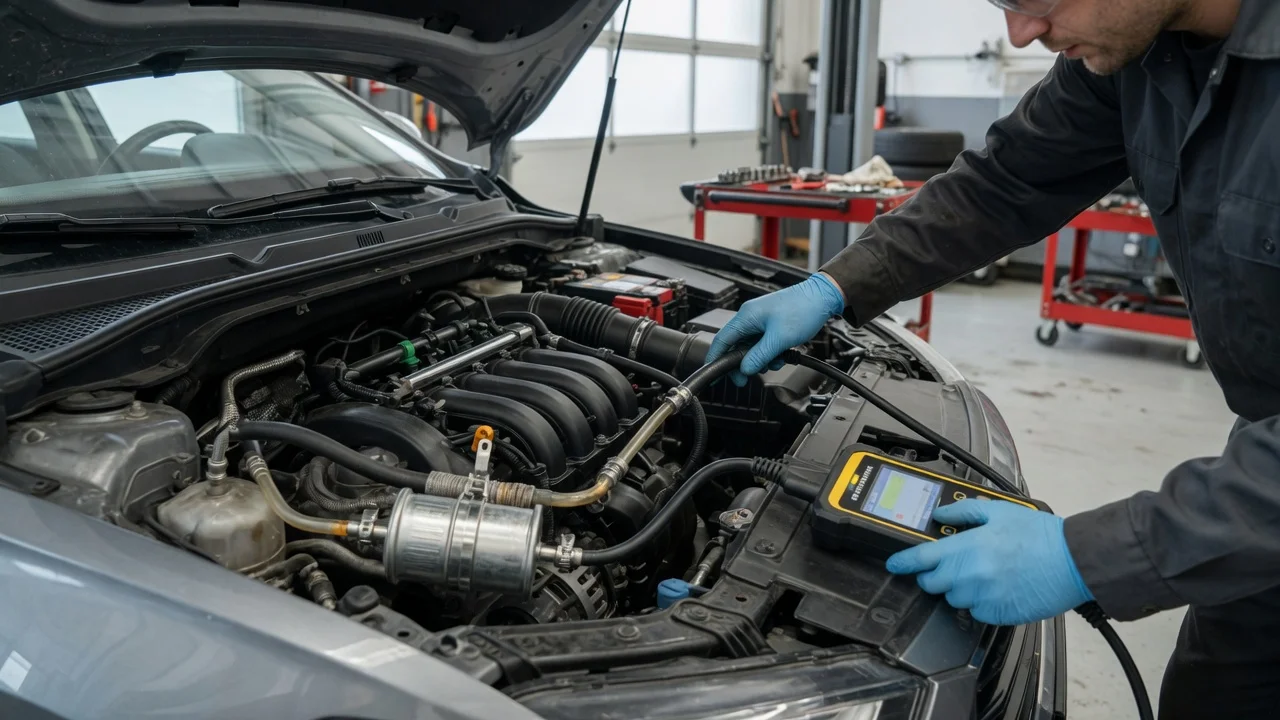
The short answer
A restricted fuel filter can contribute to a check engine light, but usually indirectly. On most gasoline cars the filter has no sensor of its own. The engine computer cannot tell that the filter is clogged. It can only detect what a clogged filter causes: low fuel pressure, a lean air-fuel mixture or misfires. The light therefore points to a fuel delivery problem in general, and the filter is only one possible cause.
Two qualifications change the answer. First, many diesel vehicles have a filter housing with a water-in-fuel sensor, and some also monitor filter restriction. These can trigger a dedicated warning lamp or a stored code that refers directly to the filter. Second, many modern gasoline vehicles have no separate serviceable filter in the fuel line. The filtering element sits inside the in-tank fuel pump module and may be described as lifetime or non-serviceable. Whether your vehicle has a replaceable inline filter, a filter in the pump module or a diesel filter with sensors depends on the model, model year, engine and market. Check the owner's manual or service information for your specific vehicle.
Start with the code, not the part
Read the stored diagnostic trouble codes before replacing anything. An OBD-II scan tool can do this, and many parts retailers offer free code reads. Treat a code as a lead to investigate, not proof that a part has failed. A code describes a condition the computer measured. It rarely names the component responsible.
Codes that can be consistent with restricted fuel delivery, depending on the vehicle, include:
P0171 and P0174: system too lean on bank 1 or bank 2. Low fuel delivery is one possible cause. Vacuum leaks, a dirty or faulty mass airflow sensor and exhaust leaks ahead of the oxygen sensor are common alternatives. P0087: fuel rail or system pressure too low. This code appears on vehicles that have a fuel pressure sensor, which many direct-injection and diesel engines do. A restricted filter, a weak pump, a faulty pressure regulator or a sensor fault can all set it. P0300 to P0308: random or cylinder-specific misfire. Fuel starvation can cause misfires, but so can ignition, injector and mechanical faults. Diesel water-in-fuel or filter-related codes: the code definitions and numbers are manufacturer-specific, so look them up for your exact vehicle.
If the light appeared right after refueling and the codes relate to the evaporative emissions system, such as P0455 or P0456, the cause is more likely a loose or faulty fuel cap or an evaporative system leak than the filter.
Symptoms that point toward fuel delivery
Engine behavior helps separate a fuel supply problem from other causes of the same codes. A restriction tends to show up most when the engine needs the most fuel. Signs consistent with a restriction include:
Hesitation, stumbling or loss of power under hard acceleration, uphill or while towing, with normal behavior at idle; Surging or bucking at steady highway speed; Long cranking before the engine starts, or stalling soon after starting; Lean codes that appear mainly under load rather than at idle
If the engine runs rough mainly at idle and smooths out at higher engine speed, look at vacuum leaks before the filter. Unmetered air has a bigger effect on the mixture at idle.
Checks to narrow it down
Find your filter. Use the owner's manual or service information to learn whether the vehicle has a serviceable filter and what replacement interval, if any, is specified. A filter that is overdue for replacement is a reasonable suspect. A lifetime filter in the pump module is far less likely to be the first suspect. Review the scan data. Live fuel trim readings can be informative if your scan tool shows them. Long-term fuel trims that rise sharply under load suggest the engine is short on fuel. Trims that are high at idle and improve with engine speed suggest an air leak. The exact thresholds vary, so compare against service information for your vehicle. Measure fuel pressure. A gauge test, or a fuel pressure sensor reading on equipped vehicles, compared with the manufacturer's specification is the most direct check. Pressure that is acceptable at idle but drops under load points to a restriction or a weak pump. Pressure that is low at all times may point to the pump, the regulator or the electrical supply to the pump. On diesels, drain the water separator if the procedure applies to your vehicle, and check whether the water-in-fuel warning clears. Follow the manufacturer's procedure, because some systems need priming or bleeding afterward. Rule out the simple causes. Inspect intake hoses and vacuum lines for cracks, check that the fuel cap seals properly, and consider whether a recent tank of poor-quality or contaminated fuel lines up with when the symptoms started.
After any repair, clear the codes and drive under the conditions that triggered the light. If the same code returns, the root cause has not been fixed. Replacing the filter without confirming low pressure or a restriction may not solve the problem.
When to stop driving or get professional help
A flashing check engine light usually indicates a severe misfire that can overheat and damage the catalytic converter. Reduce load and stop driving as soon as it is safe to do so. If you smell raw fuel or see fuel leaking, stop and do not restart the engine. Fuel leaks are a fire risk. Stalling in traffic or a sudden loss of power is a safety hazard, so get the vehicle diagnosed before driving it further. Treat a diesel water-in-fuel warning promptly. Water can damage high-pressure fuel system components, and the owner's manual typically specifies what action to take. Work on high-pressure systems needs proper tools and procedures. Direct-injection gasoline and common-rail diesel systems operate at very high pressures, and in-tank pump modules require dropping the tank or opening an access panel. Leave these jobs to a qualified technician unless you have the equipment and service information.
What this guide cannot tell you
No vehicle-specific data was available for this guide. Filter location, replacement intervals, fuel pressure specifications, sensor equipment and manufacturer-specific code definitions all vary by make, model year, engine and market. Confirm these details in the service information for your vehicle before buying parts or making a repair decision.