Diagnose fuel filter engine light

A check engine light with no other obvious symptom often points toward the delivery side of the fuel system, and a restricted fuel filter is one plausible explanation to investigate. The light does not by itself confirm the filter has failed. It signals that a diagnostic monitor recorded a reading outside its expected range, such as a lean air-fuel mixture, fuel pressure deviation, or evaporative emissions variation. When a filter becomes clogged, pressure can fall while fuel trim corrections rise, and the computer may turn on the warning before driveability becomes severe. This article explains how to interpret the light and what to check next.
Essential answer
A fuel filter related engine light is best understood as a fuel delivery concern rather than a direct filter warning. Most vehicles do not have a dedicated sensor that reports a dirty filter. Instead, the powertrain control module may detect low fuel pressure, compare readings with expected values, observe fuel trim shifting lean, or note a misfire when an injector cannot receive enough volume. Because the warning is indirect, the filter should be treated as one candidate in a system that also includes the pump, regulator, supply line, and injectors.
The essential answer is that the engine light does not prove a clogged fuel filter, but the filter should not be dismissed when symptoms and scan data point toward restricted flow. A plugged element can raise pressure before the filter while reducing pressure and volume after it, depending on the system design. Until that is confirmed with a fuel pressure reading and an evaluation of the service history, the light remains evidence to interpret. Replacement may resolve the fault if the filter is due and the measurements support a restriction.
Diagnosing a problem
Diagnosing this warning begins with reading the stored diagnostic trouble code, not by replacing parts immediately. A code for a lean condition, fuel pressure performance, or a misfire can have several causes, including a restricted fuel filter, a weak fuel pump, unmetered air entering after the mass airflow sensor, or a failing pressure regulator. Reading the code gives direction, but it is not proof that one component has failed. The next step is to compare live data and mechanical measurements with what the code suggests.
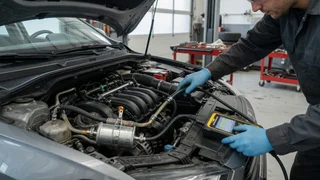
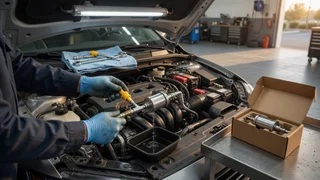
If a vehicle has a serviceable external fuel filter that has not been changed within its maintenance interval, checking fuel pressure and volume can separate a filter restriction from other faults. In a return-type system, fuel pressure that improves when a vacuum line is disconnected from the regulator suggests the regulator is responding, while low pressure that remains low under load may indicate a supply restriction or pump problem. In a returnless system, the pump is modulated to control pressure, so a clogged filter may make the pump work harder to hold the target. A fault code with fuel trim shifted lean under load and normal short-term corrections at idle can support a volume limitation such as a restricted filter, but the diagnosis still requires confirmation from fuel pressure and flow tests.