How to Diagnose a 6.0 Powerstroke Glow Plug Control Module
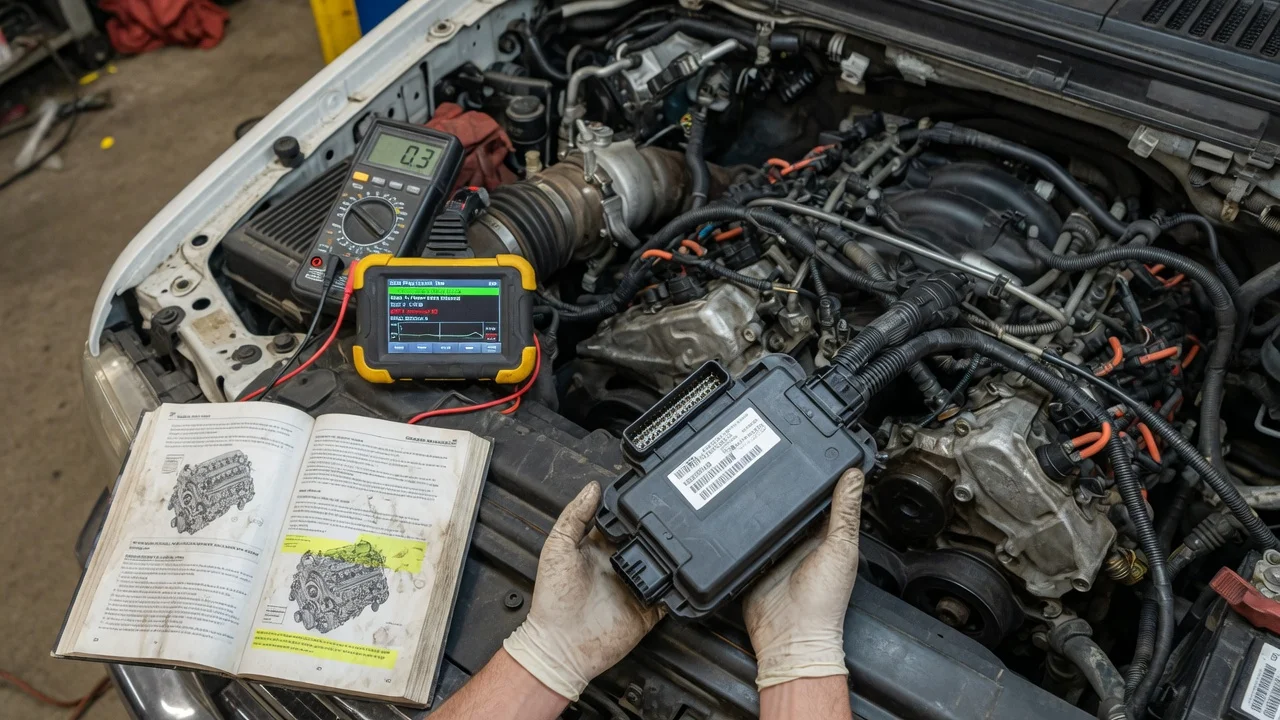
The glow plug control module on a 6.0L Power Stroke diesel switches battery current to the eight glow plugs and reports circuit faults to the powertrain control module. When it fails, the truck usually starts hard in cold weather and may smoke or idle roughly until it warms up. Several other faults on this engine cause similar complaints. A careful diagnosis rules out the glow plugs, wiring, batteries, fuel supply and injection oil pressure before the module is replaced.
Establish the symptoms
Start by noting when the problem happens. A glow system fault shows up mainly on cold starts, such as cold mornings or after the truck has sat overnight, and it fades once the engine is warm. Typical signs are long cranking before the engine catches, white or gray smoke with a raw diesel smell, and a shaky, misfire-like idle that smooths out after the first minutes. A check engine light may also come on. The classic pattern is a truck that starts normally when warm but struggles when cold. If it is just as hard to start hot as cold, the glow system becomes a weaker suspect.
Write down the related details too. Record any stored codes, whether the wait-to-start lamp comes on and for how long, battery age, and the outside temperature. Note any recent changes: valve cover gasket or injector work, a fuel filter change, a pressure wash of the underside, or driving through deep water or salted roads. Note the fuel as well, since a summer diesel blend in cold weather can behave very differently from winter-blend diesel. Glow faults on this engine are commonly logged as individual cylinder circuit codes P0671 through P0678, a module circuit code P0670, or P0683 for communication between the module and the powertrain control module. Basic code readers may not show all of them, so a capable scan tool helps.
Distinguish plausible causes
Within the glow system there are three main suspects. Failed glow plugs usually cause a rough, smoky cold idle on specific cylinders, but the engine often still starts, and the codes name those cylinders. In this V8 engine configuration, four plugs sit under each valve cover. Their wiring passes through connectors built into the valve cover gaskets, and damaged or loose connectors there can set codes for one cylinder or one bank. The module itself becomes the stronger suspect in three cases: no plugs heat at all, plug codes appear across both banks at once, or a communication code is present. The module is mounted where it is exposed to water and road salt, so corrosion at its connectors and power feed is a frequent finding.
Several faults outside the glow system can look the same. Weak batteries or poor grounds reduce cranking speed and can upset the voltage the injection control module needs. That causes hard starts in any temperature, worse in the cold. Low injection control pressure from high-pressure oil leaks causes hard starting both hot and cold, and often worse hot. Low fuel pressure from a restricted fuel filter or a weak frame-mounted fuel pump usually adds power loss under load. Gelled fuel in severe cold causes hard starts and stalling with plugged filters. A faulty engine oil temperature sensor can shorten the glow time, and sticky injectors can cause a rough cold idle that clears as the oil warms.
Checks in a useful order
Begin with checks an owner can do safely. Read and save all codes, including any freeze frame data, before clearing anything. Have both batteries load tested, and inspect the terminals and main grounds for looseness or corrosion. With the key off, look over the module connectors and the heavy power feed for green deposits, water intrusion, chafing or melted insulation. Confirm when the fuel filters were last changed. Do a visual leak check for wet fuel lines or drips, and check the engine oil level and condition.
The next tests need tools and specifications. A technician can use a scan tool to run the module self-test and to monitor engine oil temperature, injection control pressure and glow system status. They can then measure each glow plug's resistance at the harness against the service specification. They can also check voltage at the module output and the voltage drop on its feed and ground while the system is energized. This circuit carries high current, so never bridge or jumper it to test the plugs. Fuel pressure is measured with a gauge at the designated test port. Pressure in the high-pressure oil system is checked with specialized equipment. Do not open fuel or oil lines while the engine is running, and relieve pressure only by the published service procedure.
Glow plug removal on this engine is best left to a qualified technician. The plugs can swell in the cylinder head and break during removal, and a broken tip can turn a simple job into a much larger one. Avoid starting fluid on a diesel with glow plugs, because ether combined with hot plugs can damage the engine.
Interpret the findings
Read each result for what it actually proves. A single cylinder code with an out-of-spec plug points to that plug. If the plug measures correctly but the code persists, look at that branch of the harness and the valve cover gasket connector. Codes on several cylinders across both banks, with good plugs and wiring, point to the module or its supply. If the module has good power, a good ground and a command signal but still sends no output to the plugs, the module is the likely failure. A communication code with good module power points to the wiring and connectors between the module and the powertrain control module.
Some things still need confirmation before you buy parts. Clearing codes and getting one easy start, especially on a warm engine, proves nothing. Confirm power, ground and the command signal at the module first, because a corroded connector or feed will leave a new module just as dead. If the glow system tests good and the batteries are healthy but cold starts are still poor, the diagnosis moves on to fuel pressure, injection control pressure and injector condition. Anti-gel and other fuel additives can help prevent fuel gelling in cold weather. They do not repair glow plugs, the module, injectors or wiring, and they should not be treated as a fix.
Urgency and next action
A glow system fault alone rarely affects a warm, running engine. Still, repeated long cranking strains the starter and drains the batteries, and rough, smoky cold starts send unburned fuel through the engine. Stop using the truck and arrange a repair if you notice any of the following: smoke or a burning smell from the module or wiring, melted connectors, a fuel leak or strong fuel smell, engine knocking, sudden power loss with warning lights, or a no-start that needs repeated long cranking. No particular distance or number of starts can be called safe once these signs appear.
Give the repair shop clear information. That includes the saved codes and freeze frame data, the temperatures at which the problem occurs, and whether the truck starts differently hot versus cold. Add battery test results, fuel filter service dates and the type of diesel used, and any recent work on the valve covers, injectors or fuel system. Include the model year and body style as well, because the module location and access vary between Super Duty, Excursion and E-Series vehicles.