Commercial Vehicle Safety Inspections and CVSA Requirements
The Short Answer
A commercial vehicle safety inspection is an examination of a truck, bus or other commercial motor vehicle, and often its driver, to confirm that the vehicle is mechanically safe and that the driver is qualified and compliant with operating rules. In the United States, two related but separate systems are involved. Federal and state regulations, administered at the federal level by the Federal Motor Carrier Safety Administration (FMCSA), set the legal requirements, including periodic inspections that carriers must arrange themselves. The Commercial Vehicle Safety Alliance (CVSA) develops the uniform roadside inspection procedures and out-of-service criteria that enforcement officers use to check vehicles on the road.
The key qualification is that CVSA is not a government regulator and does not write law. It is a nonprofit association of commercial vehicle safety officials and industry representatives from the United States, Canada and Mexico. Its standards carry weight because member jurisdictions adopt them for their enforcement programs, so a roadside inspection conducted by a state officer generally follows CVSA procedures while enforcing federal and state rules.
Which Vehicles Are Covered
Inspections apply to commercial motor vehicles as defined by federal and state regulations, which generally include heavier trucks and trailers used in commerce, passenger-carrying vehicles above certain seating capacities and vehicles transporting hazardous materials that require placards. The exact thresholds depend on whether the operation is interstate or intrastate and on the rules of the individual state, so an operator should confirm which definitions apply to their specific vehicle and route. No vehicle-specific thresholds were supplied for this article.
Two Kinds of Inspection: Periodic and Roadside
Periodic inspection is the carrier's responsibility. Federal regulations require each commercial motor vehicle in interstate operation to undergo a documented inspection at least once every 12 months by a qualified inspector, with proof of that inspection kept on the vehicle or in the carrier's records. Some states run their own periodic inspection programs that may be accepted in place of the federal requirement. Drivers are also required to perform and document routine vehicle inspections as part of normal operation.
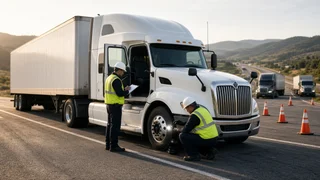
Roadside inspection is carried out by enforcement personnel at weigh stations, inspection sites or other locations, either at random, during targeted enforcement or after an observed violation. These inspections follow the CVSA North American Standard Inspection Program, which is designed so that a vehicle is assessed in a consistent way regardless of which jurisdiction stops it.
The CVSA Inspection Levels
CVSA defines eight inspection levels. The level determines how much of the driver and vehicle is examined.
Level | Name | What it covers; I | North American Standard Inspection | The most thorough check, covering driver credentials and compliance plus a full vehicle examination, including components underneath the vehicle; II | Walk-Around Driver/Vehicle Inspection | Driver checks plus a vehicle examination of items that can be inspected without physically getting under the vehicle; III | Driver/Credential/Administrative Inspection | Focuses on the driver and paperwork, such as license, medical certification, hours-of-service records and related documents; IV | Special Inspection | A one-time examination of a particular item, often to support a study or verify a specific trend; V | Vehicle-Only Inspection | A vehicle examination conducted without the driver present, such as at a carrier's facility; VI | Enhanced NAS Inspection for Radioactive Shipments | An enhanced inspection for select radiological shipments, with additional procedures and standards; VII | Jurisdictional Mandated Commercial Vehicle Inspection | An inspection required by a jurisdiction for vehicles that fall outside the standard levels, such as certain school buses or other locally regulated vehicles; VIII | Electronic Inspection | An inspection performed electronically or wirelessly while the vehicle is in motion, without direct interaction with an officer
Out-of-Service Criteria and the CVSA Decal
CVSA publishes North American Standard Out-of-Service Criteria, which identify violations serious enough that the vehicle or driver must not continue until the problem is fixed. If an inspector finds such a condition, the vehicle or driver is placed out of service. Less serious defects can be recorded as violations without stopping the trip. Typical areas examined include brakes, tires, wheels, lighting, steering, suspension, coupling devices, cargo securement and fuel and exhaust systems on the vehicle side, and licensing, medical qualification, hours of service and impairment on the driver side.
A vehicle that passes a Level I or Level V inspection with no critical violations may receive a CVSA decal. The decal indicates a recent successful inspection and, during its validity period, inspectors generally will not reinspect that vehicle unless there is an obvious defect. A decal does not exempt the driver from inspection and does not replace the carrier's required periodic inspection.
What International Roadcheck Is
International Roadcheck is CVSA's annual high-volume enforcement event, during which inspectors across participating jurisdictions in North America conduct large numbers of inspections over a concentrated period of several days. The inspections use the same standard procedures and out-of-service criteria as any other roadside check; what differs is the volume and visibility. Each year CVSA typically announces dates in advance and names focus areas, which are specific vehicle or driver categories that receive extra attention. CVSA also runs other targeted campaigns, such as events focused on brakes or driver behavior.
The dates and focus areas for the current or upcoming Roadcheck were not included in the evidence for this article. Operators should check CVSA's current announcements directly before planning around a specific event.
How the Pieces Differ
FMCSA and state agencies set the legal requirements and penalties. CVSA sets uniform inspection procedures, inspection levels and out-of-service criteria that enforcement agencies apply. Periodic inspections are arranged and documented by the carrier on a fixed schedule. Roadside inspections are performed by enforcement officers at any time, with results that can affect a carrier's safety record. International Roadcheck is a concentrated, publicized period of roadside inspections, not a separate set of rules.
Practical Next Steps and Gaps
For a carrier or driver, the practical takeaway is to keep the annual inspection current and documented, perform and record driver inspections consistently, and maintain the items most commonly flagged as out-of-service conditions, especially brakes, tires and lighting. Because vehicle classification thresholds, state program details, decal validity and each year's Roadcheck focus areas can change and were not supplied here, those specifics should be verified with the current FMCSA regulations, the relevant state enforcement agency and CVSA's published criteria.