DOT Commercial Vehicle Inspection Requirements and Checklist
The Short Answer
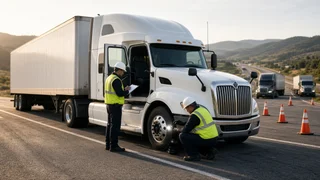
A DOT commercial motor vehicle (CMV) inspection is a set of federally required checks covering a truck, bus or trailer used in commerce. For interstate operations, the rules come mainly from the Federal Motor Carrier Safety Administration (FMCSA) in Part 396 of the Federal Motor Carrier Safety Regulations. Three layers apply: drivers inspect the vehicle before and after each trip, the motor carrier makes sure every vehicle passes a periodic inspection at least once every 12 months, and enforcement officers can stop vehicles for roadside inspections. Roadside inspections usually follow procedures set by the Commercial Vehicle Safety Alliance (CVSA).
Two factors change the answer for a specific operation: whether the vehicle meets the federal CMV definition, and whether it runs interstate or only within one state. Intrastate carriers are governed by state rules. Most states adopt the federal standards, but some modify thresholds or exemptions. Always check the current regulation text and your state's requirements before relying on any summary, including this one.
Which Vehicles Count as CMVs
Under the federal definition, a vehicle used in interstate commerce is generally a CMV if it meets any of these conditions:
It has a gross vehicle weight rating or gross combination weight rating (GVWR or GCWR), or an actual gross weight, of 10,001 pounds or more. It is designed or used to carry 9 to 15 passengers, including the driver, for compensation. It is designed or used to carry 16 or more passengers, including the driver, whether or not compensation is involved. It transports hazardous materials in a quantity that requires placards.
Do not confuse this definition with the commercial driver's license (CDL) threshold, which is higher for most vehicles. A pickup towing a trailer used for business can be a CMV subject to inspection rules even when the driver needs no CDL.
How the Inspection Types Differ
Inspection type | Who performs it | When | What it produces; Pre-trip inspection | Driver | Before driving the vehicle | Confirmation that the vehicle is safe and that the last DVIR's defects were repaired or judged not to need repair; Post-trip inspection and DVIR | Driver | At the end of each workday's driving | A written Driver Vehicle Inspection Report listing any defects found; Annual (periodic) inspection | Qualified inspector arranged by the carrier | At least once every 12 months | An inspection report and proof of inspection carried on the vehicle; Roadside inspection | Certified enforcement officer | At random, at weigh stations, or after a stop | An inspection report that may include violations or out-of-service orders
Driver Pre-Trip and Post-Trip Requirements
Before driving, the driver must be satisfied that the vehicle is in safe operating condition. The driver must also review the previous Driver Vehicle Inspection Report (DVIR). If that report listed defects, the driver checks that someone certified them as repaired or as not needing repair, and signs the report to acknowledge the review.
At the end of each day's driving, the driver prepares a DVIR covering at least these parts and accessories:
Service brakes, including trailer brake connections; Parking brake; Steering mechanism; Lighting devices and reflectors; Tires; Horn; Windshield wipers; Rear-vision mirrors; Coupling devices; Wheels and rims; Emergency equipment
Since a 2014 rule change, drivers of property-carrying CMVs do not need to submit a DVIR when they find no defects. Drivers of passenger-carrying CMVs still must submit one after every workday, even when nothing is wrong. Carriers must repair reported defects that affect safe operation before the vehicle is dispatched again. They must also keep the original DVIR and the repair certification for three months.
The Annual Periodic Inspection
Every CMV, including each trailer, must pass a periodic inspection at least once every 12 months. The inspection must meet the minimum standards in Appendix G to the federal regulations. Those standards set out specific pass/fail conditions for brakes, coupling devices, exhaust, fuel and lighting systems, safe loading, steering, suspension, frame, tires, wheels and rims, windshield glazing and wipers. Buses have additional items, such as emergency exits.
The inspector must be qualified by training or experience, and brake work has its own inspector qualification rules. The carrier keeps the inspection report for 14 months. Proof of inspection, either a copy of the report or a decal, must be kept on the vehicle. Some state inspection programs are accepted as equivalent to the federal annual inspection. In those states, a passing state inspection can satisfy the requirement.
CVSA Roadside Inspection Levels
CVSA is an organization of enforcement agencies and industry representatives in the United States, Canada and Mexico. It publishes the North American Standard Inspection procedures that most officers follow. Inspections are grouped into levels:
Level I, North American Standard Inspection: the most thorough check, covering driver documents and a full vehicle examination, including work underneath the vehicle. Level II, Walk-Around Driver/Vehicle Inspection: driver credentials plus a vehicle check that does not require going under the vehicle. Level III, Driver-Only Inspection: licenses, medical certification, hours-of-service records and related documents. Level IV, Special Inspection: a one-time check of a particular item, often for a study or to verify a trend. Level V, Vehicle-Only Inspection: a full vehicle inspection without the driver present, often done at a carrier's facility. Level VI, Enhanced NAS Inspection for Radioactive Shipments: for certain highway route-controlled radioactive and transuranic loads. Level VII, Jurisdictional Mandated Inspection: inspections required by a specific jurisdiction that do not fit the other levels, such as school bus programs. Level VIII, Electronic Inspection: data collected wirelessly from the vehicle while it is moving, without officer contact.
Serious problems found during a roadside inspection can trigger an out-of-service order under the CVSA North American Standard Out-of-Service Criteria. The vehicle or driver may not continue until the condition is corrected. A vehicle that passes a Level I or Level V inspection with no critical violations may get a CVSA decal. The decal is valid for up to three months, and officers generally do not re-inspect a decaled vehicle without cause during that time. Roadside results feed into FMCSA's carrier safety data, so findings affect a carrier's safety profile.
Practical DOT Vehicle Inspection Checklist
The list below combines the regulatory DVIR items with areas roadside inspectors commonly examine. Use it as a working guide, not a replacement for the Appendix G standards or a carrier's own written procedures.
Documents: driver's license, medical examiner's certificate, hours-of-service records or ELD access, registration, proof of annual inspection, previous DVIR, and shipping papers where required. Brakes: air leaks, audible warnings, slack adjuster stroke, pushrod travel, lining and drum condition, hoses and gladhands, air compressor and governor function, ABS warning lamp, and parking brake hold. Steering: excessive free play, loose or damaged components, and power steering fluid leaks. Tires and wheels: tread depth, cuts or bulges, inflation, mismatched duals, loose or missing lug nuts, and cracked rims. Lighting: headlights, turn signals, brake lights, clearance and marker lamps, and reflective tape on trailers where required. Coupling: fifth wheel locking jaws, kingpin, mounting bolts, safety chains, and pintle hooks. Suspension and frame: broken springs, damaged air bags, cracked or sagging frame members, and loose U-bolts. Cab and visibility: windshield cracks in the driver's view, wiper and washer function, mirrors, horn, and seat belts. Fluids and exhaust: oil, coolant and fuel leaks, and exhaust leaks or damage near the cab or fuel system. Cargo securement: tiedowns, blocking and bracing appropriate to the load, and closed and secured doors. Emergency equipment: a properly rated and charged fire extinguisher, warning triangles, and spare fuses if the vehicle uses them.
Next Steps for Owners and Carriers
Confirm whether each vehicle meets the CMV definition and whether it operates interstate, intrastate, or both. Check whether your state runs an inspection program that counts as equivalent to the federal annual inspection. Set up a system for DVIR review, defect repair, repair certification and record retention. Schedule annual inspections with a qualified inspector and keep proof of inspection on every power unit and trailer. Train drivers on pre-trip and post-trip routines that reflect the out-of-service criteria, since those are the conditions most likely to stop a vehicle at roadside.