Choosing Motorcycle Footrests: What to Check Before You Buy
The right motorcycle footrest is the one that suits how you ride, fits your body and mounts to your exact bike without interfering with the controls, exhaust or suspension. For most riders, a direct-fit replacement footpeg or floorboard designed for their specific model and year is the safest and simplest choice. The answer changes if you want to alter your riding position, add highway comfort on longer trips or improve passenger accommodation. In those cases, you are choosing a different type of footrest, such as rearsets, highway pegs or passenger floorboards, and compatibility checks become more important.
What a Motorcycle Footrest Actually Does
A footrest is more than a place to park your boots. It supports part of your weight, especially when standing on rough ground or shifting weight through corners. Its position relative to the seat and handlebars sets your knee angle and how much your hips and lower back are loaded. On the rider side, it also sits next to the shift lever and rear brake pedal, so its height and fore-aft position determine how easily you can operate those riding controls. Changing a footrest can therefore change comfort, control feel and ground clearance at the same time.
Main Types of Motorcycle Footrests
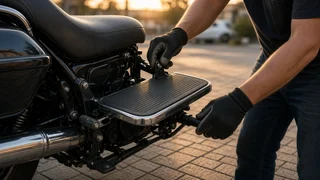
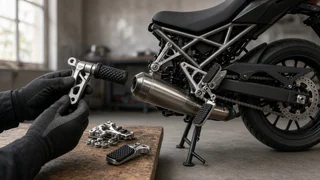
Standard footpegs: The narrow pegs fitted to most bikes. Replacements range from stock-style rubber-topped pegs to metal pegs with grip teeth. Wide or platform pegs: Larger surface area that spreads load across the sole of the boot. Common on adventure and off-road bikes where riders stand often. Floorboards: Flat platforms that let the foot move forward and back. Typical on cruisers and touring bikes, used by both riders and passengers. Highway pegs: Additional pegs, usually mounted on engine guards or the frame, that let the rider stretch their legs forward on long straight stretches. They are a supplementary resting position, not a replacement for the main controls position. Rearsets: Adjustable rider footrest assemblies that move the pegs and controls rearward and often higher, mainly for sport and track riding where ground clearance and a tucked position matter. Passenger pegs and passenger floorboards: Rear footrests for the pillion. Upgrades focus on comfort, adjustability and sometimes relocating the passenger's feet to improve legroom. Lowering or forward-relocation kits: Brackets that change peg position to suit shorter or taller riders without replacing the whole control setup.
Which Footrest Fits Your Priorities
Type | Best suited to | Main benefit | Main trade-off; Stock-style replacement peg | Replacing worn or damaged pegs | Predictable fit and unchanged ergonomics | No comfort or position improvement; Wide platform peg | Standing, off-road, adventure riding | Better support and grip under load | Can sit closer to the ground or contact controls if poorly matched; Floorboard | Cruising and touring | Lets the feet shift position on long rides | Reduces cornering clearance; may need matching control changes; Highway peg | Long highway distances | Extra leg-stretch position | Feet are away from the brake and shifter while in use; Rearset | Sport and track riding | More clearance and an aggressive, adjustable position | Tighter knee angle; usually the most involved installation; Passenger peg or board upgrade | Regular two-up riding | Improves pillion comfort and stability | Must clear the exhaust, swingarm and luggage; Relocation bracket | Riders who find the stock position cramped or stretched | Adjusts fit without replacing controls | Adds leverage on mounts; check clearance in all directions
As a rough guide by use case: commuters and general riders are usually best served by a quality direct-fit peg, possibly with a grippier surface. Touring riders tend to benefit most from floorboards or highway pegs. Adventure and off-road riders usually prioritize wide platform pegs with good grip and mud clearance. Sport riders focused on cornering and track days look at rearsets. Anyone who regularly carries a passenger should treat the pillion footrests as part of the decision rather than an afterthought.
What to Check Before Buying
Exact Model Identification
Footrest mounts vary between manufacturers, models, model years, trims and markets, even when bikes look similar. Confirm the make, model, year and trim, and where possible check the part fitment against your vehicle identification details. A peg listed for a model family may not fit every version, particularly across generation changes. If a listing does not state which years and variants it fits, treat that as a reason to ask the seller before buying.
Mounting Style and Equipment Compatibility
Pegs attach in different ways, including clevis-style mounts with a pin and spring, bolt-on brackets and integrated hanger assemblies. Some aftermarket footrests require an adapter for your bike, and some brands use their own mounting systems. Check whether the part is a direct replacement or needs extra brackets, and whether it works with any equipment already fitted, such as crash bars, engine guards, luggage racks, saddlebags or aftermarket exhausts.
Clearance Around the Engine, Exhaust and Drive System
Moving a footrest even slightly can bring a boot closer to hot exhaust parts, engine covers or moving components. Engine configuration affects where those parts sit; on some bikes the cylinders, primary cover or headers are close to the rider's feet. On the passenger side, check clearance from the swingarm, rear wheel and the drive system, whether chain, belt or shaft, through the full range of suspension travel. Also consider cornering clearance: wider pegs and floorboards will touch down sooner when the bike leans.
Interaction With Riding Controls
On the rider side, the footrest, shift lever and rear brake pedal work as a set. If the peg moves, you may need to adjust the lever and pedal, or buy relocation linkages, so that you can operate them without lifting or twisting your foot awkwardly. Rearsets usually include their own controls; check whether they support your bike's shift pattern preference, any quickshifter, and the rear brake light switch.
Rider Fit and Passenger Accommodation
Sit on the bike in your normal riding gear and note where discomfort appears. Cramped knees or sore hips often point to pegs that are too high or too far back for your leg length. Feeling stretched or unsupported suggests the opposite. Adjustable footrests let you fine-tune position, but the useful range depends on your seat height and handlebar position. For passengers, check their knee angle, whether their feet clear any luggage and whether they can brace comfortably during braking.
Grip, Material and Build Quality
Rubber-topped pegs reduce vibration reaching the feet and are comfortable on the road, but grip less well in mud or with off-road boots. Metal pegs with teeth or serrations grip strongly but transmit more vibration and can wear boot soles faster. Folding pegs with a working return spring are preferable on most bikes because they can fold away on contact with the ground or in a fall. Inspect finish quality, pivot fit and fastener quality, since a loose or flexing footrest is both uncomfortable and unsafe.
Legal and Practical Considerations
If you carry passengers, many US states expect the motorcycle to have passenger footrests, and removing or relocating them can affect whether the bike is legal for two-up riding. Rules differ by state, so check your local requirements if you are removing, relocating or significantly altering passenger pegs.
Installation and Total Cost
The purchase price is only part of the cost. Simple peg swaps are usually straightforward with basic hand tools, while floorboards, relocation kits and rearsets may require extra brackets, new linkages, brake switch work or adjustment of the controls. Budget for any adapters, replacement hardware and, if you are not confident, professional installation. Follow the service specification for your bike when tightening fasteners, including the recommended torque and any thread-locking requirements, because footrest mounts take repeated load and vibration.
When comparing listings, confirm what is included. Some footrests are sold individually, some as pairs and some as kits with mounting hardware. Advertised prices from different sellers may not include the same items, shipping or adapters, so compare the full cost of a working installation rather than the headline figure.
Buying Used Footrests
Used or take-off footrests can be good value, especially stock parts from the same model. Check for bent pegs or brackets, cracked mounts, worn pivot holes, missing springs or pins, and stripped threads. A footrest that has been bent in a crash may have been straightened and weakened. Make sure all the mounting hardware is included, as missing pieces can make a cheap part more expensive to complete.
Quick Pre-Purchase Checklist
Confirm the part fits your exact make, model, year and trim. Identify whether it is direct-fit or needs adapters or relocation brackets. Check clearance from exhaust, engine covers, swingarm and drive components. Confirm the shift lever and rear brake pedal will still be easy to reach and adjust. Check compatibility with crash bars, luggage and other installed equipment. Choose a surface and material suited to your riding conditions and boots. Consider passenger comfort and any legal requirements for passenger footrests. Compare full installed cost, including hardware, adapters and labor.
If you are unsure which direction to go, start by identifying the specific problem you want to solve, whether that is worn parts, cramped legs, fatigue on long rides, poor grip when standing or an uncomfortable passenger. Matching the footrest type to that problem, then confirming fit for your exact bike, will narrow the options quickly.