Car still overheating after water pump replacement

A fresh water pump or thermostat often seems like the obvious fix for an overheating engine, yet the gauge can still climb after the parts are installed. When this happens, the new components may be working correctly while another portion of the cooling circuit is failing. Air pockets, a weak pressure cap, a partially clogged radiator, or incorrect coolant concentration can all keep heat from leaving the engine. The key is to treat the replacement as one step in a system diagnosis rather than proof that the cooling problem is solved.
Direct answer
The direct answer is that replacing the thermostat and water pump does not guarantee the cooling system is healthy. Those parts are central to coolant flow, but they cannot overcome restrictions elsewhere or compensate for combustion gas entering the coolant. After installation, the engine may still overheat because trapped air is blocking circulation, the radiator is not rejecting enough heat, or the cooling fan is not engaging when airflow across the radiator is low. A new pump can also be installed on a system that still holds debris from a previous failure.
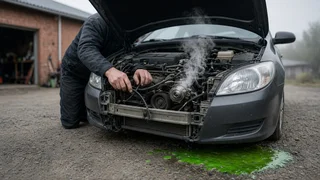
Begin by confirming the actual operating condition rather than assuming the replacement failed. Check whether the upper and lower radiator hoses become warm after the thermostat opens, which indicates circulation. Look for coolant loss, a collapsing hose, or a weak pressure cap that lowers the boiling point. Because manufacturer-specific cooling layouts vary, a fault code or gauge reading is only evidence to interpret. If the level keeps dropping without an external leak, combustion pressure may be entering the cooling circuit through a head gasket breach or cracked casting.