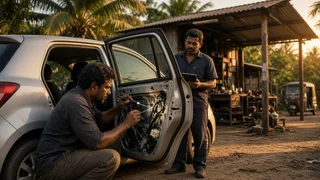
Car door lock repair in Johannesburg

The short answer
Most car door lock faults can be repaired rather than requiring a whole new door assembly. The right repairer depends on where the fault is. A purely mechanical problem usually suits an automotive locksmith. Examples include a worn key cylinder, a seized lock or a disconnected linkage. If the remote or central locking fails, an auto electrician or a dealer workshop may be better placed. The same applies when one door ignores the remote while the key still works. Some repairers handle both kinds of fault, so ask before booking.
Two situations change the urgency. A door that will not latch shut securely should be treated as a safety problem. So should a door that cannot be opened from the inside. Neither is just an inconvenience. If the lock was damaged in a break-in, record the damage before any repair. You may need that record for an insurance claim or a police report.
No verified local prices, turnaround times, provider names or reviews were available for this article. Confirm all of these directly with each repairer you consider.
What could be causing the fault
A car door lock is several connected parts, and symptoms often overlap. The key cylinder is the part the key turns in. The latch is the mechanism that holds the door closed. Rods or cables connect the handles and cylinder to the latch. Most modern cars also have an actuator, a small electric motor that locks and unlocks the door for the central locking system. The causes below are plausible explanations to test, not confirmed findings.
Symptom | Plausible causes | Discriminating check; Key will not turn or feels stiff | Worn key, worn or dirty cylinder, seized cylinder after a break-in attempt | Try the spare key; if the spare turns smoothly, the original key is the likelier problem; Key turns but the door does not lock or unlock | Disconnected or broken rod or clip between cylinder and latch | Check whether the remote or interior switch still operates that door; if it does, the latch and actuator are probably working; One door ignores the remote or central locking switch | Failed actuator, broken wire where the loom passes through the door hinge, faulty latch switch | Listen at the door while locking; silence suggests a power or actuator fault, buzzing or clicking suggests a worn actuator; No doors respond to the remote | Weak remote battery, remote fault, fuse, wider central locking or body control fault | Try the spare remote and the interior central locking switch; if the switch works, the remote is the likelier cause; Door will not open from inside or outside | Stretched or detached handle cable, faulty latch, child lock engaged on a rear door | Check the child lock setting first, then compare the inside and outside handles; Door will not stay shut or bounces open | Worn or damaged latch, misaligned striker | Stop using the door until it is inspected
Checks to do before calling a repairer
Try every way of operating the lock: key, remote, interior switch and interior handle. Note which work and which do not. Try the spare key and spare remote if you have them. Check whether the problem affects one door or all of them. Listen at the affected door while locking and unlocking. Check that the child lock is not engaged if the problem is a rear door that will not open from inside. Note whether the fault started after a break-in, an accident, heavy rain or recent door repair work.
These notes help a repairer tell a mechanical fault from an electrical one before they quote, and help you judge whether the quote makes sense. Do not force a key that will not turn, because a snapped key inside the cylinder adds to the job. If you lubricate the cylinder, use a product made for locks.
About diagnostic codes
On many vehicles, the central locking is managed by a body control module, which can store fault codes. A code can point to a circuit or component, such as a specific door actuator. It does not by itself prove that the part needs replacing. A wiring break or poor connection can produce the same code. Also check that the code was read from the body or central locking system, not from an unrelated system. Ask the repairer how they confirmed the fault beyond the code itself.
When to stop and get it fixed
The door does not latch fully or opens while driving: do not drive with passengers next to that door until it is repaired. A door cannot be opened from the inside: occupants may be unable to get out in an emergency. The car cannot be locked: keep valuables out and consider where you park until it is fixed. The lock was damaged in a break-in: photograph the damage and report it before repair if you intend to claim on insurance. The key is stuck or broken in the cylinder: stop trying to turn it and leave removal to a locksmith.
Choosing a car door lock repairer in Johannesburg
The options are mobile automotive locksmiths, workshop-based locksmiths, auto electricians and franchised dealers. Mobile services can be convenient when the car cannot be locked or driven safely. Dealers may be the more direct route for newer vehicles where parts or key programming are tied to the manufacturer. Neither is automatically better. The questions below matter more than the type of business.
Do they work on your make, model and year? Lock parts and electronics often differ between model years, markets and trim levels, so give the exact vehicle details. Will they diagnose before quoting, and is there a charge for diagnosis or a call-out? Is the quote itemised into labour and parts, and will they contact you before doing extra work? Are the parts original manufacturer parts or aftermarket, and what does that mean for fit and warranty? If the cylinder is replaced, will it be matched to your existing key, or will you need a separate key? Ask whether rekeying is possible so that one key still works the door and ignition. What warranty do they give on parts and labour? Will they ask for proof of ownership, such as identification and vehicle registration documents? A careful repairer should, because lock work affects vehicle security. Can they provide documentation for an insurance claim if the damage came from a break-in?
Repair or replace?
A worn cylinder can sometimes be serviced or rekeyed instead of replaced. A disconnected linkage may only need refitting. A failed actuator is usually replaced as a unit, though on some vehicles it is built into the latch assembly. That makes the part larger and may raise the cost. Ask the repairer which applies to your vehicle and why. Then compare quotes on the same scope of work, not on the total figure alone.