Car Battery Warning Signs: How to Tell If Your Battery Is Dying
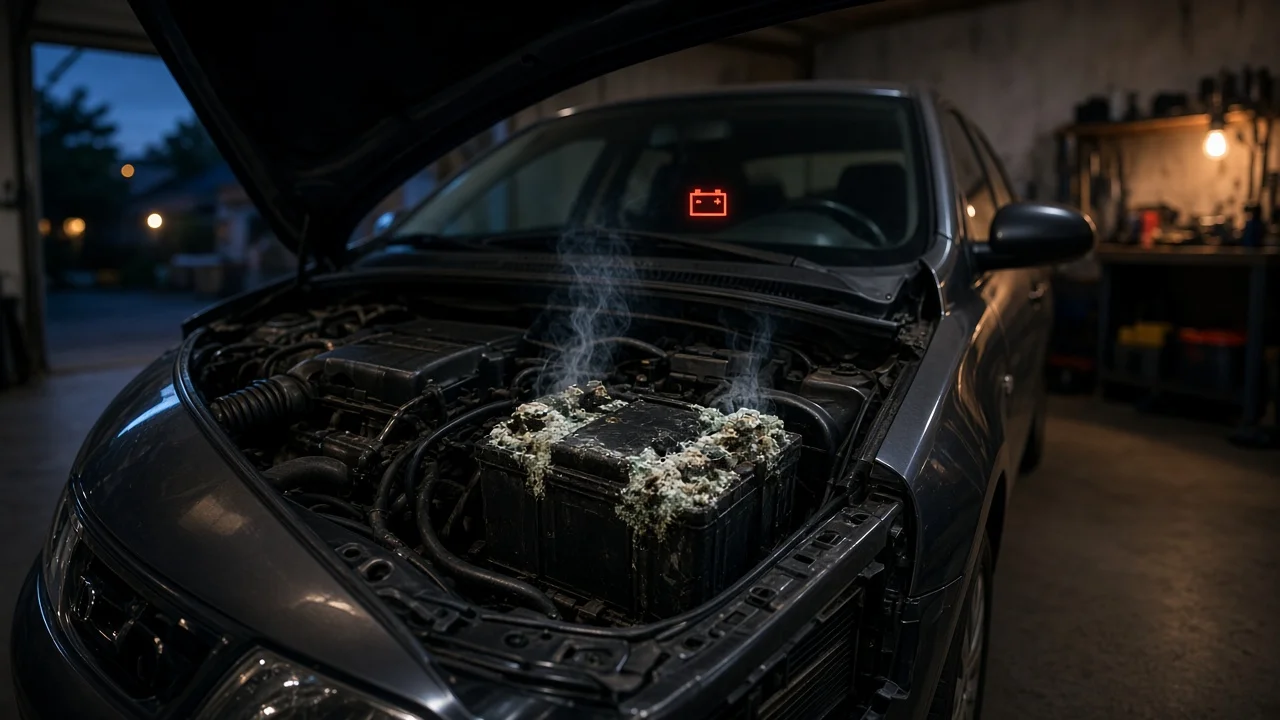
A dying car battery usually announces itself before it leaves you stranded. Slow cranking, dim lights at startup, clicking when you turn the key or press the start button, and a battery or charging warning light are the most common car battery warning signs. The important qualification is that many of these symptoms are not unique to the battery. A failing alternator, corroded battery terminals, a loose ground connection or a hidden electrical drain can produce nearly identical behavior. This guide explains the typical signs, what else can cause them, and the simple checks that help you decide whether the battery itself is the problem.
The Short Answer
If your engine cranks more slowly than usual, especially on cold mornings or after the car has sat for a few days, the battery is the most likely suspect. If the car starts fine but the battery warning light comes on while driving, or the battery goes flat repeatedly even after being charged or replaced, the charging system or a parasitic draw is more likely to blame. Testing the battery's voltage at rest and with the engine running is the quickest way to separate these possibilities.
This guide focuses on conventional 12-volt batteries used to start gasoline and diesel vehicles. Hybrid and electric vehicles also have a 12-volt battery that powers control electronics, and it can show some of the same signs, but their high-voltage traction batteries are a separate system that should only be diagnosed by trained technicians.
Common Warning Signs of a Dying Car Battery
Slow or labored cranking: the starter turns the engine sluggishly, sounding like it is struggling before the engine catches. Clicking with no crank: a rapid clicking or a single click when you try to start often means there is enough power to engage the starter relay or solenoid but not enough to turn the starter motor. Dim headlights or interior lights when starting: lights that noticeably dim during cranking, or look weak with the engine off, suggest low stored charge. Electrical glitches at startup: the radio resets, the clock loses its time, dashboard displays flicker, or warning lights flash briefly as the engine cranks. Need for frequent jump-starts: a battery that cannot hold a charge overnight or over a weekend is either worn out, not being recharged properly, or being drained. Battery or charging warning light: on most vehicles this light indicates a charging system problem rather than a battery fault specifically, though the two are closely linked. Swollen, cracked or leaking case: physical deformation or leakage indicates internal damage and is a reason to stop using the battery. Corrosion on the battery terminals: white, blue or green crusty deposits increase resistance and can mimic a weak battery. A rotten-egg smell near the battery: this can indicate overcharging or internal failure and should be treated as a safety concern. Age: lead-acid batteries wear out gradually, and an older battery is more likely to fail suddenly, particularly in extreme heat or cold.
How a Dying Battery Differs From Other Electrical Problems
The battery stores energy for starting and supports electrical loads when the engine is off. The alternator recharges the battery and powers the vehicle's electrical system while the engine runs. The cables, terminals, grounds and fuses connect everything together. A fault in any one of these can look like a battery problem, so it helps to compare the patterns.
Symptom pattern | Most likely cause | Why; Slow crank, worse in cold weather, car runs normally once started | Weak or aging battery | Battery capacity drops in the cold, and a worn battery has less reserve to begin with; Car starts, then battery light comes on and lights dim while driving | Alternator or charging system | The system is not replacing the energy being used, so the battery is being drained while driving; New or recently charged battery goes flat after sitting | Parasitic draw or charging fault | Something is drawing power with the car off, or the battery is never fully recharged; No crank or intermittent no-start that improves after wiggling cables | Loose or corroded battery terminals or ground | Poor connections cause voltage drop under heavy load; No response at all, no lights, no click | Fully discharged battery, disconnected cable or main fuse issue | Power is not reaching the vehicle's electrical system; Headlights brighten and dim with engine speed | Charging output problem | Alternator output or regulation may be unstable
What to Check Next
These checks move from the simplest and safest to those that require a meter or professional equipment. Before working near the battery, turn off the engine and accessories, avoid sparks or open flames, and wear eye protection. Batteries contain corrosive acid and can release flammable gas.
1) Inspect the Battery and Terminals
Look for corrosion, loose clamps, frayed cables or a damaged case. Try to move each terminal clamp by hand; it should not twist or shift on the post. Corrosion and loose connections create resistance, and under the heavy current demand of the starter that resistance causes a voltage drop that can stop the engine from cranking even when the battery is healthy. If the case is swollen, cracked or leaking, stop here and have the battery replaced rather than trying to charge or jump it.
2) Measure Resting Voltage
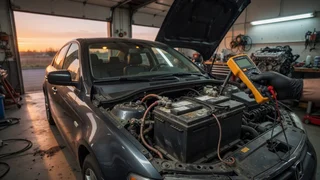
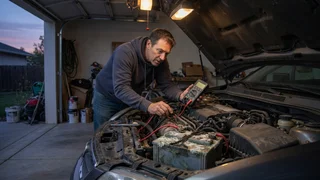
With a digital multimeter set to DC volts, measure across the battery posts after the car has been off for a while, ideally several hours, so any surface charge has dissipated. As a general guide for a conventional 12-volt lead-acid battery, a reading around 12.6 volts indicates a fully charged battery, and readings that fall progressively toward 12 volts indicate a battery that is substantially discharged. Exact thresholds vary somewhat by battery type, including flooded, AGM and enhanced flooded designs, so treat these as approximate. A low reading tells you the battery is discharged, but not why. A battery that reads low after a full charge and a short rest may be worn out.
3) Check Charging Output With the Engine Running
Start the engine and measure voltage at the battery again. System voltage should rise noticeably above the resting reading, which shows the alternator is charging. On many conventional vehicles, a running voltage in roughly the high 13s to mid 14s is typical, but some modern vehicles use smart charging strategies that deliberately vary charging output depending on battery condition, temperature and electrical load. If the running voltage is no higher than the resting voltage, or it climbs excessively high, the charging system needs attention. Your vehicle's service information gives the expected range for that specific model.
4) Get a Load Test
Voltage alone does not reveal how well a battery performs under load. A battery can show acceptable resting voltage and still collapse when the starter draws heavy current. Many auto parts stores and repair shops can perform a battery load or conductance test, which estimates the battery's ability to deliver starting current compared with its rating. This is often the clearest way to confirm whether the battery itself is failing.
5) Look for Parasitic Draw
If a healthy, fully charged battery keeps going flat after the car sits, something may be drawing current with the ignition off. Common culprits include a glovebox, trunk or under-hood light that stays on, an aftermarket accessory wired incorrectly, a module that fails to go to sleep, or a stuck relay. Measuring parasitic draw involves placing an ammeter in series with the battery and waiting for the vehicle's modules to shut down, which can take some time on modern cars. Isolating the circuit responsible usually means pulling fuses one at a time while watching the reading and referring to a wiring diagram. Because disconnecting the battery can reset modules or trigger security features on some vehicles, many owners leave this step to a technician.
6) Check Fuses and Grounds
A blown main fuse or fusible link can cut power entirely, and a corroded engine or body ground can cause starting problems that look like a weak battery. If you replace a fuse, always use one with the same fuse rating shown on the fuse box cover or in the owner's manual. A fuse that blows again points to a short circuit that needs proper diagnosis; installing a higher-rated fuse risks overheated wiring and fire.
Interpreting Warning Lights and Fault Codes
The battery-shaped warning light on most vehicles reports a charging system condition, not the battery's state of health. It can be triggered by a failing alternator, a broken or slipping drive belt, a wiring fault or a control module issue. Some vehicles also store diagnostic trouble codes related to system voltage or charging performance. Treat a code or warning light as a starting point for investigation rather than proof that a specific part has failed. A low-voltage code, for example, may be the result of a weak battery, a bad connection or an alternator fault.
When to Stop Driving or Seek Professional Help
The battery or charging light comes on while driving, along with dimming lights or other electrical problems: the vehicle may be running only on stored battery power and could shut down. Get somewhere safe and have the charging system checked. The battery case is swollen, cracked or leaking, or you notice a strong sulfur smell: do not charge or jump-start it. You smell burning or see smoke from wiring or the fuse box. A fuse repeatedly blows after replacement. The drive belt is squealing, damaged or missing, since on many engines the same belt also drives other essential components. You drive a hybrid or electric vehicle and the problem involves anything beyond the 12-volt battery.
Should You Replace the Battery?
Replace the battery when it fails a load test, cannot hold a charge after being fully recharged, or shows physical damage. Before replacing it, rule out corroded terminals, a charging fault and parasitic draw; otherwise a new battery may fail the same way. When buying a replacement, match the group size, terminal layout and battery type specified for your vehicle, and make sure the cold cranking amp rating meets or exceeds the original specification. Some newer vehicles, particularly those with start-stop systems, require a specific battery type and may need the new battery registered with the vehicle's electronics so the charging system manages it correctly.
Key Takeaways
Slow cranking, clicking, dim lights at startup and repeated jump-starts are the classic signs of a dying car battery, but they overlap with alternator faults, poor connections and parasitic drains. Inspecting the battery terminals, measuring resting and running voltage, and getting a load test will usually tell you which part of the system is responsible. If a warning light appears while driving or the battery shows physical damage, stop and have the vehicle inspected rather than continuing to rely on it.