Car Battery Warning Signs: How to Tell If Your Battery Is Dying
The short answer
A dying car battery usually shows itself at startup. The engine cranks slowly or not at all, you hear clicking, or the lights and dashboard dim while you turn the key or press the start button. Other signs build up over time: you need jump starts more often, the terminals corrode, the electrical system behaves oddly, or the battery case looks swollen or damaged. None of these signs proves the battery is at fault on its own. A failing alternator, a loose or corroded connection, a fault that drains power while the car is parked, or a starter problem can look much the same. The reliable approach is to note the symptoms, then confirm with simple checks and a proper battery test before replacing anything.
This guide covers the conventional 12-volt battery that starts the engine and powers accessories. Hybrids and electric vehicles usually still have a 12-volt auxiliary battery, and many of the same signs apply to it. Their high-voltage traction battery is a separate system with its own warnings, and it should only be inspected or serviced by qualified technicians.
Common warning signs of a weak or dying battery
Slow or labored cranking: the engine turns over more sluggishly than usual, especially on cold mornings. Clicking when you try to start: a rapid click or a single click with no cranking often means there is too little current to turn the starter. Dim or flickering lights at startup: headlights, interior lights or the instrument cluster fade noticeably while the engine cranks. Electrical oddities: the radio resets, the clock loses time, warning lights appear briefly, or electronic features behave erratically. Repeated jump starts: the car starts after a jump but fails again after sitting. Corrosion on the terminals: white, green or bluish crusty buildup around the battery posts or cable clamps. Physical damage: a bulging or cracked case, or signs of leaking. Unusual smell: a sulfur or rotten-egg odor near the battery. Start-stop changes: on vehicles with automatic engine start-stop, the system may stop working when the battery's charge or condition is low. Whether and how this happens depends on the make and model. Age: an older battery is more likely to fail. How long batteries last varies with climate, driving patterns and battery type, so treat age as a reason to test, not as proof of failure.
Battery, alternator or something else? What each symptom may point to
Several parts of the starting and charging system can cause similar symptoms. The battery stores energy for starting. The alternator, which the engine drives, recharges the battery and powers the electrical system while the engine runs. The starter motor turns the engine over. Cables and connections link all of them. The patterns below can help narrow down the cause, but they point you toward the right check rather than giving a diagnosis.
The car starts after a jump, runs normally, but won't restart after sitting overnight: this suggests a weak battery that can't hold a charge, or something drawing power while the car is off (a parasitic drain). The car starts after a jump but stalls or loses electrical power while driving: this points more toward the charging system, such as the alternator or its drive belt, than toward the battery alone. The battery or charging warning light comes on while driving: on most vehicles this light reports a charging-system problem, not necessarily a bad battery. Check the owner's manual for what it means on your vehicle. One loud click with no cranking, while the lights stay bright: this can indicate a starter or starter-circuit problem rather than a flat battery. Intermittent no-starts that come and go: loose or corroded terminals and cable connections are a common cause and are worth ruling out first. Symptoms that appear only in cold weather: cold reduces a battery's ability to deliver current, so a marginal battery often shows weakness first in winter.
What to check next
Work from the simplest checks to the more involved ones. With the engine off and the key removed, start with a visual inspection. Look for corrosion, loose clamps, frayed or damaged cables, and any swelling, cracking or leakage of the battery case. A clamp that moves by hand or heavy buildup on the posts can interrupt current even when the battery itself is healthy.
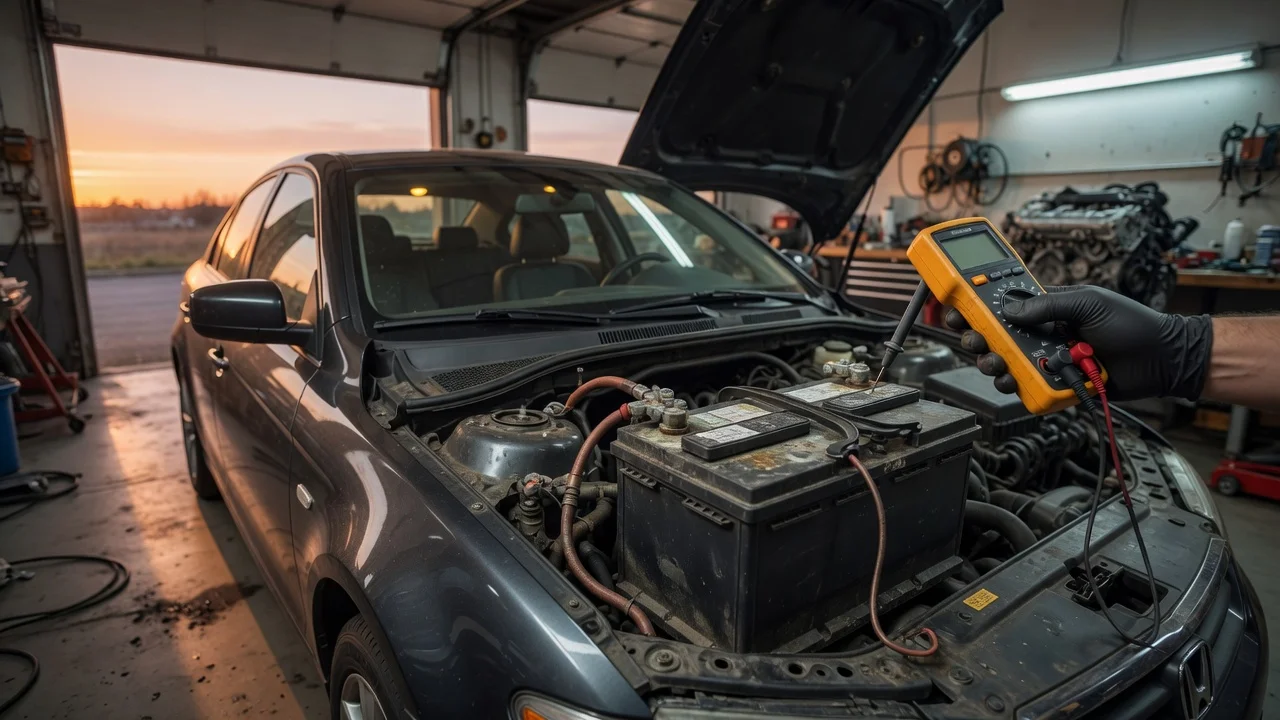
Next, measure voltage with a multimeter, first with the engine off and then with it running. The engine-off reading shows roughly how charged the battery is at rest. The engine-running reading shows whether the charging system is raising the voltage as expected. Target values depend on the battery type and the vehicle, and specific thresholds aren't given here. Compare your readings with the specifications on the battery label, in the owner's manual, or in the multimeter or tester instructions.
A voltage reading alone can't confirm a battery's health. A battery can show acceptable resting voltage and still fail under the heavy demand of starting. A load test or an electronic battery test checks how the battery performs under demand. Many repair shops and parts retailers offer this, and it is the most useful step before deciding to replace the battery. If the battery passes but the car keeps going flat after sitting, ask a technician to test for a parasitic drain.
If a scan tool shows diagnostic trouble codes about voltage, charging or the battery-monitoring system, treat them as leads to investigate, not as proof that a particular part has failed. Low voltage from a weak battery can set codes in unrelated modules, and a charging fault can make a good battery look bad.
Vehicle-specific considerations
Battery requirements differ by vehicle. Some models, particularly those with start-stop systems, use enhanced flooded (EFB) or absorbent glass mat (AGM) batteries rather than conventional flooded batteries. Some vehicles also need a replacement battery registered or coded to the car's battery management system so it charges correctly. Whether this applies depends on the manufacturer, model, model year and equipment. Check the owner's manual or ask a dealer or qualified shop before buying or fitting a replacement. Battery location also varies: it may be under the hood, in the trunk or under a seat.
When to stop and get professional help
The battery case is swollen, cracked or leaking: avoid handling it without protection and have it replaced professionally. You notice a strong sulfur or rotten-egg smell, or hissing, near the battery: this may mean the battery is overheating or overcharging. Don't try to start or charge it, and keep sparks and flames away. The charging warning light stays on while driving, or electrical systems fade: the vehicle may soon lose power, so drive only as far as needed to reach a safe place or a repair shop. The battery keeps going flat after it has passed a load test: a parasitic drain or charging fault needs proper diagnosis. Any warning involving a hybrid or electric vehicle's high-voltage system: do not open or touch high-voltage components, which are typically marked with orange cabling. Contact a qualified technician.
What this guide does not cover
This article doesn't give specific voltage thresholds, expected battery lifespans or model-specific battery specifications, because those vary by battery type, vehicle and climate. For those details, use the battery manufacturer's information, your vehicle's owner's manual or a qualified technician's test results.