Car Battery Voltage Drops While the Engine Is Running

The short answer
With the engine running, the alternator should be charging the battery. Voltage at the battery terminals is normally higher than when the engine is off. If the reading stays at or below the engine-off level, keeps falling the longer the engine runs, or drops sharply when you add electrical load, the most likely cause is a charging-system fault. Check it promptly, because the battery will eventually discharge and the car may stall or fail to restart.
There is one important qualification. Many newer vehicles use smart or variable-voltage charging. On these cars, a lower running voltage can be normal and does not on its own prove a fault.
What readings are usually considered normal
Commonly cited general guidance gives these approximate figures for a conventional 12-volt system:
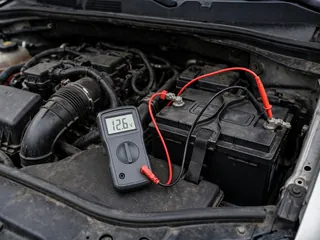
Engine off, fully charged battery that has rested: about 12.6 volts. Engine running on a conventionally regulated system: roughly 13.5 to 14.7 volts at the battery. A running reading near or below the resting level suggests the battery is not being charged.
These are general reference ranges, not specifications for any particular vehicle. The correct values depend on the make, model year, battery type (flooded, EFB or AGM) and charging strategy. The vehicle's service information is the authoritative source. No model-specific specifications were available for this article.
When a lower running voltage can be normal
Some vehicles, especially those with stop-start systems or energy-management software, control the alternator according to battery state of charge, temperature and electrical demand. Once the battery is judged sufficiently charged, the system may lower the charging voltage to cut alternator load and fuel use. A reading that dips into the low 13-volt range or below while cruising can therefore be intended behavior. Such systems often use a battery sensor and may need the battery to be registered with the vehicle after replacement. Whether a given car uses this approach, and which voltages it targets, varies by manufacturer, model and model year.
Brief dips are also normal when a large load switches on, such as the cooling fan, rear window heater or headlights. The voltage should recover within moments as the regulator responds.
When the drop points to a problem
A drop is more likely to mean a fault in these cases:
The voltage falls steadily the longer the engine runs. The running voltage stays at or below the engine-off reading. A battery or charging warning light comes on. Lights dim noticeably, or electrical accessories behave erratically. The engine stalls, or the battery goes flat after driving.
Common causes include:
A failing alternator or voltage regulator. A slipping or worn drive belt. Loose or corroded battery terminals. A poor engine or chassis ground connection. A damaged charging cable or blown fusible link. A battery with an internal fault that cannot hold charge.
On vehicles with smart charging, a faulty battery sensor or an unregistered replacement battery can also cause incorrect charging behavior.
Sensible next step
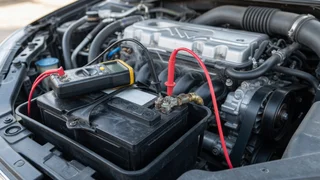
First measure the voltage directly at the battery terminals with a multimeter. Take one reading with the engine off and one with it running, then repeat with headlights, blower and rear window heater switched on. A dashboard voltmeter or a plug-in socket reader can be less accurate. If the running voltage does not rise above the resting level, or falls under load and does not recover, have the charging system tested. Many parts retailers and workshops can test the battery and alternator. If your vehicle has stop-start or smart charging, have the readings judged against that model's specifications rather than the general ranges above.