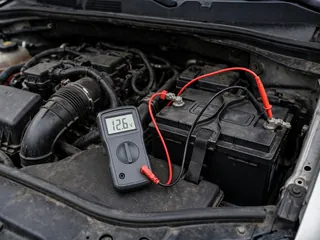
Normal Car Battery Voltage Drop When Starting
A momentary dip in charging-system voltage while cranking is a normal part of how a 12-volt automotive electrical system supplies the heavy current a starter demands. Drivers measuring this with a multimeter or watching a digital gauge often ask how low car battery voltage drop when starting should be before the reading indicates trouble. The key is interpreting the lowest value during the starter engagement alongside the resting voltage before the key is turned and the recovery voltage once the engine fires. Temperature, battery condition, cable resistance, and engine load all change that brief sag.
Essential answer
A healthy fully charged automotive battery typically rests near 12.6 volts with the ignition off, but the reading falls while the starter motor pulls a large surge. Some normal voltage drop when starting is unavoidable because the starter is a high-current load acting through the internal resistance of the battery and the battery terminals and cables. The brief sag may fall into roughly the 9- to 11-volt range during a normal cold crank, though the specific figure depends on engine size, temperature, and battery capacity.
What matters is not only the lowest number but the recovery pattern. A strong battery at the battery terminals should return close to its prior open-circuit voltage after the starter is released and then show charging output from the alternator in the high-13 to mid-14-volt range. A lower floor, a slow recovery, or voltage falling below the range expected for the conditions can point to a weak cell, high resistance in a cable or connection, excessive parasitic draw, or a failing starter drawing too much current. Because voltage drop on car battery when starting can be caused by more than one circuit condition, the reading is a clue rather than a standalone diagnosis.
The difference between a normal sag and a problem often appears in how the voltage behaves across the whole starting event. Before cranking, a settled battery should hold a stable resting voltage. During cranking, a brief drop is expected because starter inrush current may briefly exceed normal steady-state draw. After the engine starts, charging-system voltage should climb above the resting level as the alternator replaces the charge used during the start.
A consistently low before-start reading changes the interpretation of the crank dip. If the battery voltage drop when starting car is accompanied by slow cranking or a clicking sound, the battery may simply lack enough charge or capacity rather than having an unusual starter load. If the resting voltage is normal but the sag is extreme and the cables or terminals are warm, resistance in the high-current path is a likely suspect. The same voltage drop is therefore read alongside the starter sound, cranking speed, and recovery voltage rather than as a single pass-fail number.
Vehicle-specific electrical behavior can shift the expected range, especially in cold weather or with a smaller battery. A manufacturer-dependent body control strategy, stop-start system, or battery monitoring sensor may also affect observed numbers. Because this is informational rather than a service manual value, the normal voltage drop during starting should be treated as a range that confirms the circuit remains within expected behavior.
The practical next step is a before-during-after check at the battery posts, not just one glance at a gauge. A reading that drops only modestly, cranks the engine quickly, and recovers to charging output is generally consistent with a healthy starting circuit. A reading that dips far lower or stays depressed after the engine starts suggests further testing of battery state of charge, terminal condition, and cable connections may be useful before replacing parts.