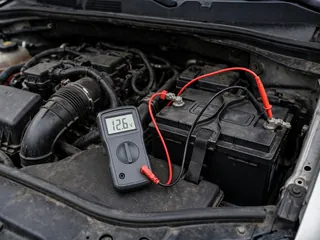
Battery voltage when the engine is running
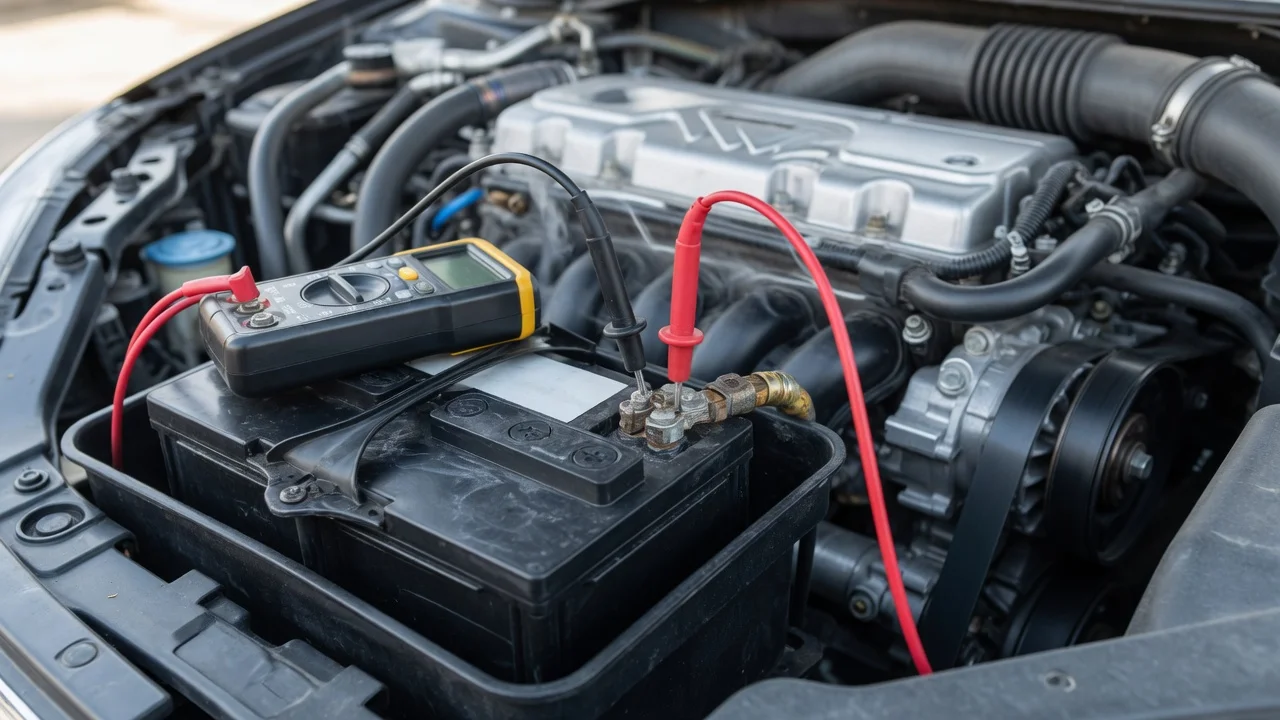
The short answer
In a conventional 12-volt car with the engine running, a reading across the battery terminals of roughly 13.7 to 14.7 volts is commonly cited as normal. The reading is higher than a resting battery because the alternator is supplying current and recharging the battery. The alternator is the engine-driven generator that powers the electrical system while the engine runs. A fully charged 12-volt lead-acid battery at rest, with the engine off, is commonly cited at about 12.6 volts.
These figures are general guidance, not a specification for any particular vehicle. No manufacturer service data was supplied for this article. The exact acceptable range for a given car is set by its maker and can vary by model year, powertrain and charging-system design. The owner's manual or service information for the specific vehicle is the authoritative reference.
Commonly cited reference points
Condition | Commonly cited reading (conventional 12 V system) | What it generally suggests; Engine off, battery rested | About 12.6 V | Battery is near full charge; Engine running | About 13.7 to 14.7 V | Alternator is charging the battery; Engine running, consistently below about 13 V | Below the usual charging range | Possible undercharging, unless the vehicle uses a variable-voltage charging system; Engine running, consistently above about 15 V | Above the usual charging range | Possible overcharging, often linked to a voltage-regulation fault
Qualifications that change the answer
Smart or variable charging systems: Many newer vehicles adjust alternator output to save fuel. They can show running voltages below the conventional range at times, and this may be normal for that design. The vehicle's service information defines what is expected. Hybrids and electric vehicles: These usually have no conventional alternator. The 12-volt battery is charged by a DC-to-DC converter from the high-voltage system, so the typical alternator-based range may not apply. Start-stop vehicles and battery type: Vehicles fitted with AGM (absorbent glass mat) or EFB (enhanced flooded battery) units may use charging strategies matched to that battery, which can affect readings. Operating conditions: Electrical load, engine speed, temperature and how recently the engine was started can all move the reading. A single snapshot is less informative than readings taken under stated conditions. 24-volt systems: Some heavy-duty and commercial vehicles use 24-volt electrics. Their normal running voltage is roughly double the 12-volt figures and should be taken from the manufacturer's data.
What to do with your reading
If your running reading sits within the commonly cited range, the charging system is generally doing its job. If it is consistently low or high, compare it with the specification for your vehicle before drawing conclusions, especially on a newer car with variable charging. Readings that stay outside the specified range are a reason to have the battery, alternator and voltage regulation checked by a qualified technician.
Evidence gaps
This guide does not include vehicle-specific charging specifications, test measurements or manufacturer documentation. The ranges above are widely repeated general reference points for conventional 12-volt systems, not verified figures for any named model, generation or market.