Brake Line Repair: Kits, Methods and Limitations
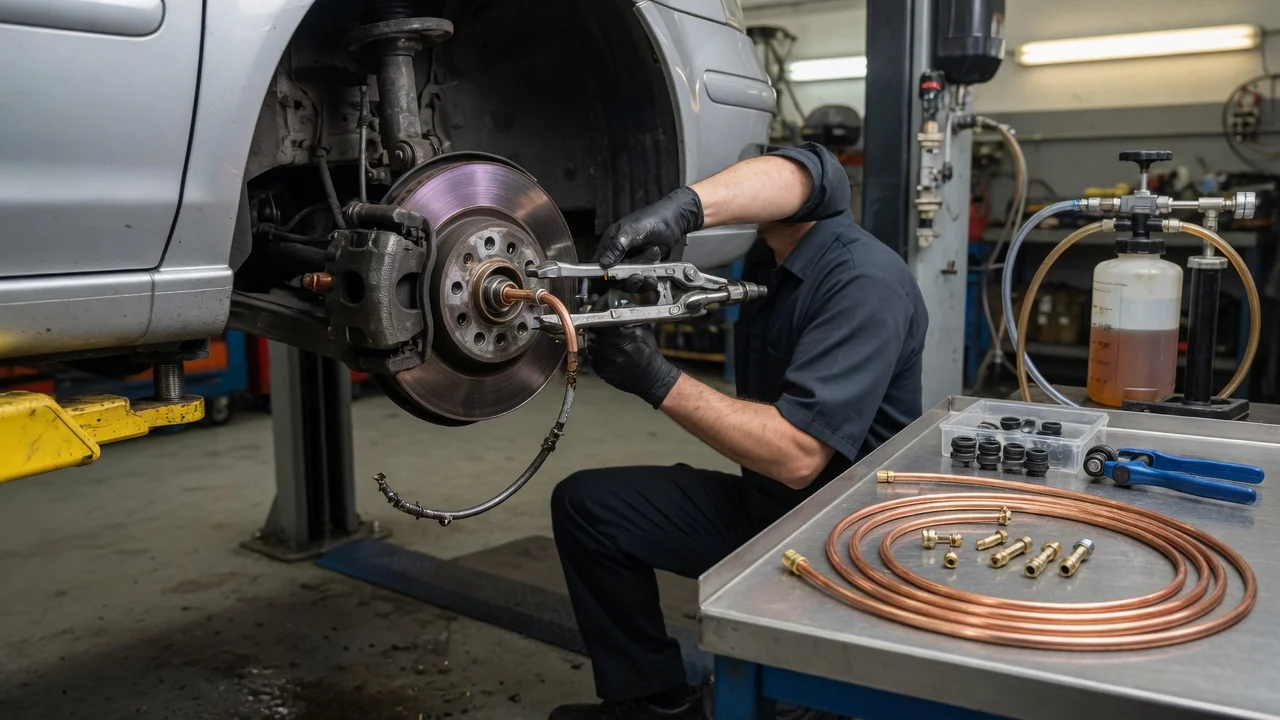
What a brake line repair kit is for
A brake line repair kit is a set of fittings, tubing, or both used to restore a damaged section of hydraulic brake pipe. Typical kits join two cut ends of the original steel or copper-nickel line, or replace a short corroded stretch with a new piece of tubing. The kit’s job is to keep brake fluid sealed at system pressure so pedal force still reaches the calipers or wheel cylinders.
That scope is narrow. A kit addresses a local leak, kink, crush, or rust hole in a rigid metal line. It does not repair a failed flexible hose, a leaking master cylinder, a seized caliper, or a problem in the ABS hydraulic unit. It also does not restore a line whose remaining pipe is already thin, scaled, or cracked along much of its length. In those cases the supported next action is replacement of the affected run, not another splice.
Why the original line fails
Rigid brake tubing is usually low-carbon steel with a corrosion-resistant coating, or copper-nickel (often called CuNi or Cunifer) on some vehicles and aftermarket replacements. Steel lines fail most often where coating is damaged and moisture sits: along chassis rails, above the rear axle, at clips, and near the fuel tank or spare-wheel well. Impact, a jack pad, or a stone can crush or nick a line even when rust is not the cause. Once the wall is perforated, fluid weeps or sprays, the pedal sinks, and stopping distance increases.
A visible wet spot, a rust blister that flakes to bare metal, a flattened section, or a pedal that fades under steady pressure are reasons to inspect the hard lines before driving further. A low-fluid warning or a spongy pedal is a reason to stop using the vehicle until the hydraulic circuit is sealed and bled. Diagnosis of a leaking line is visual and tactile: follow the wet path to the source rather than assuming a kit will fix an unseen hose or caliper leak.
What typical kits contain
Retail and professional kits fall into a few families. Contents vary by brand and intended tubing size, which on passenger cars is commonly 3/16 inch (about 4.75 mm) outside diameter, with 1/4 inch used on some circuits. Using the wrong diameter or thread is a leak path, so the line size and the flare type at each end must match the vehicle.
Compression or mechanical splice fittings that clamp onto the existing pipe without a traditional double flare; Flare-union kits that require cutting the line, forming a flare, and joining with a bubble-flare or inverted-flare union; Pre-flared replacement sections with nuts, plus a union, so a short new piece can be inserted; Copper-nickel or coated-steel tubing coils sold with fittings, intended for fabricating a longer replacement run rather than a tiny patch; Thread adapters and banjo or junction-block hardware, which belong at the hose or master-cylinder end, not in the middle of a straight pipe unless the original layout used a block
Compression-style “no-flare” fittings are marketed for emergency or rusted-line repairs because they avoid flaring brittle old steel. Flare unions remain the method that matches how most original equipment lines are joined. Coil-and-fitting kits are closer to a proper replacement than to a patch.
How a splice is made
The shared sequence is: depressurize and contain fluid, cut out the damaged section with a tubing cutter, square and deburr the ends, join with the chosen fitting or a new pre-flared piece, torque or tighten to the kit’s specification, refill, and bleed the circuit that was opened. Air left in the line leaves a long or fading pedal even if the joint is dry.
For a flare union, each cut end needs a flare that matches the vehicle. Many European cars use a DIN/ISO bubble (convex) flare. Many North American applications use an inverted (double) SAE flare. Mixing flare types, or seating a single flare in a double-flare seat, can leak under heat and pressure. A dedicated flaring tool, the correct die, and tubing that is still ductile enough to form without cracking are required. Old steel that splits when flared is a reason to abandon a short splice and replace more of the run with new tubing.
Compression and similar mechanical fittings typically slide over a clean, round pipe and clamp a ferrule or seal against the outer wall. The pipe must be round, free of deep pits, and cut square. Tightening onto rust scale or an oval crush is a common cause of later seepage. These fittings also add bulk; they must clear suspension travel, heat shields, and chassis members, and they should be supported so the joint is not a lever under vibration.
After any joint, the line must be clipped back to the original path. A sagging or rubbing pipe will fail again. Brake fluid is hygroscopic and damages paint; spilled fluid should be cleaned from the chassis. The system is then bled until the pedal is firm, using the vehicle’s specified sequence, which on ABS-equipped cars may require a scan tool to cycle valves if a conventional pedal bleed does not clear the circuit.
Limitations that change the answer
A kit is a local repair, not a redesign of the brake hydraulic system. Several limits decide whether it is an acceptable next action or a delay before full replacement.
Remaining pipe condition: if rust, pitting, or coating loss continues beyond the cut, another hole is likely. Replacing the whole run from hose to hose, or from the master cylinder or proportioning/ABS block to the hose, is the durable repair. Number and location of joints: each extra fitting is a leak and snag point. A cluster of splices along a frame rail is weaker practice than one new continuous line. Joints in unprotected, high-heat, or high-stone-impact zones are especially poor candidates. Material match: copper-nickel is more corrosion-resistant and easier to flare than aged steel, but it is softer. It must be routed and clipped so it cannot chafe or sag. Do not mix incompatible metals in a way that leaves a steel remnant as the next rust site. Bundled steel and copper-nickel in the same clip can still allow the steel side to fail. Pressure and heat: service-brake pressures are high, and lines near exhaust or turbo plumbing see heat that ages seals and coatings. A fitting rated only for low-pressure fuel or air line work is not a brake fitting. Use hardware specified for hydraulic brake tubing of that size. Flexible hose versus hard line: a cracked, swollen, or internally collapsed rubber hose needs a hose, not a hard-line kit. The junction is usually a flare nut at a bracket; that nut is not a mid-pipe splice. Electronic parking brakes, ESC, and ABS: opening the hydraulics can set faults and may require a bleed procedure the kit instructions do not cover. That does not make the mechanical joint invalid, but it does mean the job is unfinished until the pedal is firm and any required bleed routine is complete. Inspection and legal fitness: some inspection regimes and manufacturer procedures treat a compression splice as temporary or unacceptable, and expect continuous OEM-style flared tubing. Local rules and the vehicle maker’s service information govern what is roadworthy. A kit that seals in the driveway can still fail an inspection. Emergency use: a mechanical splice can restore a leak enough to move a disabled vehicle a short distance after a proper bleed. Treating that joint as permanent without checking remaining line condition, flare type, clip layout, and inspection rules overstates what the kit did.
Choosing a method
Choose by how much good tubing remains, whether the old pipe will still flare, and how the vehicle was originally joined.
Situation Method that fits Main caution; Short rust hole or nick, rest of line sound, steel still round and thick enough Flare union or a short pre-flared insert of the same diameter and flare type Confirm bubble versus inverted flare; do not flare cracked pipe; Line too corroded to flare, isolated damage, need to restore a seal quickly Brake-rated mechanical or compression splice on clean, round pipe May be treated as temporary; extra bulk; remaining rust still a risk; Long run pitted, multiple leaks, or coating gone along a rail Replace the full hard-line section with coated steel or copper-nickel, factory-style flares and clips Measure length and bends; copy the original path and support points; Damage at a hose bracket, union block, or master-cylinder fitting Replace the hose or the end fitting; do not splice mid-hose Hoses are date- and application-specific; thread and banjo size must match; Pedal fade with no wet hard line Do not start with a line kit; inspect hoses, calipers, wheel cylinders, master cylinder, and fluid level A kit will not correct a non-line hydraulic fault
What the kit will not tell you
Kit packaging rarely states the vehicle’s flare standard, original tubing material, or whether a compression joint is accepted in your inspection jurisdiction. Those facts come from the service information for the model year, the markings on existing nuts, and local rules. Torque values, bleed sequences, and ABS service bleed steps are also vehicle-specific; a generic kit cannot supply them.
There is no single supported mileage or year after which every line must be replaced. Corrosion depends on climate, road salt, underbody coatings, and whether lines were already renewed. The practical check is the pipe in front of you: wall thickness, coating, wetness, and whether a cutter leaves a clean, unpitted ring. If that evidence is ambiguous, treating the line as failed and replacing the run is the conservative choice because a hidden pit can open after the first heat cycle.
A supported next step
If the leak is a single defect in otherwise sound hard line, a brake-rated kit of the correct diameter and flare type can restore the circuit after a correct cut, join, clip, fill, and bleed. If the pipe is widely corroded, will not flare, sits in a high-risk location, or the leak is not in the rigid line at all, skip the patch and replace the affected line or hose, or have the hydraulic system diagnosed. Do not drive with a soft pedal, a visible spray of fluid, or a warning that braking is impaired. A sealed, firm pedal and a line that is fully supported along its original path are the tests that the repair is complete.