BMW 1 Series Differential Oil Capacity: How to Find the Right Fill Quantity
There is no single differential oil capacity for the BMW 1 Series. The correct fill quantity depends on the generation, whether the car is rear-wheel drive, front-wheel drive or xDrive all-wheel drive, and which final drive unit was fitted at the factory. The most dependable answer is the quantity listed for your exact vehicle, identified by VIN, in BMW service information or from a BMW dealer. In practice, the fill level matters more than the quoted volume. BMW rear differentials are normally filled until oil reaches the lower edge of the fill plug opening, so a published capacity is mainly useful for knowing roughly how much oil to buy.
Why the Capacity Varies Between 1 Series Models
The 1 Series name covers very different layouts. The earlier generations are rear-wheel drive with a separate rear differential, also called the rear final drive, that has its own oil. The current generation is built on a front-wheel-drive platform. On front-drive versions, the differential sits inside the transmission housing, which forms a combined unit called a transaxle. On xDrive versions there can be more than one gear unit with its own oil supply. Different housings, gear sizes and ratios can also mean different fill quantities, even within one generation.
Which 1 Series Do You Have?
Generation | Body styles | Drivetrain | Where the final drive oil is; E81 / E82 / E87 / E88 (roughly 2004–2013) | Hatchback, coupe, convertible | Rear-wheel drive; some coupes offered with xDrive in certain markets | Separate rear differential with its own oil; xDrive cars also have a transfer case and front differential; F20 / F21 (roughly 2011–2019) | Five-door and three-door hatchback | Rear-wheel drive; xDrive on some versions | Separate rear differential; xDrive adds a transfer case and front final drive; F40 (2019 onward) | Five-door hatchback | Front-wheel drive; xDrive on some versions | Front final drive is part of the transaxle; xDrive models add a power take-off unit and a rear final drive
US buyers should note the market history. In the United States, the 1 Series was sold only as the 128i and 135i coupe and convertible (E82 and E88), and the related 1M Coupe, during the late 2000s and early 2010s. These are rear-wheel-drive cars with a conventional rear differential. The F20, F21 and F40 hatchbacks were not sold new in the US. If you are working on a US-market 1 Series, it is almost certainly an E82 or E88.
How to Identify Your Differential
Before you look up a fill quantity, confirm exactly which unit is fitted. Cars with the same badge can have different final drives depending on engine, transmission and options.
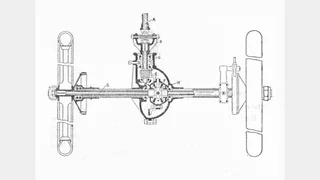
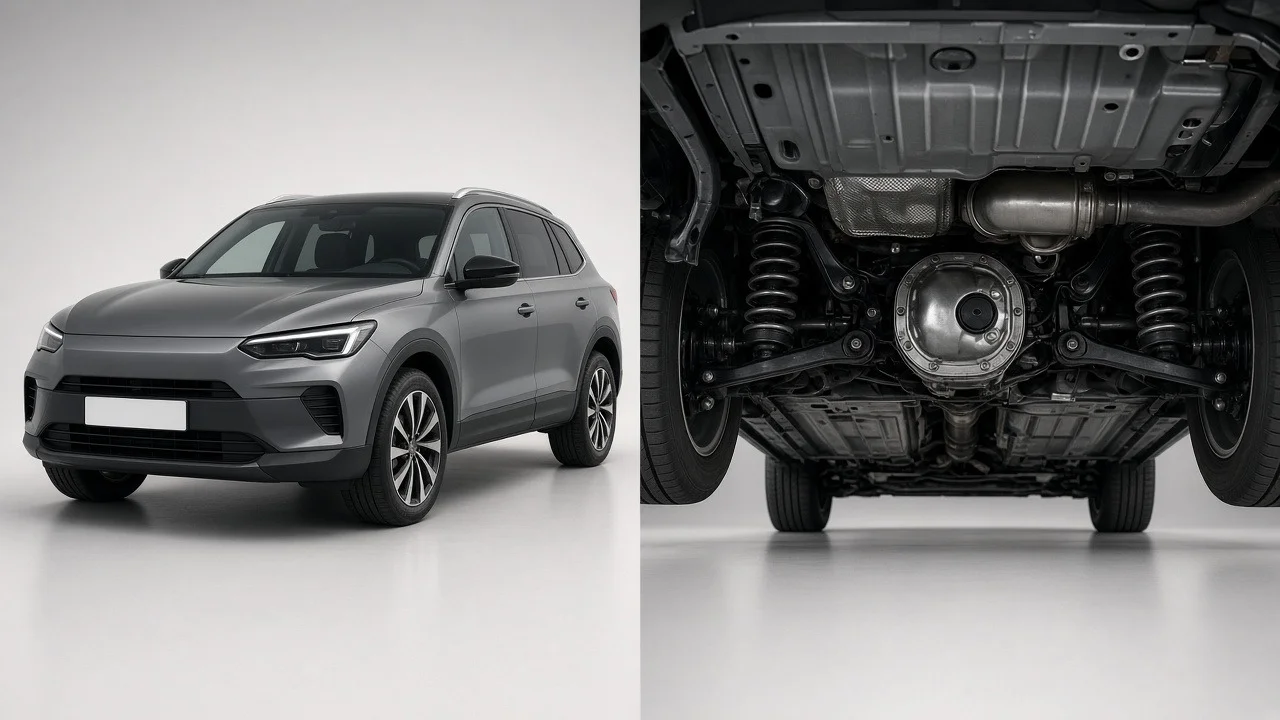
VIN lookup: a BMW dealer or a VIN-based parts catalog can show the factory final drive part number and ratio for your car. This is the most reliable way to identify the equipment. Housing label or tag: BMW rear differentials usually carry a sticker or stamped marking on the housing showing the ratio and part information. It is often covered in road grime and may need cleaning before you can read it. Location: on rear-wheel-drive 1 Series models, the rear differential is the cast unit between the rear wheels, where the driveshaft meets the two rear axle shafts. It has a fill plug on the side or rear cover and a drain plug lower down. Performance variants: high-output models and the 1M Coupe may use a different or larger differential, and limited-slip units can have their own lubricant requirements. Front-drive F40: there is no separate front differential fill. The final drive shares the transmission's housing, so its service follows the transmission procedure for that gearbox.
Fill Quantity vs. Fill Level
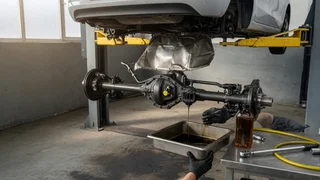
A capacity figure tells you roughly how much oil the unit holds after a full drain. The actual service is done by level. On BMW rear differentials, the usual method is to remove the fill plug first, then drain, then refill until oil just begins to run out of the fill opening with the car level. Removing the fill plug before the drain plug matters: if the fill plug is seized, you have not emptied a unit you cannot refill.
Several things affect how much oil goes back in. The car must be level, ideally on a lift or on four stands at equal height, because a tilted car gives a false reading. Oil clinging inside the housing means a drain-and-fill rarely uses the full published capacity. Buy a little more than the listed quantity so you are not caught short.
Lubricant Specification and Manufacturer Approval
Using the right oil matters as much as the quantity. BMW differentials typically use a hypoid gear oil, a type of gear lubricant designed for the sliding, high-pressure contact of hypoid gear sets. BMW specifies particular approved fluids for its final drives, and the correct one can differ between standard and limited-slip units and between generations. Look for oil that explicitly states BMW approval for your differential type, or use the BMW-branded fluid listed for your VIN. A generic gear oil with the right viscosity grade is not necessarily equivalent, especially in limited-slip differentials, which can need friction modifiers to work smoothly.
For xDrive models, the transfer case, front final drive or power take-off unit may each need a different fluid from the rear differential. Check the requirement for each unit separately rather than assuming one oil fits all.
Level Check and Service Interval
BMW has often described final drive oil as long-life or lifetime fill. That means the official maintenance schedule may not include a fixed change interval. Many owners and independent specialists still choose to change the oil, particularly on higher-mileage cars, cars that are driven hard or used on track, or when buying a used car with no service history. Whether to do this is an ownership judgment, not a documented BMW requirement.
A level check is simple on rear-wheel-drive cars. With the car level, remove the fill plug. If oil reaches the bottom of the opening, or seeps out slightly, the level is correct. Also look for signs that point to a leak: wet residue around the pinion seal at the front of the differential or the axle output seals at the sides, a whining or howling noise that changes with road speed, or clunking when you engage drive. Any of these is worth investigating before simply topping up.
Practical Next Steps
Confirm the generation, body style and drivetrain of your 1 Series, and remember that US-market cars are E82 or E88 coupes and convertibles. Identify the exact differential by VIN or by the housing label, and note whether it is a limited-slip unit. Get the fill quantity and approved lubricant for that unit from BMW service information or a dealer parts department. Buy the approved oil plus a small margin, new sealing washers or plugs if they are single-use, and the correct tools for the plugs. With the car level, remove the fill plug first, then drain, refill to the lower edge of the fill opening and tighten the plugs to the specified torque. On xDrive models, treat each gear unit as a separate job with its own fluid and level procedure.
In short, the right differential oil capacity for a BMW 1 Series comes from correctly identifying your car and its final drive. Once you know the unit, the approved lubricant and the fill-to-the-plug method matter more than the exact number.