API GL-5 SAE 90 Hypoid Gear Oil: When It Is the Right Choice
The short answer
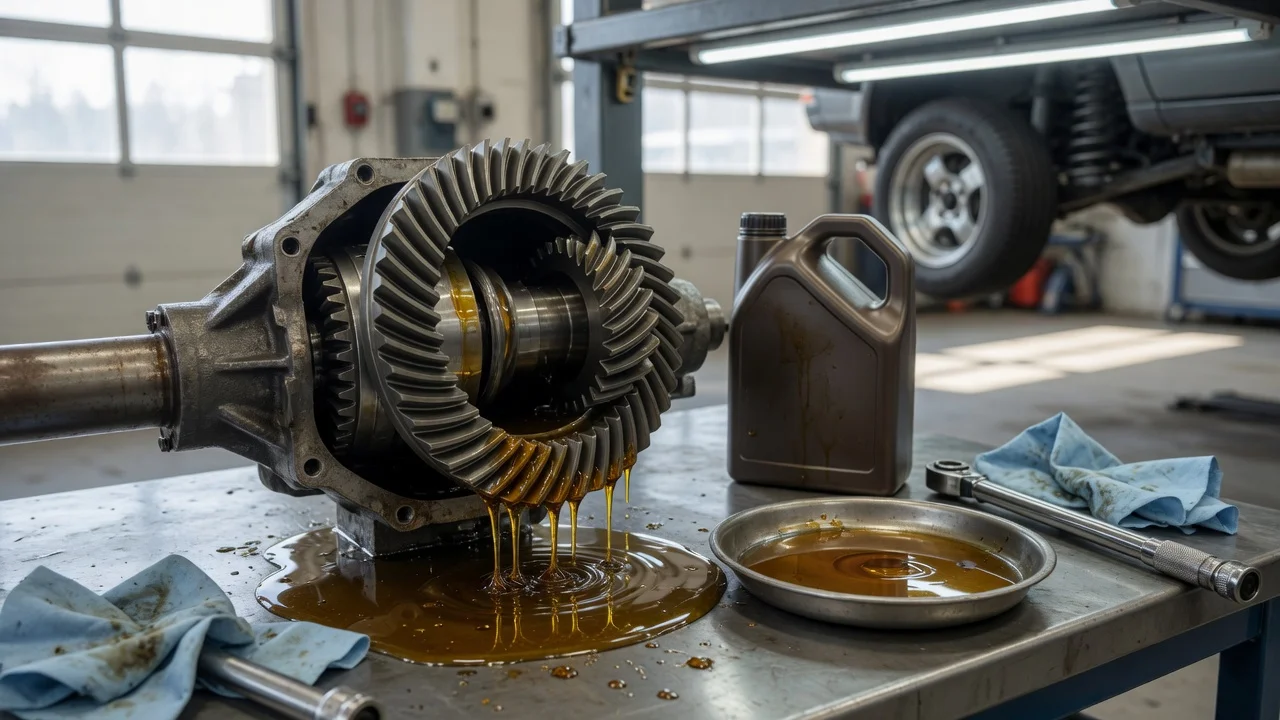
An API GL-5 SAE 90 hypoid gear oil is a heavy-duty gear lubricant made mainly for hypoid differentials and axles, such as the rear axle of many rear-wheel-drive cars, trucks and four-wheel-drive vehicles. It is a suitable choice when your owner's manual or service information calls for API GL-5 and SAE 90 viscosity, or lists it as an acceptable option for your climate. Three conditions can change that answer: the unit specifies GL-4 instead of GL-5, the differential has a limited-slip design that needs friction modifier, or the vehicle operates in cold conditions where a multigrade such as 80W-90 is specified instead.
What the label means
API GL-5: an American Petroleum Institute service category for gear lubricants intended for hypoid gears under severe conditions, including high-speed shock loads and low-speed, high-torque operation. These oils carry a high level of extreme-pressure (EP) additives. SAE 90: a viscosity grade defined by the SAE J306 gear oil standard, based on how thick the oil is at operating temperature. A single number with no "W" means it is a monograde with no low-temperature rating. Hypoid gear: a type of spiral bevel gear set where the pinion sits offset from the centre of the ring gear. The offset creates heavy sliding pressure between gear teeth, which is why these gears need EP protection.
Conditions that change the answer
Manual transmissions that call for GL-4
Do not assume GL-5 is an upgrade over GL-4. In some manual gearboxes, the EP additives used in GL-5 oils can attack brass or bronze synchronizer parts or change shift feel. If the manual specifies GL-4 only, use a GL-4 oil or a product the oil maker explicitly states meets both GL-4 and GL-5. Check the exact product data sheet rather than relying on the front label alone.
Limited-slip differentials
Many clutch-type limited-slip differentials need a friction modifier to prevent chatter or shudder in turns. Some GL-5 oils are formulated for limited-slip use and say so on the label; others are not and may need a separate additive. Follow the vehicle maker's instruction for your specific axle, because requirements differ between designs.
Climate and viscosity
Because SAE 90 has no winter rating, it flows less readily when cold than an 80W-90 or 75W-90. Some manufacturers allow straight 90 only above a certain ambient temperature range and specify a multigrade for colder use. Use the temperature chart in your owner's manual if one is provided.
Units that need a different fluid altogether
Gear oil is not a substitute for automatic transmission fluid. Some transaxles, transfer cases and manual gearboxes are filled with ATF, engine oil or a dedicated manufacturer fluid. If the specification is not a gear oil, do not use GL-5 SAE 90 in that unit.
How to confirm it fits your vehicle
Find the fluid specification for the exact component (front axle, rear axle, transfer case or gearbox), as one vehicle can use different gear oils in different units. Match the model year, market, trim and powertrain, since specifications can change between production years and regions. Check whether the unit has a limited-slip differential, which may be noted on a tag on the axle housing or in vehicle build information. Compare the oil's product data sheet against the required API category, viscosity grade and any manufacturer approval number. If the manual lists a manufacturer-specific approval, confirm the oil carries that approval rather than only the generic API GL-5 rating.
Information not covered here
No vehicle-specific data, product test results, prices or availability details were supplied for this article, so it cannot confirm which models use GL-5 SAE 90, recommend particular brands or state fill capacities and change intervals. Those details should come from the owner's manual, factory service information or the oil maker's published specifications for the product you are considering.