What Is API GL-5 Gear Oil?
API GL-5 is a performance classification for gear oil set by the American Petroleum Institute (API). The "GL" stands for "gear lubricant." A gear oil labeled GL-5 is formulated for hypoid gears and other gear sets that see severe loads, high sliding pressure and shock. It is one of the most common ratings on bottles of differential and axle oil sold in the US.
What the GL-5 Rating Means
The API gear lubricant categories describe the kind of service an oil is designed to handle, not how thick it is. GL-5 sits at the heavy-duty end of the commonly used categories. It indicates the oil carries a high level of extreme-pressure (EP) additives so it can protect gear teeth where metal surfaces press and slide against each other under great force.
In practical terms, GL-5 tells you the oil is intended for demanding gear applications, most often the rear differential on rear-wheel-drive and four-wheel-drive vehicles, front and rear axles on trucks and SUVs, and some transfer cases and final drives. Whether it is the right oil for a specific component depends on what the vehicle manufacturer specifies for that component.
How GL-5 Gear Oil Works
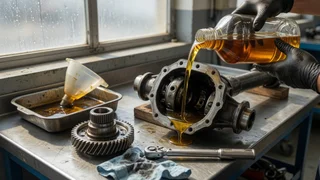
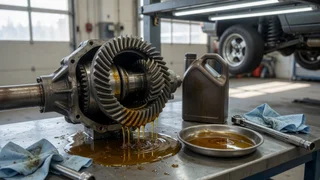
Many differentials use hypoid gears, in which the pinion gear meets the ring gear below its centerline. This design allows a lower driveshaft and quieter operation, but it also makes the gear teeth slide across each other rather than simply roll. That sliding, combined with heavy torque, creates very high pressure at the contact points.
Under those conditions, ordinary oil film can be squeezed out, allowing metal-to-metal contact that leads to scuffing, pitting and wear. The EP additives in GL-5 oil, typically sulfur and phosphorus compounds, react with the metal surfaces when heat and pressure spike. They form a protective layer that helps prevent the gear teeth from welding or tearing at the contact points.
For an owner, this protection affects gear life, noise and reliability. A differential running on oil that cannot handle its loads may develop whining, wear faster or fail under towing, hauling or hard acceleration.
GL-5 vs. GL-4: The Key Difference
GL-4 is the category most often compared with GL-5. Both are gear lubricants, but they are built for different jobs, and they are not automatically interchangeable.
Criterion | API GL-4 | API GL-5; Intended service | Moderate loads and speeds | Severe loads, shock and high sliding pressure; Typical applications | Many manual transmissions and transaxles, some spiral-bevel gear sets | Hypoid differentials and axles, many truck and SUV final drives; Extreme-pressure additive level | Moderate | High; Compatibility with brass or bronze synchronizers | Generally designed with these parts in mind | Some formulations may be too chemically active for these parts; Can it replace the other? | Not suitable where GL-5 is specified | Use where GL-4 is specified only if the manufacturer or oil maker approves it
The main concern with using GL-5 in place of GL-4 involves "yellow metals" such as brass and bronze, which are often used in manual transmission synchronizers. The same additives that protect hypoid gears can, in some formulations, be harsh on these softer metals or change how synchronizers grip, which may affect shift feel and component life. Some gear oils are labeled as meeting both GL-4 and GL-5, and some manufacturers allow GL-5 in certain transmissions, so the label and the vehicle specification should be checked together.
Going the other way, putting GL-4 oil in a differential that calls for GL-5, risks inadequate protection for heavily loaded hypoid gears.
GL-5 Is Not a Viscosity Grade
The API GL rating and the viscosity grade are separate pieces of information. Viscosity, meaning how thick the oil is at low and high temperatures, is shown by an SAE gear oil grade such as 75W-90 or 80W-140. A bottle might be labeled "SAE 75W-90, API GL-5," which tells you both its thickness and its service category.
Gear oil viscosity grades follow a different scale from engine oil grades, so a gear oil number cannot be compared directly to an engine oil number. Choosing the correct gear oil means matching both the viscosity grade and the API category that the manufacturer specifies.
Limited-Slip Differentials and GL-5
Some differentials are limited-slip designs that use clutch packs to send power to the wheel with more traction. These often need a friction modifier so the clutches engage smoothly. Some GL-5 oils already contain one and are marked for limited-slip use, while others require a separate additive. Using oil without the right friction properties in a clutch-type limited-slip unit can cause chatter or groaning in tight turns. The owner's manual or service information will indicate whether a limited-slip formulation or additive is required.
Other Related Ratings You May See
API GL-1 through GL-6: The full family of API gear lubricant categories; several of these are rarely used or no longer active, and GL-4 and GL-5 are the ones most drivers encounter. API MT-1: A separate API category for non-synchronized manual transmissions, mainly in heavy-duty trucks and buses. SAE J2360: An industry standard that builds on GL-5 performance with additional testing and a qualification process; oils meeting it are often marketed for commercial and fleet use. LS or limited-slip: A label indicating the oil is formulated for limited-slip differentials.
How to Know Whether Your Vehicle Needs GL-5
Different components on the same vehicle can call for different fluids. A truck might need GL-5 in its axles, a specific automatic transmission fluid in its transmission and yet another fluid in its transfer case. The owner's manual, service information or a dealer parts department can confirm which category and viscosity grade apply to each component on your make, model, year and drivetrain.
Check the owner's manual fluid chart for each gear housing, not just the engine oil section. Match both the API category and the SAE viscosity grade. Note whether the differential is limited-slip and whether a friction modifier is required. Do not substitute GL-5 for GL-4 in a manual transmission unless the manufacturer or the oil maker explicitly allows it. Keep gear oil separate from automatic transmission fluid and engine oil; they are different products.
The Bottom Line
API GL-5 gear oil is a heavy-duty gear lubricant designed to protect hypoid gears and similar gear sets under high pressure and shock loads, which is why it is widely used in differentials and axles. The rating describes protection level, not thickness, and it is not a universal replacement for GL-4. The right choice is the one that matches the vehicle manufacturer's specification for each specific component.