7.3 Powerstroke Glow Plug Relay: How to Choose the Right Replacement
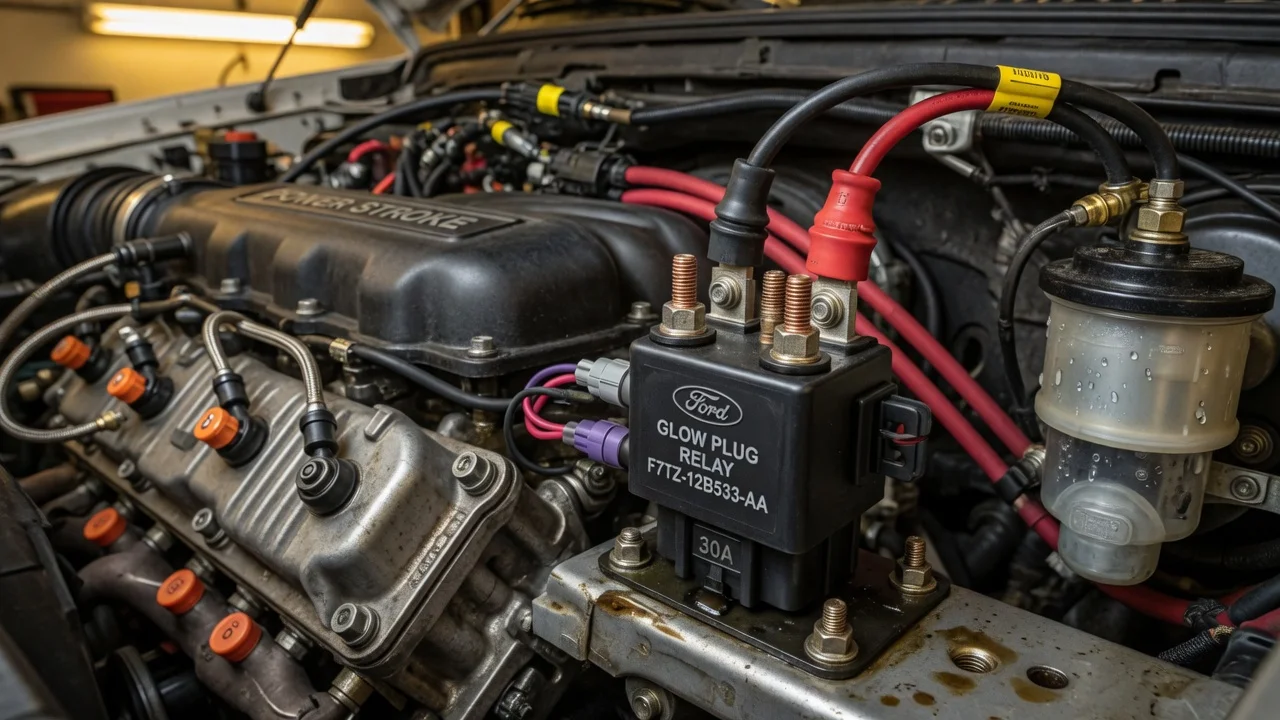
On a 7.3L Powerstroke, the glow plug relay switches heavy battery current to all eight glow plugs so the engine can fire on cold mornings. When it sticks, clicks without passing power, or never engages, cold starts drag on and white smoke lingers. Choosing a replacement looks simple, but the right part depends on model year, chassis, and whether your truck uses a relay at all. This guide covers fitment, features and ownership costs before you spend money.
Define the job the product must do
The relay is a high-current switch. The powertrain control module decides how long the glow plugs should heat, mainly from engine oil temperature, and grounds the relay's control circuit for that period. The relay then connects battery power to the glow plug feed. The wait-to-start lamp is timed separately by the computer, so a lamp that turns on and off normally does not prove the plugs actually received power. Your replacement needs to handle that current reliably, release cleanly when the control signal ends, and survive heat and moisture on top of the engine.
Before buying, confirm the relay is the real problem. Hard starting on a 7.3 diesel has several causes that a relay cannot touch: low fuel pressure from a weak fuel pump, a restricted fuel filter, worn injector O-rings, or a leak in the high-pressure oil system that fires the HEUI injectors. Fuel and high-pressure oil circuits should be diagnosed with gauges and the service procedure, not by cracking lines on a running or recently run engine. Also consider how you use the truck: a daily driver in a cold climate without a block heater depends on the glow system far more than a truck kept in a mild region or plugged in overnight.
Check compatibility
Model year is the first filter. OBS F-Series pickups from 1994.5 through 1997, including the common 1996 and 97 7.3 trucks, use a glow plug relay, typically mounted on the driver-side valve cover on pickups. Super Duty trucks such as the 1999 and 2000 F-250 and F-350, along with early 2001 builds, also use a relay. Partway through the 2001 model year Ford moved to a glow plug control module, so most 2001 late-build and 2002 to 2003 trucks need that module instead of a simple relay. If you searched for a 2002 7.3 glow plug relay, the part you need is most likely the module, which is not a direct swap. E-Series vans and the Excursion follow their own timelines, so check the build date on the door label and look at what is physically installed before ordering.
Next, match the interfaces. Compare the battery feed stud, the output stud to the glow plug harness, and the small control terminal or terminals against your original, including stud size and orientation. Check the mounting bracket and whether the relay grounds through its mount or through a separate wire. On 1999 and later Super Duty trucks, do not confuse the glow plug relay with the intake air heater relays, which serve a different circuit. Engine configuration is the same V8 across these years, but the harness routing and connectors differ between OBS and Super Duty, so a part listed only as fitting a 7.3 is not enough.
Features that affect the choice
Most options fall into OE-style replacements and aftermarket units marketed as heavy duty. The label itself is not evidence. Look for a published current rating and duty cycle, sealed construction that keeps water away from the contacts, solid terminal studs that will not spin when torqued, and included boots, nuts and hardware. A clear warranty and return policy matters because a relay that sticks closed can keep the glow plugs energized far longer than intended and shorten their life. If a seller cannot state how the unit is rated, treat performance claims cautiously.
Some owners replace computer control with a manual switch or an aftermarket timer. These setups can be useful on a truck with a confirmed control-side fault, but they move the timing decision to the driver or a fixed timer that ignores oil temperature. Leaving the plugs on too long can damage them and the harness. For most owners, a correctly specified relay controlled by the factory computer is the safer and simpler choice.
Limitations and ownership costs
A new relay cannot fix burned-out glow plugs, a damaged under-valve-cover harness, corroded feed cables, a failing control circuit from the computer, or weak batteries. Test before you buy: with a cold engine and the key on, listen for the click, then check for battery voltage at the output stud while the relay is energized. If the relay switches correctly, measure each glow plug's resistance against the service manual specification and inspect the harness connectors. The 7.3 uses two batteries, so disconnect both before working on the relay terminals, since the feed stud is live at all times.
The relay has no consumables, but plan for related costs. Glow plugs wear over time, the under-valve-cover harness connectors can fail from heat, and valve cover gaskets may need attention if you open the covers to replace plugs. Keep terminals clean and tight, refit protective boots, and check for chafed wiring near the mount. A loose output nut can create heat and voltage drop that mimic a failing relay.
Build a practical shortlist
Start by confirming whether your truck uses a relay or a control module, using build date and a visual check rather than model year alone. Then narrow candidates to parts listed for your exact chassis, whether that is an OBS pickup, a 2000 F350 or F250 Super Duty, an Excursion or a van. Compare terminal layout, stud sizes and mounting against the original, and favor units with a stated current rating and duty cycle over vague heavy-duty claims.
Before ordering, check that hardware and boots are included, that the warranty covers a relay sticking closed, and that returns are practical. Finally, make sure the diagnosis is complete: verified voltage at the relay output, glow plug resistance within specification, a sound harness, healthy batteries, and a fuel system with adequate fuel pressure and a clean fuel filter. If every item checks out except the relay, the replacement should restore reliable cold starts.