5.9 Cummins Wastegate Actuator: Identification and Checks
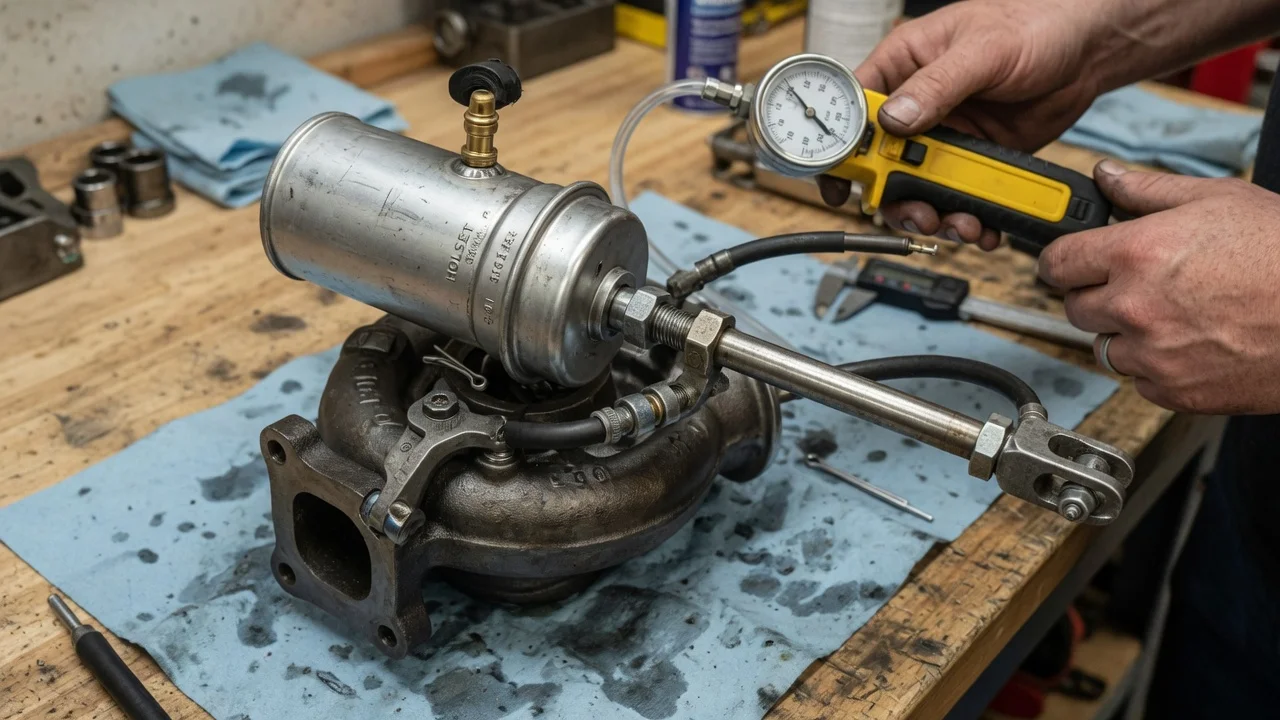
The wastegate actuator on a 5.9 Cummins decides when exhaust gas starts bypassing the turbine, so it directly limits how much boost the turbocharger makes. When it sticks, leaks or is misadjusted, the truck can overboost, feel flat or surge under load. Before buying a replacement, confirm that the turbo on your truck is actually wastegated, then work through symptoms, causes and checks in order. Turbo hardware differs across model years and configurations, so rely on service information for your exact vehicle.
Establish the symptoms
Start by confirming what you are looking at. On a wastegated 5.9 Cummins turbo, the actuator is normally a round canister mounted on a bracket next to the compressor housing. A small hose runs to it from the boost side of the turbo, and a rod leaves the canister and connects to a lever on the turbine housing. That lever moves the internal wastegate valve. Not every 5.9 Cummins configuration used a wastegated turbocharger, so if there is no canister and rod, the actuator is not part of your problem. The identification tag on the turbo housing and your vehicle configuration tell you which unit is fitted.
Then write down when the problem appears rather than relying on memory. Note whether it happens cold or hot, at light throttle or under heavy load, while towing, or at altitude. If you have a boost gauge or scan tool, record the boost reading at the moment of the complaint, plus any stored fault codes. Also note smoke color, high exhaust gas temperature readings, hissing, whistling or a rattle near the turbo. Finally, list recent changes: tuning, a different turbo, intercooler or boot work, a replaced actuator hose, or any adjustment to the actuator rod. Recent work is often the most useful clue in the service history.
Distinguish plausible causes
An overboost pattern, where boost climbs higher than normal under load, points toward a wastegate that is not opening. Possible reasons include a torn actuator diaphragm that can no longer push the rod, a disconnected, cracked or blocked signal hose, a wastegate valve or pivot seized with carbon, or an actuator that has been modified or shimmed to raise boost. If overboost started right after tuning or actuator adjustment, the modification is the leading suspect rather than a failed part.
Low boost with sluggish acceleration points the other way: a wastegate held partly open, a rod adjusted too short, a weakened actuator, or a valve that does not seat. However, low boost is far more often caused by something other than the actuator. A split intercooler boot, loose clamp, leaking intake horn or cracked intercooler lets boost escape and produces the same complaint. Fuel delivery problems, a restricted air filter, exhaust restrictions and a faulty boost or MAP sensor reading can also mimic a wastegate fault. A worn turbo with shaft play, oil leakage or contact damage on the wheels is another candidate.
A rattle near the turbo at idle or light load can come from a worn wastegate pivot or loose linkage, but heat shields, exhaust clamps and manifold hardware rattle too. Treat the noise as a lead to inspect, not proof that the actuator itself has failed.
Checks in a useful order
Begin with safe observations, engine off and the turbo completely cool. Inspect the actuator hose along its full length for cracks, softness, oil saturation, kinks or a loose fit at either end. Confirm the rod clip or retaining hardware is present and that the bracket is not cracked or bent. Look for signs of tampering, such as added washers, a modified rod or a boost controller spliced into the hose. Check the intercooler boots, clamps and intake piping for oil film, splits or movement, because oily residue often marks a boost leak. Never reach near the turbo with the engine running.
The next checks need tools. With a hand pressure pump connected to the actuator port, you can see whether the rod moves smoothly as pressure is applied and whether the canister holds pressure without bleeding down. The pressure at which the rod should start moving, and how far it should travel, must come from manufacturer specifications for your turbo, not from a forum figure. With the rod disconnected, you can check whether the wastegate lever moves freely through its range. A boost gauge or scan tool log during a controlled road test shows actual boost against the expected value, and a smoke test of the intake side is the reliable way to find boost leaks.
Leave rod length adjustment, internal wastegate inspection and turbo removal to a qualified technician unless you have the service procedure and specifications. A small change in actuator setting changes maximum boost, and incorrect settings can stress the turbo and engine.
Interpret the findings
If the rod moves smoothly under pump pressure and the canister holds pressure, the diaphragm is likely sound, and the cause of the complaint probably lies elsewhere: hose, linkage, valve, boost leak or fuel system. If the canister will not hold pressure, the diaphragm is leaking and the actuator is a strong candidate. If the actuator holds pressure but the rod does not move, check whether the wastegate lever is seized, because replacing the actuator will not free a stuck valve or pivot in the turbine housing.
A road test reading still needs context. Boost that matches specification while the truck feels weak shifts attention to fuel delivery, sensors or exhaust restriction. Overboost with a healthy actuator and free lever usually means a blocked or misrouted signal hose, a modification, or an incorrect rod setting. Low boost with a passing smoke test and correct actuator behavior makes turbo condition the next item to check. Before replacing parts, make sure the finding explains the original symptom under the same operating conditions in which it was recorded, and that any fault codes are consistent with it.
Urgency and next action
Stop heavy use if boost is clearly above normal, exhaust gas temperatures climb unusually high, the turbo starts howling or grinding, or you see blue smoke or oil leaking from the turbo area. Overboost and excessive heat can damage the turbo and engine quickly, and towing or climbing grades makes it worse. Low boost alone is less immediately dangerous, but black smoke and high temperatures under load still call for reduced use until the cause is found. No checklist can promise how far the truck can safely be driven with an unresolved fault.
For the repair visit, bring the model year, engine and transmission details, the turbo identification tag information, a list of modifications and recent service history, your recorded boost readings and conditions, and any stored codes. That information lets a technician compare results against the correct specifications and decide whether the actuator, the wastegate valve, a boost leak or another system needs attention, instead of replacing the actuator on suspicion. If the actuator is replaced, its setting should be verified against the service information before the truck returns to normal work.