1310 to 1350 Conversion U-Joints: Checking Compatibility
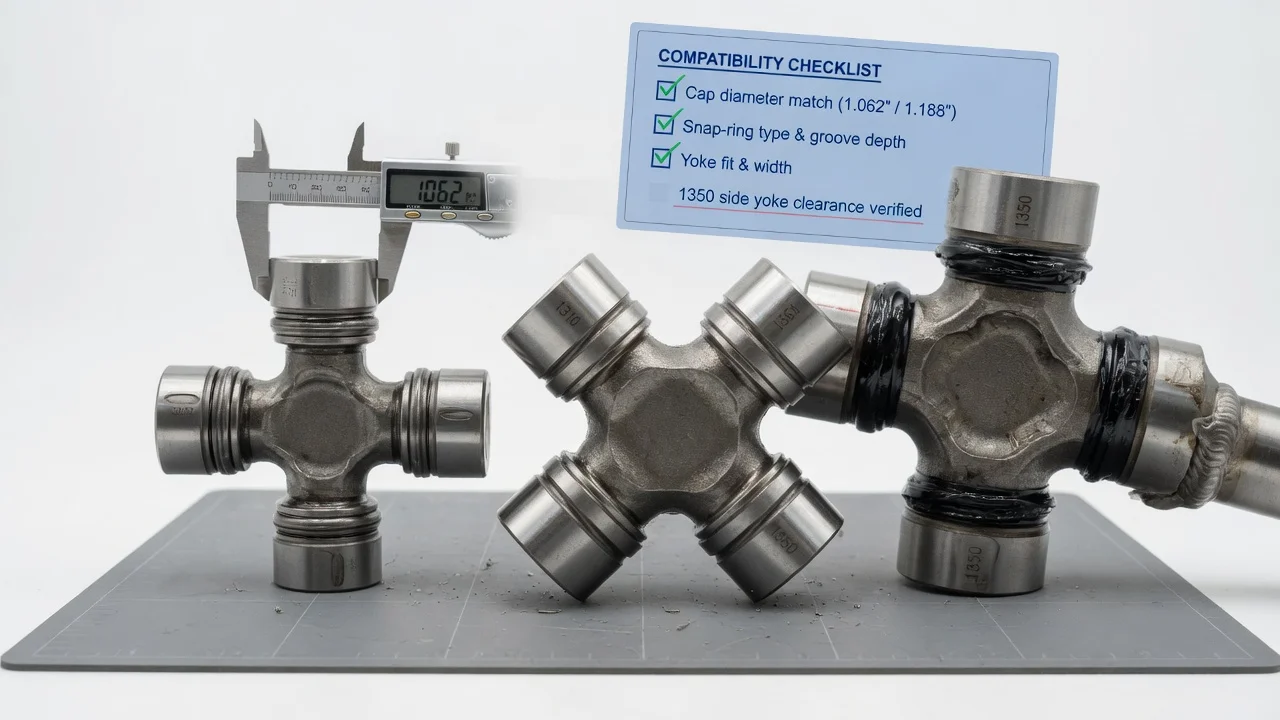
A 1310 to 1350 conversion U-joint connects two different Spicer-style series in one cross: one pair of bearing caps fits a 1310 yoke and the other pair fits a 1350 yoke. Owners usually meet this part after installing a stronger 1350 driveshaft that still has to bolt to a 1310 yoke on the transmission, transfer case or axle. Before blaming the joint or ordering another one, confirm what each yoke actually accepts, how the caps are retained and what changed on the vehicle.
Establish the symptoms
Start by writing down exactly when the problem appears. Note whether it happens on takeoff, when shifting between drive and reverse, at a particular road speed, under load such as towing or climbing, or while coasting. A complaint that started the day a conversion joint was installed points in a different direction than one that crept in after months of normal use, so record the date of the last driveline work alongside the symptom.
Then list the associated signs. Useful observations include a single clunk when the driveline takes up slack, a chirp or squeak that rises with vehicle speed, vibration felt through the floor or seat, rust-colored dust or flung grease around the bearing caps, and a cap that looks shifted in its yoke. Add every recent change from the service history: a new or shortened driveshaft, a yoke swap, a lift kit, a transfer case or axle change, or a joint replaced by someone else. These details decide which checks matter first.
Distinguish plausible causes
The first candidate is a dimensional mismatch. Each series has its own bearing cap diameter and cap-to-cap span, and a conversion joint must match both yokes at once. Caps that are too small can rattle in the bore, while caps that are too large will not enter it. A wrong span stops snap rings from seating or makes the joint bind. Evidence for this cause is strong when trouble started immediately after installation, when clips were difficult to fit, or when the joint feels notchy when rotated by hand. It is weakened if the same joint ran quietly for a long period before symptoms began.
A second candidate is a retention-style mismatch. The series can be correct while the joint is wrong for the yoke design, for example inside snap rings versus outside snap rings, or a strap or U-bolt pinion yoke that needs caps without clip grooves on that side. Look at how the old joint was held in place and compare it with the replacement before assuming the series is at fault.
Third, the joint may be compatible but the symptom comes from elsewhere: a worn joint, worn or oval yoke bores, bent yoke ears, an improperly seated cap, or driveline operating angles that changed after a lift or ride-height change. Vibration that varies with load and appeared after suspension work leans toward angles. Play that develops gradually with dust around a cap leans toward wear.
Checks in a useful order
Begin with observations that need no tools. Park on level ground, set the parking brake, chock the wheels and switch the engine off. Never work under a vehicle held only by a jack; use properly rated stands. Look at each joint for missing or partly seated snap rings, loose straps or U-bolts, rust dust, grease leakage and shiny contact marks. Grip the driveshaft near each joint and try to twist and lift it. Any clunk or visible movement between the cap and the yoke is worth recording before anything is disassembled.
Measurement comes next and is the only way to confirm compatibility. Mark the driveshaft orientation at both ends before removal so it can be reinstalled in the same position. With the joint out, use calipers to measure the cap diameter and the overall span across both pairs of caps, and measure the yoke bores and the distance between snap-ring grooves or strap seats. Compare these figures with the joint manufacturer's catalog listing for the exact part number. The 1350 caps are larger than the 1310 caps, often listed around 1-3/16 inch versus 1-1/16 inch, but rely on the manufacturer specifications rather than a general figure. Read any part numbers stamped on the yokes or the old joint as well.
Some tests need specific tools, data or a qualified technician. Measuring driveline operating angles requires an angle finder and the target values for your vehicle configuration. Strap and U-bolt fasteners need the specified torque. Checking yoke bore wear precisely, driveshaft runout and driveshaft balance generally calls for shop equipment.
Interpret the findings
If both cap pairs match their yoke bores, the span matches the yoke spacing, the retention style is correct and the clips seat fully without binding, compatibility is established. Any remaining noise or vibration then points to wear, angles, balance or another driveline component rather than the joint series. If one pair of caps or the span does not match, the part is wrong for that yoke, or a conversion joint was installed rotated so the 1310 caps sit in the 1350 yoke. That finding confirms the joint is incorrect; it does not prove the yoke is damaged, so inspect the bores separately before replacing a yoke.
Play with correct dimensions indicates wear in the joint, the yoke bore or both. A loose new joint in a worn bore will quickly wear again, so confirm bore condition before fitting another cross. When vibration persists with a correct, tight joint, the next step is angle and balance confirmation. Avoid buying yokes or a driveshaft until those results identify the actual fault.
Urgency and next action
Stop driving and arrange a tow if you hear a loud repeated clunk or metallic knocking, see a cap moving in its yoke, find a missing or loose snap ring, strap or U-bolt, feel sudden heavy vibration, or notice the driveshaft hanging low or contacting other parts. A failing U-joint can let the driveshaft separate, which can damage the vehicle and cause loss of drive. There is no reliable safe remaining mileage for a joint showing these signs.
For a correct repair, gather the full vehicle configuration: year, model, engine, transmission, transfer case, axle and whether it is two- or four-wheel drive. Note which component each end of the shaft connects to, the series and retention style of each yoke, your measurements, any stamped part numbers, the service history including recent driveline or suspension work, lift height and typical operating conditions such as towing or off-road use. If the joint is greaseable, follow the maintenance schedule the joint or vehicle manufacturer provides, and include the last service date when you hand the information to a parts supplier or technician.