1350 U-Joints: Identifying the Correct Fit
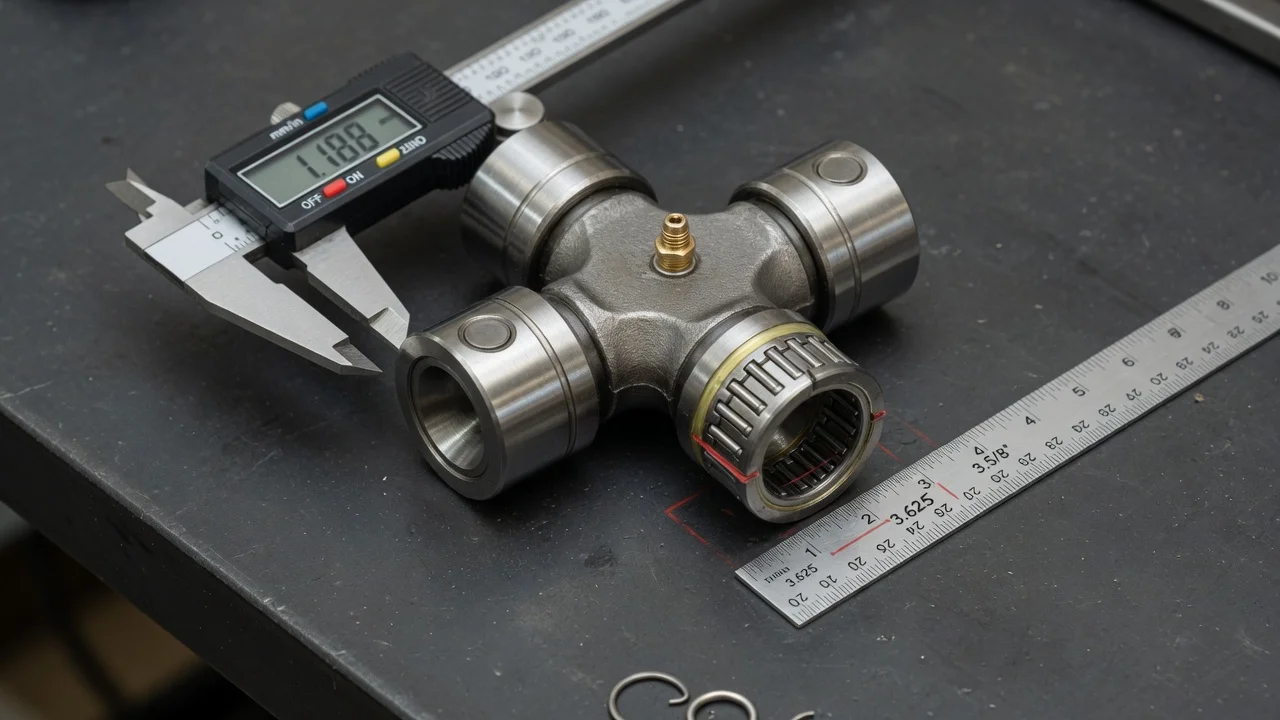
A 1350 U-joint is one of the most common heavy-duty universal joint sizes on American trucks and aftermarket driveshafts. The series name alone does not guarantee a part will fit. Before ordering a replacement, confirm the joint's cap diameter, span, retention style and lube design against the yokes on your vehicle. This guide explains how to identify a 1350 joint, what the dimensions mean, and when you need vehicle-specific help.
What defines a 1350 U-joint
The 1350 designation comes from the Spicer series naming system, which is widely used across the industry. A 1350 joint has bearing caps 1.188 inches (1-3/16) in diameter and a span of 3.625 inches (3-5/8), measured across the caps on the cross. Those two numbers identify the series. If either measurement differs, the joint belongs to a different series, even if it looks similar.
Three neighboring sizes are often confused with the 1350. The 1330 has the same 3.625-inch span but smaller 1.062-inch caps. The 1410 uses the same 1.188-inch caps on a longer 4.188-inch span. The 1310, found on many lighter applications, has 1.062-inch caps and a 3.219-inch span. A joint that matches one dimension but not the other will not seat correctly in the yoke. Do not force it.
How the joint fits into the driveline
A U-joint connects two yokes so the driveshaft can keep transmitting torque as the suspension moves and the angle between the transmission or transfer case and the axle changes. The cross sits in the middle. Each of its four trunnions carries a bearing cap filled with needle rollers. Two caps press into the bores of one yoke. The other two press into the opposite yoke or are held by straps or U-bolts.
Because the caps ride in machined bores or saddles, cap diameter must match the bore exactly, and span must match the distance between the yoke ears or retention points. A cap that is too small allows movement and vibration, and one that is too large will not install. The span also determines whether the clips can be installed and whether the cross sits centered, which affects driveshaft balance.
What changes the correct part
Retention style is the most common reason for wrong orders. Outside snap ring joints use clips that sit against the outer face of the yoke ear. Inside snap ring joints use clips in grooves on the inner side and are typical of many factory driveshafts. Both styles exist in 1350 size, but the caps are machined differently and are not interchangeable. Some yokes use half-round straps or U-bolts on one axis instead of a bore. Some factory joints are held by injected plastic instead of clips, and their replacements are service joints designed to be retained with clips.
Lubrication design also matters. Greasable joints have a zerk fitting in the cross or a cap, which allows periodic service. Non-greasable joints use a solid cross with no grease passage and rely on factory-filled lubricant. The right choice depends on how the vehicle is used, its operating conditions, and whether you can reach the fitting with the driveshaft installed.
Combination or conversion joints carry 1350 caps on one pair of trunnions and a different series on the other. They are used where a 1350 driveshaft meets a yoke of another size. Metric joints on some imported vehicles can come close to 1350 dimensions without actually matching. A single driveshaft can also use a different series at each end, so identify each joint separately rather than assuming the whole shaft is 1350.
How to identify the joint on your vehicle
Start with the vehicle configuration: drivetrain, transfer case, axles, and any driveshaft modifications recorded in the service history. Aftermarket and rebuilt driveshafts often use a different series than the factory shaft, so the original parts listing may not apply. If no reliable records exist, measure the parts.
Remove the old joint and clean the caps. Use a caliper to measure each cap's outside diameter; a 1350 cap reads about 1.188 inches. Then, with both caps fully seated on the cross, measure the span from the outer end of one cap to the outer end of the opposite cap; a 1350 reads about 3.625 inches. Measure both axes, because a combination joint will differ between them. Record where the clips sit, whether the yoke uses bores, straps or U-bolts, and whether there is a grease fitting. Worn caps can read slightly under nominal, so match the reading to the closest standard size rather than expecting an exact figure. During the same inspection, check the yoke ears for oval bores, galling or cracks, since a correct new joint will not cure a damaged yoke.
Installation and inspection checks
Mark the driveshaft orientation before removal so phasing and balance are preserved. When installing, make sure the needle bearings stay in place as the caps are pressed in. The clips should seat fully, and the joint should move freely through its full range without binding. Tighten strap and U-bolt fasteners to the manufacturer specifications for your vehicle, not to a generic figure.
After installation, watch for clunking on takeoff, vibration that grows with speed, rust-colored dust around the caps, or play when you twist the shaft by hand. Grease and inspection intervals should come from the vehicle's maintenance schedule or the driveshaft builder, adjusted for conditions such as off-road use, towing or water crossings. No single interval applies to every 1350 application.
Limitations and when to get help
The two dimensions identify the series but not everything about a specific part. Cap retention, grease routing, materials and the intended yoke still vary by manufacturer. Measurements on worn parts can be ambiguous, and modified vehicles may mix series front to rear. Take the driveshaft to a driveline shop if any of these apply: your readings fall between sizes, a yoke is damaged, or vibration continues after replacement. The shop can measure the shaft and check its angles and balance. Bring your measurements, clip style and service history so they can confirm the correct joint before you order parts.