Bad U-Joint Symptoms: How to Check for Wear
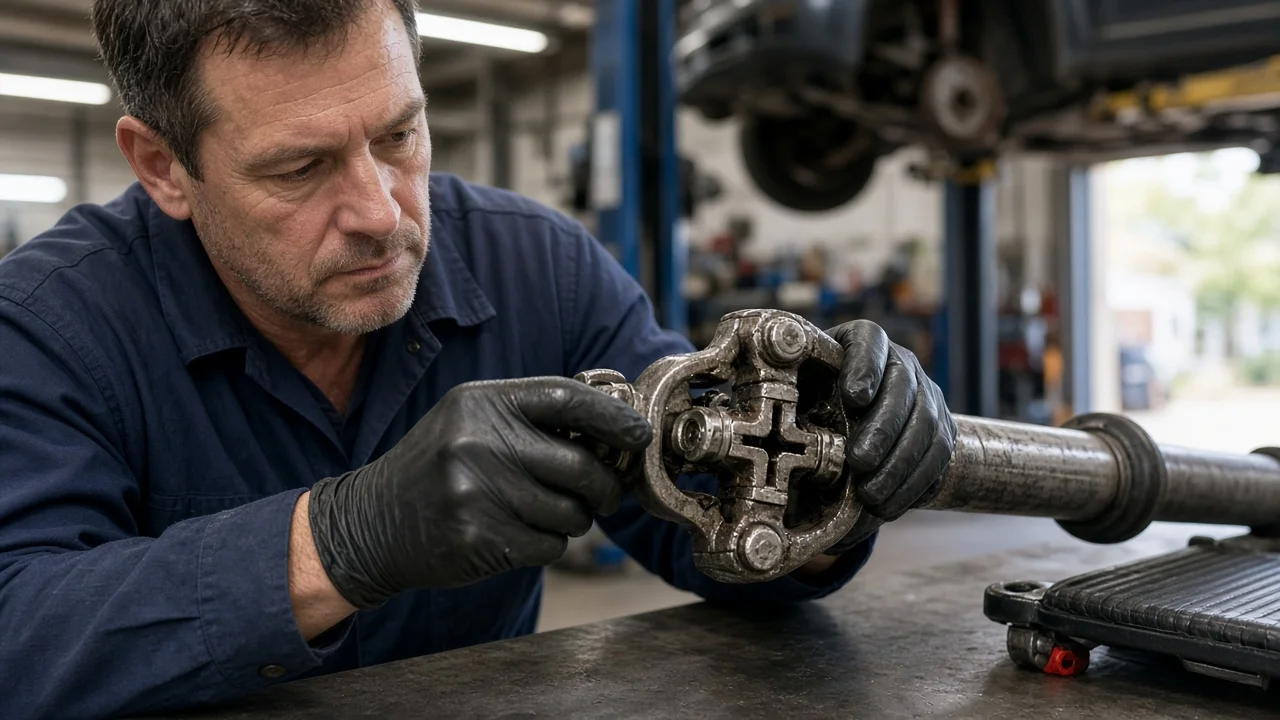
A worn universal joint usually gives warning before it fails, but those warnings overlap with several other driveline problems. U-joints connect the driveshaft to the transmission, transfer case and axle on most rear-wheel-drive trucks and SUVs, many four-wheel-drive vehicles and some all-wheel-drive models. This guide covers how the symptoms of a bad U-joint typically show up, what else can cause them, how to check for wear in a sensible order and when to stop driving.
Establish the symptoms
Start by describing the problem as precisely as you can. The classic signs of a failing U-joint are a clunk when shifting from park into drive or reverse, or when getting on and off the throttle. Another sign is a rhythmic squeak or chirp at low speed that quickens as the vehicle speeds up. You may also feel a vibration through the floor or seat that grows with road speed and is often worse under acceleration. On four-wheel-drive vehicles with a solid front axle, a worn axle U-joint can cause clicking, binding or a jerky feel when turning with four-wheel drive engaged.
Note when each sign appears. Record whether the vehicle is cold or warm, accelerating, coasting or braking, at a particular speed, in two- or four-wheel drive, and loaded or empty. Also record recent changes, such as a lift kit, new tires, driveshaft or differential work, towing, off-road use or a skipped grease service. These details, together with the vehicle's service history, narrow the list of suspects far more than the noise alone. If the vehicle has a two-piece driveshaft or separate front and rear shafts, note which end the sound seems to come from. Driveline noise travels through the body, though, so its apparent location can mislead.
Distinguish plausible causes
A worn U-joint is the likely cause when the clunk appears at every change between drive and reverse, the squeak follows road speed rather than engine speed, and there is visible play or rust at the joint. The joint's needle bearings run inside sealed or greaseable caps. Once the lubrication is lost or water gets in, the bearings wear, develop play and eventually bind or seize. A joint with play tends to clunk, while a joint that binds tends to cause vibration.
Several other faults mimic these symptoms. Excess backlash in the differential and worn engine, transmission or transfer case mounts can also clunk on shifts, but they leave no play at the U-joint itself. A failing center support bearing on a two-piece driveshaft causes speed-related vibration and sometimes a rumble. Tire and wheel imbalance, a bent wheel, a shifted tire belt or worn wheel bearings can also produce vibration that rises with speed. Tire problems are often felt in the steering wheel, while driveline vibration is more often felt in the seat or floor. A bent driveshaft, a missing balance weight or a shaft reassembled out of phase can vibrate even with healthy joints. Front-wheel-drive cars and many all-wheel-drive designs use CV joints on their half shafts instead of U-joints. On those vehicles, clicking while turning points to the CV joints.
Checks in a useful order
Begin with observations that need no lifting. Park on level ground, set the parking brake and hold the brake pedal firmly while shifting slowly between drive and reverse. Listen for a single clunk from underneath each time. During a test drive on a safe, quiet road, note whether the noise or vibration follows road speed, engine speed or steering input. Then, with the engine off, look under the vehicle for these signs: reddish-brown rust dust around the bearing caps, torn seals, dry joints, fresh fluid at the transmission or transfer case output seal, and dents or missing balance weights on the driveshaft.
The hands-on inspection requires the vehicle to be safely supported. Raise it at the lifting points described in the owner's or service manual, place it on rated jack stands or a lift, and chock any wheels left on the ground. Never get under a vehicle held only by a jack. Grip the driveshaft next to each joint and try to rock it up and down, side to side and in rotation against the yoke. A healthy joint has no perceptible free play. Any knock or movement between the yoke and the cross indicates wear. Where the shaft can be turned safely, rotate it slowly and feel for tight or notchy spots, which suggest binding.
Leave some checks to a qualified technician or to someone with the right tools and service information. These include measuring driveshaft runout, checking driveline angles after a lift or suspension change, measuring differential backlash, inspecting a center support bearing and diagnosing vibration with electronic equipment. These tests depend on manufacturer specifications for your exact vehicle configuration, and guessing at them can lead you to the wrong part.
Interpret the findings
Any of these findings establishes a worn U-joint: visible play at the cross, a knock when the shaft is rocked by hand, rust dust from a bearing cap, or a cap that has started to work out of the yoke. That usually justifies replacing the joint, but it does not prove the joint caused every symptom. A vibration that remains after replacement may come from driveline angles, shaft balance, tires or a support bearing, so recheck the original complaint afterward.
If every joint is tight and smooth but the clunk persists, look more closely at the mounts, differential backlash and slip yoke splines. If the joints are tight and the vibration follows wheel speed rather than load, start with tire condition and wheel balance. A joint that is merely dry, with no play or roughness, may only need grease if it has a fitting; sealed joints cannot be lubricated. To decide when to grease, use your vehicle's maintenance schedule and your operating conditions, such as towing, water crossings or off-road use, rather than a generic interval. When one joint on a shaft is worn, inspect the others closely, since they have the same mileage and operating history.
Urgency and next action
Stop driving and arrange a tow if you notice any of the following: a loud bang, a rapid or worsening clunk, a sudden heavy vibration, a displaced bearing cap, or a driveshaft that hangs or strikes the underside. A U-joint that comes apart can drop the driveshaft and damage the transmission, fuel or brake lines and exhaust. It can also cause loss of drive or loss of control. There is no reliable way to predict how many miles a worn joint has left, so treat confirmed play as a repair to schedule promptly, not something to monitor indefinitely.
Before contacting a shop, gather the year, make, model, engine and drivetrain, plus cab, bed or wheelbase details where relevant. Include any lift or other modifications, because driveshafts and joints vary with vehicle configuration. Bring your symptom notes, which joint you suspect, and the service history for any driveshaft, differential, mount or tire work. Ask the technician to confirm play at the suspect joint, inspect the remaining joints and the shaft, and road test the vehicle afterward to confirm the original symptom is gone.