Writing a Vehicle Accident Report: How to Describe a Crash Clearly and Accurately
A vehicle accident report is a written, factual account of a collision: who was involved, where and when it happened, what each vehicle was doing, what damage and injuries resulted, and what evidence exists. Describing an accident well means sticking to what you directly observed, in chronological order, without guessing at fault or speeds you cannot know. The same core facts feed several different documents in the US, including the police report, a driver's report that some states require to be filed with the motor vehicle agency, your insurance claim, and, for company vehicles, an employer or fleet incident report. The exact forms, filing deadlines and reporting thresholds vary by state and by insurer, so the principles below apply broadly, but the specific requirements depend on where the crash occurred and who you are reporting to.
Types of Accident Reports and How They Differ
People often use "accident report" to mean any of several documents. They overlap in content but serve different purposes and are written by different people.
Report type | Who writes it | Main purpose; Police crash report | Responding officer | Official record of the scene, parties, citations and the officer's observations; Driver's report to the state | Driver involved in the crash | Required in some states when a crash meets certain injury, death or property-damage criteria, especially if police did not file a report; Insurance claim statement | Policyholder or claimant | Gives the insurer the facts needed to open and evaluate a claim; Fleet or workplace incident report | Employee driver, sometimes with a supervisor | Internal record for the employer, its insurer and safety review
A police report is not something you write yourself, but you can review it once it is available and request a correction if a factual detail, such as your name, vehicle information or insurance details, is wrong. The officer's narrative and conclusions generally reflect the officer's own judgment, so disputes about how the crash happened are usually addressed through your insurer or your own written statement rather than by changing the officer's account.
What to Record at the Scene
A clear report depends on information gathered before memories fade and vehicles are moved. Once everyone is safe and emergency help has been called if needed, collect the following where it is practical and safe to do so.
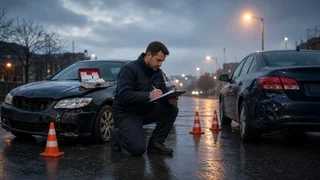
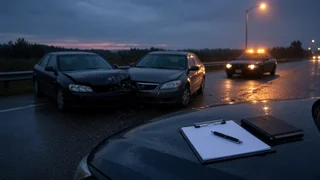
Date, time and exact location, including street names, the nearest cross street, mile marker or landmark, and the direction each vehicle was traveling; Names, phone numbers, driver's license details and insurance information for every driver involved; Vehicle details for each car: make, model, color, license plate and, if accessible, the VIN; Names and contact details of passengers and independent witnesses; Responding agency, officer names or badge numbers, and the report or incident number if one is given; Photos of all vehicles from several angles, close-ups of damage, final resting positions, skid marks, debris, traffic signals, signs and lane markings; Road, weather and lighting conditions, such as wet pavement, glare, fog, darkness or construction zones; Visible injuries and whether anyone was transported for medical care; Dashcam footage or nearby cameras that may have recorded the event
How to Describe the Accident
The narrative is the part of any driver's report that matters most and causes the most trouble. A good description reads like a neutral sequence of events that someone who was not there could picture accurately.
Write in chronological order: what you were doing before the collision, the moment of impact, and what happened immediately after; Use the first person and plain language, for example "I was traveling north in the right lane"; Give positions and directions using compass points, lane numbers or street names rather than vague terms like "the other side"; Describe actions, not intentions: "the blue sedan entered the intersection" rather than "the driver tried to beat the light"; Qualify estimates honestly, such as "I estimate I was traveling about the speed limit" or "I did not see the other vehicle before impact"; State which part of each vehicle made contact, such as the front of one car striking the rear passenger side of another; Note traffic control devices and their status if you know it, and say so plainly if you did not see the signal; Record what was said only when it is relevant and quote it as closely as you can remember, without adding interpretation; Leave out opinions about fault, apologies and speculation about the other driver's condition or distraction unless you directly observed something specific
Fault is ultimately determined by insurers, and sometimes by courts, based on all the evidence and the applicable state law. Your job in the report is to provide accurate facts, not to argue the case. Statements such as "it was my fault" or "I'm sorry, I didn't see you" can be interpreted as admissions even when the full picture is more complicated.
Recommended Structure for a Written Report
If you are writing a statement for an insurer, an employer, or a state form that leaves room for a narrative, organizing it into consistent sections makes it easier to read and harder to misinterpret.
Basic details: date, time, location and your role (driver, passenger, owner); Parties and vehicles: each driver, owner, vehicle and insurer; Conditions: weather, lighting, road surface and traffic; Narrative: a chronological description of events before, during and after the collision; Damage: what was damaged on each vehicle and any other property, such as fences, poles or signs; Injuries: who reported pain or was visibly hurt, and any medical treatment sought; Witnesses and responders: names, contact details, police agency and report number; Attachments: photos, a simple diagram, dashcam footage and the exchange of information; Signature and date, if the form requires it
Sample Vehicular Accident Report
The example below is a fictional template showing the format and tone of a driver's incident report. Replace the bracketed placeholders with your own information, and follow the layout of any official form you are given rather than this one when they differ.
DRIVER'S ACCIDENT REPORT; Date / Time: [Date], approximately [time]; Location: Intersection of [Street A] and [Street B], [City], [State]; Reporting driver: [Your name], driver of Vehicle 1; VEHICLE 1 (mine); [Year/Make/Model], [color], plate [number]; Insurer: [Company], policy [number]; VEHICLE 2; Driver: [Name], phone [number]; [Year/Make/Model], [color], plate [number]; Insurer: [Company], policy [number]; CONDITIONS; Daylight, clear weather, dry pavement, moderate traffic. NARRATIVE; I was driving northbound on [Street A] in the right lane and; stopped for a red signal at [Street B]. When the signal turned; green, I proceeded into the intersection. Vehicle 2, traveling; westbound on [Street B], entered the intersection and its front; end struck the passenger side of my vehicle near the rear door. Both vehicles came to rest in the intersection. I did not see; Vehicle 2 before the impact. I moved my vehicle to the curb; after photographing the positions of both cars. DAMAGE; Vehicle 1: dented rear passenger door and quarter panel. Vehicle 2: damaged front bumper and hood. INJURIES; I reported soreness in my right shoulder. No one was transported; from the scene. WITNESSES; [Name], phone [number], was stopped at the southbound signal. POLICE; [Agency], Officer [name/badge], report number [number]. ATTACHMENTS; Photos of both vehicles and the intersection; scene diagram. Signature: ____ Date: __
Notice what the sample does: it identifies directions and lanes, describes the point of contact on each vehicle, admits plainly what the driver did not see, and avoids any statement about who was at fault or why the other driver entered the intersection.
Adding a Simple Diagram
Many report forms include space for a sketch, and insurers often find one useful. Draw the roads as straight lines, label street names and a north arrow, show each vehicle as a numbered box with an arrow for its direction of travel, and mark the point of impact and where each vehicle came to rest. Accuracy matters more than artistic detail; a neat, labeled sketch is better than an elaborate one that guesses at distances.
Common Mistakes to Avoid
Guessing at specific speeds or distances and presenting the guesses as facts; Admitting fault or speculating about the other driver's behavior; Leaving out details that seem minor, such as a passenger's soreness that later turns into a medical claim; Giving different versions of events to the police, the insurer and the other driver's insurer; Waiting too long to write the account, which allows memory to blur details; Signing statements for the other party's insurer before understanding what you are agreeing to; Forgetting to keep copies of everything you submit
Filing Requirements and Deadlines
Whether you must file a report with the state, and how quickly, depends on the state where the crash happened. Many states require a report when a collision involves injury, death or property damage above a set dollar amount, and some require it only when police did not investigate. Thresholds and deadlines differ, so check the requirements of that state's motor vehicle or transportation agency. Separately, most auto insurance policies require prompt notice of any accident, and company drivers are usually bound by their employer's own reporting rules. When the crash involves serious injuries, disputed fault or uninsured drivers, many people also consult an attorney before giving detailed recorded statements.
Putting It Together
An effective accident report is factual, chronological and specific about positions, directions and damage, while being honest about what you did not see or cannot measure. Gather information at the scene, write your account as soon as you safely can, use the same facts consistently across every report you submit, and keep copies of your statement, photos and the police report number. Done this way, the report supports your claim without saying more than the evidence does.