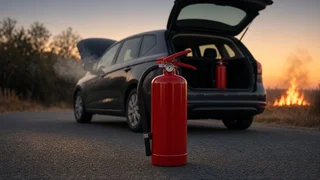
Wood and Paper Fire Extinguishers: What Class A Means and Whether It Belongs in Your Car
The Short Answer
A fire extinguisher meant for wood and paper is a Class A extinguisher. In the US system, Class A covers ordinary solid combustibles such as wood, paper, cardboard, cloth, many plastics and rubber. That matters for vehicles because a car fire rarely involves only these materials. Fuel, oil, other automotive fluids and live electrical wiring are usually part of the problem. Those fall under Class B (flammable liquids) and Class C (energized electrical equipment).
For a passenger car, truck or SUV, a unit rated only for Class A, especially a plain water extinguisher, is the wrong choice. The practical choice for most drivers is a multipurpose extinguisher rated A, B and C, usually labeled ABC. It still handles wood and paper but also covers the liquid and electrical fires a vehicle is more likely to produce.
What the Class A Rating Covers
Class A fires involve solid materials that leave ash or embers. Inside a vehicle, that includes seat fabric and foam, carpet, headliner material, paper and cardboard in the cabin or cargo area, and some plastic trim. Solid fuels can smolder below the surface and reignite, so Class A agents work by cooling the material, by coating it to cut off oxygen, or both.
An extinguisher can carry a Class A rating without being limited to Class A. Many units carry several ratings at once. When people search for a wood and paper extinguisher, the answer may be a Class A-only model or a multipurpose model that includes Class A. For vehicle use, that difference decides whether the extinguisher is suitable at all.
How to Read the Label
US extinguishers show their fire classes with letters, symbols or both. Newer labels use pictograms. Class A shows a burning trash can and wood pile. Class B shows a burning fuel can. Class C shows a burning electrical plug and outlet. A red slash through a pictogram means the extinguisher must not be used on that type of fire. Older labels use colored shapes: a green triangle for A, a red square for B and a blue circle for C.
Many labels also include a numerical rating, such as a number before the A and another before the B. A higher number means more firefighting capacity within that class. The A number is tied to an equivalent amount of water. The B number roughly reflects the square footage of flammable liquid fire a non-expert user could be expected to put out. Class C has no number. It only confirms the agent does not conduct electricity. Use these figures to compare models, not to predict how a real vehicle fire will go.
Common Agents That Carry a Class A Rating
Agent type | Typical classes | Suitability for vehicle carry; Pressurized water | A only | Not suitable. Water can spread burning fuel and conducts electricity. Multipurpose dry chemical (monoammonium phosphate) | A, B, C | The most common choice for vehicles. Leaves a residue that is corrosive and needs prompt cleanup. Foam (such as AFFF types) | A and B, not C | Limited. Unsuitable where live electrical components are involved. Water mist | A, sometimes C | Generally not intended for fuel fires, which makes it a poor fit for vehicles. Clean agent (halocarbon types) | B and C, with A ratings typically on larger sizes | Leaves no residue, but compact sizes may lack an A rating and cost more. Standard dry chemical (sodium bicarbonate) | B and C only | Not a wood and paper extinguisher. It lacks a Class A rating.
Why Class A Alone Falls Short for Vehicles
Most vehicle fires that start while driving begin in the engine compartment or beneath the vehicle. Common causes include leaking fuel or oil reaching hot exhaust parts, electrical faults and overheated components. These are liquid and electrical fires first, even if cabin materials later catch. Spraying water on burning fuel can scatter it and enlarge the fire, and water on energized wiring creates a shock risk. That is why water-based Class A extinguishers are kept out of vehicle kits.
An ABC dry chemical unit addresses all three likely categories. Its tradeoff is cleanup. The powder spreads widely, gets into vents and electrical connectors, and can damage metal and electronics if left in place. After a discharge, the vehicle should be cleaned thoroughly. A clean agent extinguisher avoids residue but may come with a weaker or absent Class A rating at compact sizes. Check the label rather than assuming.
Electric and Hybrid Vehicles
Lithium-ion traction batteries add another layer. Once a battery pack enters thermal runaway, a self-sustaining chain reaction inside the cells, a handheld extinguisher is not expected to stop it, whatever its rating. The pack can reignite after appearing to be out. A portable extinguisher may still help with a small fire in cabin materials or a 12-volt electrical fault before the battery is involved. If the high-voltage battery is burning or smoking, get everyone away, call 911 and tell responders the vehicle is electric or hybrid.
Choosing an Extinguisher for Your Vehicle
Look for A, B and C on the label, or the matching pictograms with no red slash through them. Confirm the unit is listed by a recognized testing laboratory and labeled for its rated classes. Choose a size you can store securely and handle with one hand, while noting that a larger unit gives more discharge time. Prefer a model with a pressure gauge, so you can confirm at a glance that it is charged. Check the manufacturer's stated storage temperature range, because a parked car can get very hot or very cold depending on climate. Use a sturdy mounting bracket designed for vehicles, since an unsecured cylinder can become a projectile in a crash or hard stop.
Mounting and Upkeep
Store the extinguisher where you can reach it quickly after leaving the vehicle. Common spots are a secured bracket in the cabin or a fixed mount in the cargo area that stays accessible even when the area is loaded. Do not leave it loose under a seat, where it can roll beneath the pedals. Check the gauge regularly. Inspect the hose, nozzle and tamper seal for damage. Follow the manufacturer's guidance on service or replacement. Dry chemical powder can compact over time, especially with vibration, so some owners periodically invert the cylinder and tap it gently if the manufacturer allows. Any extinguisher that has been partly discharged should be recharged or replaced.
Using an Extinguisher at a Vehicle Fire
People come first and the vehicle comes second. Pull over, switch off the engine, get every occupant out and well away from the vehicle and traffic, and call 911. Fight the fire only if it is small, you have a clear escape route, and you are not in danger. Do not fully open a hood over an engine fire. The rush of air can feed the flames, and you would be standing directly in front of them. If you can, aim through a gap, the grille or the wheel well instead.
The usual technique is summarized as PASS: pull the pin, aim at the base of the fire, squeeze the handle and sweep side to side. If the fire does not shrink quickly, or the extinguisher runs out, back away and wait for firefighters. Even a fire that seems to be out can flare up again, so keep your distance until responders arrive.
Bottom Line
A wood and paper fire extinguisher is a Class A unit, and Class A protection alone does not fit vehicle fire risks well. For a car or truck, choose an extinguisher rated A, B and C, which keeps the wood and paper coverage while adding protection against fuel and electrical fires. Mount it securely, check it regularly, and treat it as a tool for small fires only, never a reason to stay near a vehicle that is burning beyond control.