Why Does Tire Tread Create Noise?
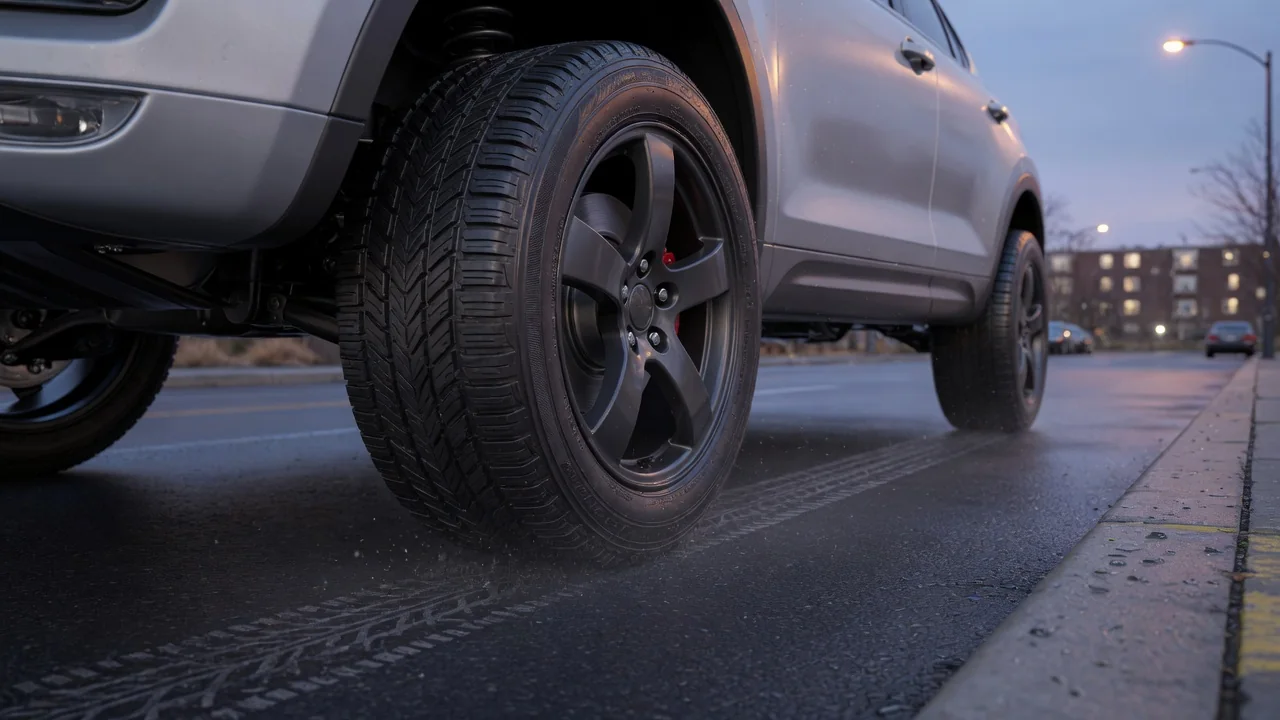
Every tire makes some sound as it rolls, and much of that sound starts in the tread. Three overlapping mechanisms explain why tire tread creates noise: air is squeezed in and out of the tread pattern, tread blocks strike and release the pavement, and the road's own texture adds to both. Understanding each one helps explain why tire tread pattern noise changes with design, wear, speed, and surface.
Air pumping
As a tire rolls, each section of tread enters the contact patch, flattens against the road, and then leaves it again. While it is in contact, the grooves, sipes, and voids between tread blocks form small pockets, with rubber on the sides and pavement underneath. At the leading edge of the contact patch, the tread is compressed, the pockets shrink, and air is pushed out. At the trailing edge, the rubber springs back, the pockets expand, and air rushes in to fill them. This rapid compression and expansion produces pressure pulses that the ear hears as noise. Engineers commonly call this process air pumping.
Air pumping depends heavily on tread geometry. Larger, more enclosed voids can move more air per cycle. Grooves that connect to open channels let air escape more gradually. Long circumferential grooves can act like short pipes while they are sealed against the road. They resonate at frequencies set by the length of groove inside the contact patch. Because pumping happens every time a void passes through the footprint, its frequency rises with road speed. That is why this kind of sound often shifts into a higher-pitched hiss or whine as a vehicle accelerates.
The geometry at the edges of the contact patch also matters. On both the entry and exit sides, the curved tire surface and the flat road form a narrowing wedge. That wedge can reflect and concentrate sound, an effect often called the horn effect. As a result, pressure pulses created near the footprint are louder by the time they reach a listener.
Block impacts
The second major source is mechanical. A tread block is a raised piece of rubber. At the leading edge of the contact patch, it goes from moving freely through the air to suddenly pressing against the pavement, and that contact acts as a small impact. The impact makes the block vibrate and sends energy into the belts and sidewalls, which can then radiate sound much like a drumhead. At the trailing edge, blocks that were compressed and slightly distorted release from the road and snap back toward their unloaded shape, adding a second source of vibration. Small amounts of slip between rubber and pavement can also create stick-slip sounds, especially when cornering, braking, or accelerating.
If every block in a tread pattern were identical and evenly spaced, the impacts would repeat at one steady rate and produce a distinct tone. To avoid that, tire designers commonly use pitch sequencing: they vary the length of tread blocks around the circumference in a planned order. This does not remove the energy of the impacts. It spreads that energy across a wider range of frequencies, so the result sounds more like a broad, less noticeable rumble than a single whine. Block stiffness, the shape of block edges, and the number and orientation of sipes also affect how sharply each block strikes and releases.
This is a large part of why tire tread pattern noise varies between tire categories. Designs with large, widely spaced blocks, such as many off-road and aggressive all-terrain patterns, tend to produce stronger, more distinct impacts. Tightly packed, rib-based designs intended mainly for paved roads tend to produce weaker ones.
Road surface
Tread noise never comes from the tire alone, because the road makes up the other half of the contact patch. Pavement texture affects both mechanisms described above. Coarse surfaces, such as chip seal or heavily textured aggregate, press into the rubber at many points and add their own small impacts and vibrations to those of the tread blocks. Very smooth, dense surfaces can have the opposite effect on air pumping. They seal tread voids more completely, which can make the trapped air produce stronger pressure pulses. Concrete with transverse grooving creates a repeating pattern that interacts with the tread and can produce a noticeable tone at certain speeds.
Some pavements are designed to reduce noise. Porous or open-graded asphalt contains connected voids that let air escape from beneath the tire instead of being squeezed out sharply, and those voids can also absorb part of the sound energy. Wet roads change the picture again: water fills the tread grooves and is expelled from the contact patch, adding splashing and hissing sounds. As a result, the same tire on the same vehicle can sound noticeably different from one stretch of road to the next, even at a constant speed.
Practical implications and limits
For drivers, the most useful takeaway is that tread noise reflects trade-offs. Features that help a tire grip in snow, mud, or standing water, such as deep voids, open shoulders, and large biting edges, often increase the potential for air pumping and block impacts. A pattern that is quieter on dry pavement may give up some capability in other conditions. When choosing tires, weigh noise against the conditions the vehicle actually faces rather than treating quietness as an isolated goal.
Tire condition also matters over time. As tread wears, groove depth decreases and the volume of air that can be pumped changes, so the character of the sound can shift. Irregular wear is a more common reason for a tire becoming louder. Cupping, feathering, or heel-and-toe wear leaves blocks with uneven surfaces that strike the road unevenly, often producing a rhythmic growl or hum. To limit these wear patterns, keep tires inflated to the vehicle manufacturer's recommended pressure, rotate them on the recommended schedule, and maintain proper alignment. Have a sudden or worsening noise inspected, because wheel bearings, brakes, and other components can make sounds that are easily mistaken for tread noise.
There are limits to what any general explanation can predict. How loud tread noise seems inside the cabin depends on the vehicle's insulation, suspension, wheel size, and body structure, not just on the tire. Speed, load, temperature, and the mix of road surfaces on a given route all change what the driver hears. These mechanisms explain why tire tread creates noise, but the actual result for a particular vehicle and tire combination can only be judged under its own real driving conditions.