Why Does Hard Water Leave Spots on Car Paint?
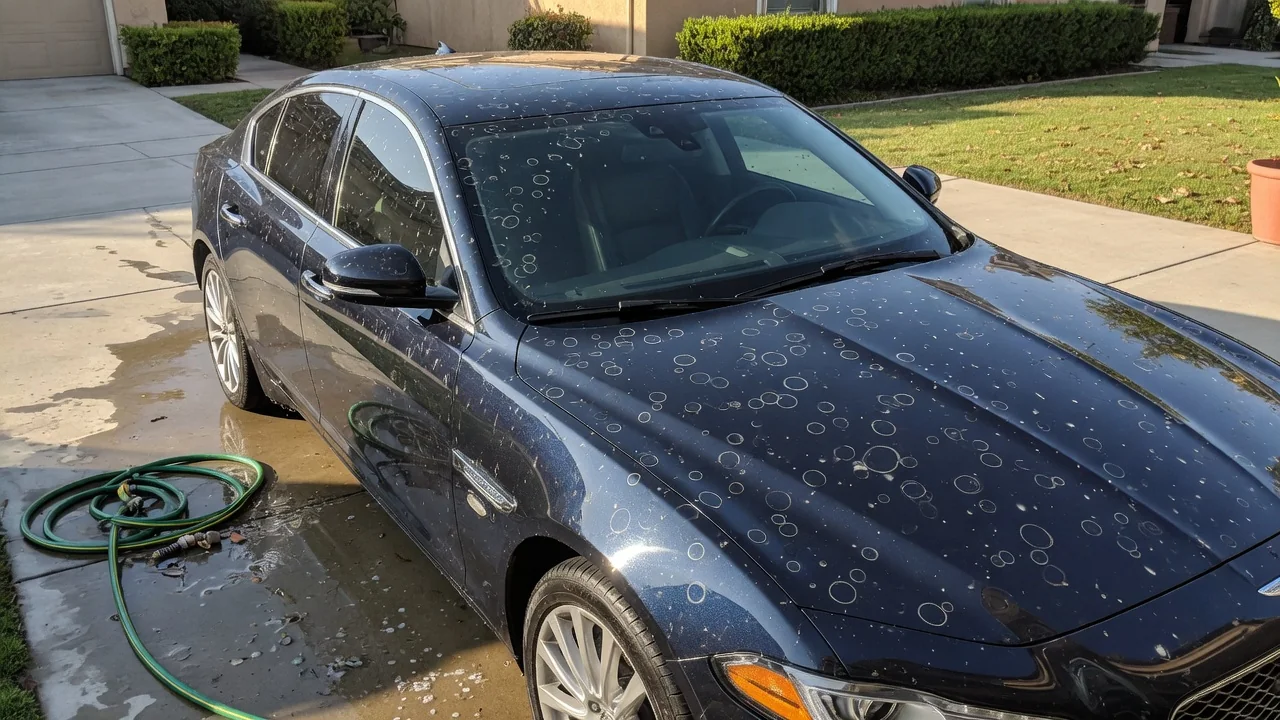
Anyone who has washed a car and found chalky rings on the hood an hour later has met hard water. These spots are not dirt left behind by a poor wash. They are dissolved minerals that stay on the surface after the water is gone. Why hard water leaves spots on car paint comes down to three things: what the water carries, how it dries, and how the residue can be removed without harming the finish.
Minerals: What Hard Water Carries Onto the Paint
Water is called hard when it carries a relatively high load of dissolved minerals, mainly calcium and magnesium. These minerals enter groundwater as it passes through limestone, chalk and similar rock. They travel in the water as dissolved ions, paired mostly with bicarbonate, sulfate and chloride. Depending on the source, the water may also contain smaller amounts of iron, silica or other dissolved solids. None of this is visible while the water is liquid, which is why a bucket of hard water looks as clean as soft water.
The key point is that these minerals do not evaporate. Water leaves the surface as vapor, but the calcium, magnesium and other ions have nowhere to go, so they stay on whatever the droplet was resting on. Calcium bicarbonate shows why the residue can be stubborn. As water evaporates and carbon dioxide escapes, it tends to convert into calcium carbonate, which dissolves poorly in plain water. That change helps explain why a fresh spot can sometimes be wiped away easily while an older one resists rinsing. Municipal water, well water and the rinse water at commercial washes can differ widely in mineral content. As a result, the same washing routine may leave heavy spotting in one place and almost none in another.
Drying: How Evaporation Concentrates the Deposit
A water droplet on paint does not dry evenly. Evaporation tends to be fastest at the droplet's edge, and as the droplet shrinks, dissolved material is carried toward that edge and deposited there. The same effect leaves a ring when spilled coffee dries. It is why many hard water spots look like crisp outlines with a lighter center rather than solid dots. On a surface where water beads, each bead becomes its own small deposit, which can leave dozens of separate rings across a single panel.
Heat and sunlight speed this up. A dark panel in direct sun, or a hood still warm from driving, can evaporate water quickly and concentrate the minerals before the owner has a chance to dry the surface. Wind has a similar effect. Fast drying mainly shortens the time available to remove the water by hand. Sprinkler overspray causes repeated spotting for a related reason: the car gets wet, dries and gets wet again, and each cycle adds another thin layer of mineral residue.
Time and temperature also affect how firmly a deposit holds on. Fresh residue usually sits on top of the clear coat as a loose film. If it stays in place through repeated heating and wetting, it can bond more tightly to the surface. In more severe cases, the area under the deposit can become visibly marked or etched into the clear coat. Detailers often describe this as a progression from surface deposits to bonded deposits to etching, and the stage determines which removal method is appropriate.
Removal: Matching the Method to the Spot
The gentlest method that works is the right one. Fresh, light spots can often be removed by rewashing the panel, rinsing it and drying it promptly with a clean microfiber towel. A spray detailer used as a lubricant while wiping is another option. Mineral deposits are hard crystals, so wiping them off dry and with pressure can drag grit across the paint. Use lubrication and light pressure.
Deposits that survive a wash usually respond to mildly acidic products, because acids dissolve carbonate-based mineral scale. Water spot removers made for automotive paint are designed for this job, and some owners use diluted white vinegar for the same chemical reason. Whatever the product, the usual precautions apply. Work on a cool panel out of direct sun, treat a small section at a time, do not let the solution dry on the surface, and rinse thoroughly afterward. Acids can also weaken wax, sealants and some trim materials, so protection may need to be reapplied. Product directions take priority over general advice.
If a spot remains after chemical treatment, it is either strongly bonded or has marked the clear coat. A clay bar or clay mitt used with lubricant can lift bonded contamination from the surface. A mark that remains after this decontamination is generally a physical defect in the clear coat. The usual fix is machine or hand polishing, which levels the surrounding surface. Polishing removes a small amount of clear coat, so it should be done conservatively, and deep etching may be beyond what polishing can safely correct.
Practical Implications and Limits
Preventing spots is usually easier than removing them. Wash in shade or at a cooler time of day, work panel by panel so soapy water does not dry on the paint, and dry the car immediately after the final rinse. These habits all shorten the time minerals have to concentrate. Where the local water is very hard, some owners finish with a rinse of deionized or filtered water. That water carries little dissolved material, so it leaves little behind. Local water utilities often publish water quality reports that include hardness, which can help explain why spotting is worse in some areas than others.
Paint protection reduces the problem but does not eliminate it. Waxes, sealants and ceramic coatings put a sacrificial or more resistant layer between the deposits and the clear coat, and their slick surface can make residue easier to remove. However, strongly water-repellent surfaces form tall beads that can still dry into spots if they are not wiped off, so a coated car is not immune. Coatings can also develop their own mineral buildup, which the coating maker's care instructions usually address.
This general explanation has limits. Not every spot is hard water. Tree sap, bird droppings, industrial fallout and acid rain can leave similar-looking marks that need different treatment. Paint systems, coating types and clear coat condition also vary between vehicles, so the same method may behave differently on a new factory finish, an older repaint, or a matte or wrapped surface, where polishing is generally inappropriate. For anything beyond surface cleaning, follow the vehicle's owner's manual and the instructions for the product being used. If etching persists, it is reasonable to consult a detailing or paint professional.