Why Does Caster Help a Steering Wheel Self-Center?
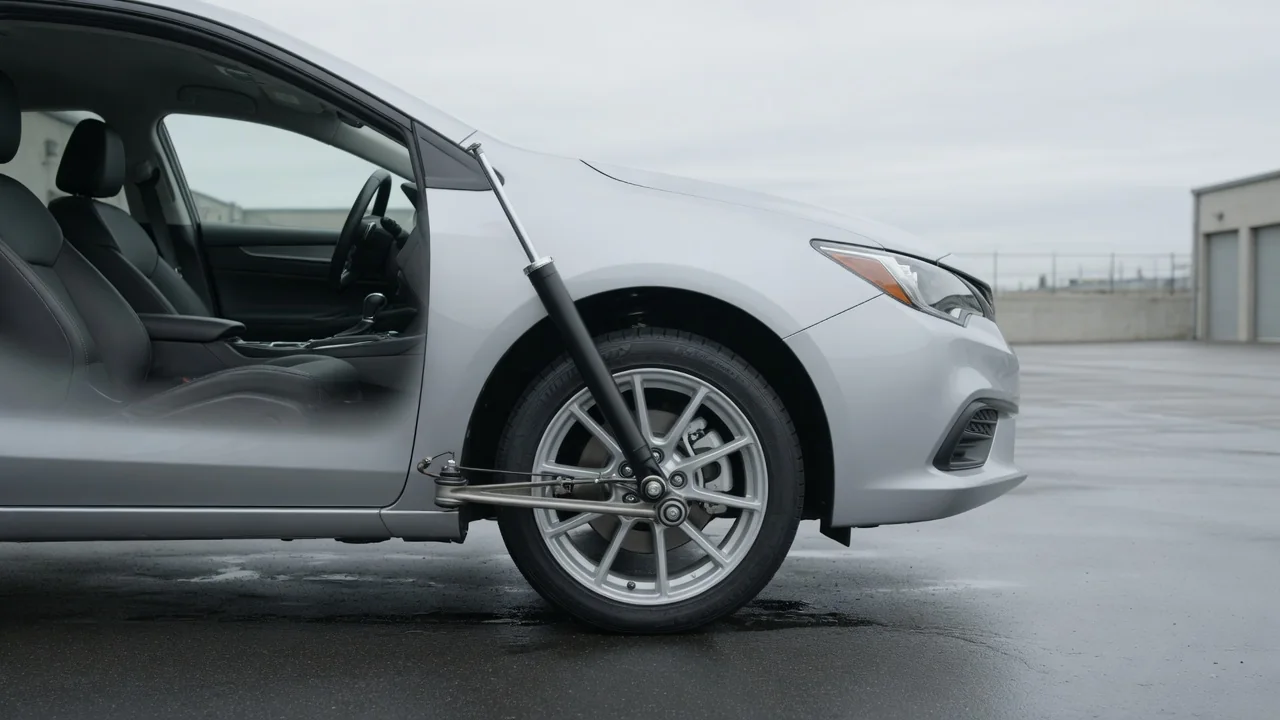
When you release the steering wheel after a turn, it tends to unwind toward straight ahead. Much of that behavior comes from caster, the fore-and-aft tilt of the steering axis. Caster places the point the wheel pivots around ahead of where the tire meets the road, so the forces from a rolling, cornering tire pull the wheel back toward center. That relationship explains why caster helps a steering wheel self-center and what alignment can change.
Pivot geometry
A front wheel does not steer around its own center. It turns around a steering axis defined by its upper and lower pivots: the upper strut mount and lower ball joint on a strut suspension, or the upper and lower ball joints on a double-wishbone design. Viewed from the side, that axis is usually tilted. When its top leans toward the rear of the vehicle, the angle is called positive caster. When it leans forward, it is negative caster. Most road vehicles use positive caster.
The key consequence is where the axis meets the road. Extend a positively castered steering axis downward and it reaches the ground ahead of the center of the tire contact patch. The distance between that point and the center of the patch is called mechanical trail, or caster trail. The tire effectively follows behind its pivot, much like the wheel of a shopping cart trails behind its swivel. A trailing wheel tends to line up with the direction of travel, because any sideways force at the contact patch has a lever arm about the pivot.
Caster is not the only tilt in the steering axis. Steering axis inclination, the inward lean seen from the front, works alongside it. Because of these combined tilts, steering the wheels changes the height of the front of the vehicle and the camber of each wheel. Those side effects also contribute to steering return, particularly at low speed.
Tire forces
Whenever a car turns, the front tires generate lateral force, the sideways grip that pushes the vehicle onto its new path. That force acts at the contact patch, which positive caster has placed behind the steering axis. Lateral force multiplied by the trail distance produces a moment around the steering axis, and that moment acts to reduce the steer angle. In other words, the cornering force itself tries to rotate the wheel back toward straight ahead. The driver feels it through the steering linkage as the wheel's tendency to return once released.
Mechanical trail is only part of the story. A rolling tire working at a slip angle does not generate its lateral force at the exact center of the contact patch. The tread deflects progressively as it passes through the patch, so the resultant force sits somewhat behind the center. That offset is called pneumatic trail, and it adds to the mechanical trail created by caster. Together they form the lever arm for what engineers call self-aligning torque. Pneumatic trail shrinks as the tire approaches its grip limit, while mechanical trail stays fixed by geometry, so caster provides a return lever that does not fade as grip runs out.
At very low speeds, such as when parking, lateral forces are small and the trail effect is weak. Here the return comes mainly from the vehicle's weight. Steering axis inclination makes the front of the vehicle rise slightly as the wheels turn away from center, so the weight on the suspension pushes them back toward straight. Caster adds a related effect by raising one side and lowering the other as the wheels steer. This is why steering often returns less firmly during a slow maneuver than when exiting a corner at road speed.
Alignment
Caster is one of the three primary alignment angles, alongside camber and toe, and it is measured in degrees. Because it cannot be read directly with the wheels pointed straight, alignment equipment typically has the wheels steered a set amount to each side and calculates caster from the resulting change in camber. The reading is compared with the vehicle manufacturer's specification, which usually gives an acceptable range and may limit the difference between the left and right sides.
Whether caster can be adjusted depends on the suspension design. Some layouts provide cam bolts, slotted mounts, shims, or adjustable strut-top plates. Many others have caster fixed by the factory mounting points, so an out-of-specification reading suggests something has moved: a bent control arm, strut, or subframe, worn bushings, or damaged mounts. In those cases the proper fix is repairing or replacing the affected parts rather than forcing a different angle.
Side-to-side balance matters as much as the absolute value. If one wheel has noticeably more positive caster than the other, the two return moments are unequal, and the car tends to drift toward the side with less caster. Some specifications deliberately allow a small difference to offset the slope of crowned roads. Toe and camber also influence how the steering feels around center, so a caster reading is best interpreted together with the other angles.
Practical implications and limits
More positive caster generally brings stronger return and steadier straight-line tracking, but the larger lever arm also raises steering effort, since the driver must overcome the aligning moment to turn the wheel. Power steering hides much of that effort, which lets designers choose generous caster without making the car tiring to drive. The right amount is a design balance for each vehicle, so there is no universally correct figure, and the manufacturer's specification remains the reference.
Caster is not the only factor in whether the wheel actually comes back. Friction in the steering system resists the aligning moment: a binding ball joint, a stiff strut bearing, a tight steering rack, or a sticking steering shaft joint can leave the wheel sitting off center even when alignment is within specification. Many electric power steering systems also apply software-controlled return assistance, so steering feel on those vehicles reflects calibration as well as geometry. When caster steering return feels weak, slow, or uneven, checking for mechanical binding belongs alongside an alignment check.
The aligning moment also carries useful information. Because its pneumatic portion fades as the front tires near their grip limit, steering tends to lighten as the front end begins to slide, although how clearly this reaches the driver's hands depends on tires, load, surface, and steering assistance. Self-centering is a tendency rather than a guarantee: on slippery roads or at parking speeds the return is weaker, and the driver should always keep control of the wheel.