Why Does a Windshield Adhesive Have a Safe-Drive Time?
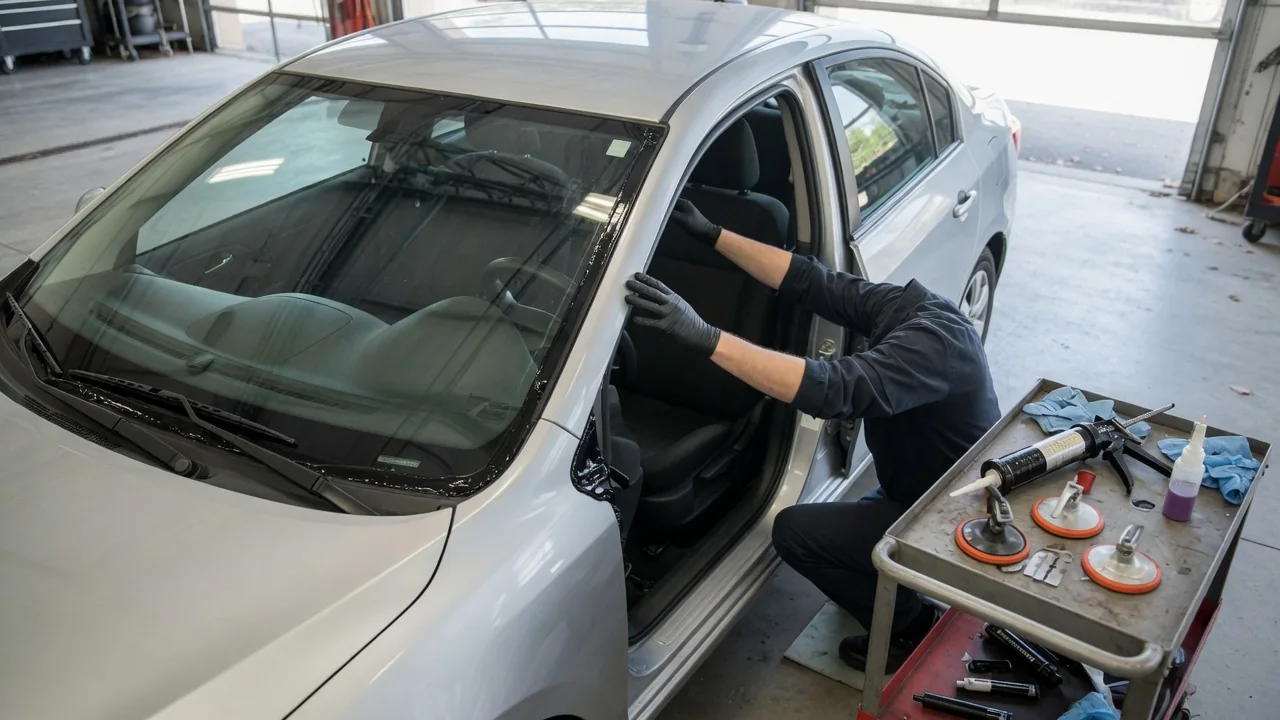
A replaced windshield can look finished the moment the installer steps back, yet the adhesive holding it in place is still building strength. That is why windshield urethanes carry a safe-drive time, sometimes called a minimum drive-away time. It marks the point at which the bond is expected to be strong enough for the glass to do its structural and safety jobs in a crash. Knowing how windshield adhesive cure time works explains why the wait matters.
Bond strength: why the glass has to stay put
In most modern vehicles the windshield is more than a window. It is bonded directly to the body opening. In many designs it adds stiffness to the cabin structure and helps the roof resist crushing in a rollover. It can also act as a backstop for the passenger-side airbag, which in many vehicles deploys upward and reflects off the glass toward the occupant. Each of these roles depends on the adhesive keeping the glass attached under sudden, high loads. A bond that holds the glass against gravity and road vibration is not necessarily ready for the forces of a collision or an airbag deployment.
Most windshield installations use a polyurethane adhesive, often simply called urethane. Common one-part urethanes cure by reacting with moisture in the air. The reaction starts at the outer surfaces of the bead and works inward, so early on the bead has a cured skin over material that is still soft. The adhesive gains strength gradually rather than all at once, both in cohesive strength, its internal toughness, and in adhesive strength, its grip on the glass and the body flange. Some products use two-part chemistry or accelerators to build strength faster, but they still follow a curve rather than switching instantly from wet to fully cured.
The safe-drive time marks a point on that curve. Adhesive manufacturers determine when their product reaches enough strength to retain the windshield in a crash under stated conditions, and they publish that interval for installers. It does not mean the urethane is fully cured; full cure generally takes considerably longer. It means the bond is expected to have the strength the manufacturer considers necessary for the vehicle to be driven safely.
Conditions that change windshield adhesive cure time
Because many urethanes depend on atmospheric moisture, temperature and humidity strongly influence how quickly they gain strength. Warm, humid air generally speeds the reaction, while cold, dry air slows it. The same product can reach its safe-drive point much sooner on a mild, damp day than on a cold, dry one. For this reason, manufacturers usually tie drive-away times to ranges of temperature and relative humidity rather than giving a single fixed number. Some products are formulated specifically for cold-weather or low-humidity work.
Other factors matter as well. The size and shape of the adhesive bead affect how far moisture must travel to cure the interior. Surface preparation is just as important. The glass and body flange must be clean, and where the adhesive system calls for it, they must be treated with the correct primers or activators. Contamination or skipped steps can leave a bead that cures but does not grip properly. The vehicle's design also plays a part, because the adhesive must meet the demands of that particular installation, including any reliance on the windshield for airbag support.
Installer guidance and what it is based on
A professional installer should choose an adhesive suited to the job and follow the manufacturer's preparation and application steps. The installer then determines the safe-drive time from the product's instructions, using the actual temperature and humidity at the time of installation. Many shops record the adhesive used, its batch, and the conditions, and tell the owner when the vehicle can be driven. Mobile installers working outdoors have to account for the weather in the same way, which can mean a longer wait than in a climate-controlled bay. Where the vehicle manufacturer's repair information specifies particular adhesives or procedures, a careful installer follows those requirements too.
Installers often add advice that protects the bond while it continues to cure. Common recommendations include leaving a window slightly open for a while so that shutting the doors does not create a sharp pressure spike. Owners are also often told to avoid high-pressure car washes for a period and to leave retention tape or moldings in place as instructed. Some installers also advise against rough roads and slammed doors shortly after the work. These recommendations vary between shops and products, so the guidance given for the specific job is the one to follow.
Practical implications and limits
For owners, the main implication is that driving before the stated time carries a risk that cannot be seen. The glass may sit perfectly in place on a calm drive. The danger appears only if a crash, a hard impact, or an airbag deployment loads the bond before it is ready. Simple ways to avoid that exposure include planning the appointment so the car can sit undisturbed, arranging other transportation, or booking indoor service in cold weather. It is reasonable to ask the installer which drive-away time applies to your installation and what conditions it assumes.
The safe-drive time also has limits as a guarantee. It is a minimum interval based on the manufacturer's assumptions about conditions and correct application, not a measurement of the bond in your particular vehicle. The bond may be weaker than the rating suggests if preparation was poor, if conditions were colder or drier than assumed, or if an unsuitable product was used. Waiting longer than the minimum does the bond no harm. Wind noise, water leaks, or visible gaps after installation are reasons to return to the installer for inspection, because they can point to a sealing or bonding problem.
The reasons behind a safe-drive time apply to bonded windshields in general, but the details are not universal. How much a vehicle relies on its windshield for structure or airbag support depends on its design, and adhesive products differ in chemistry and cure behavior. For any specific case, the product instructions and the vehicle's repair information remain the authoritative references.