Why Does a Timing Belt Need Replacement?
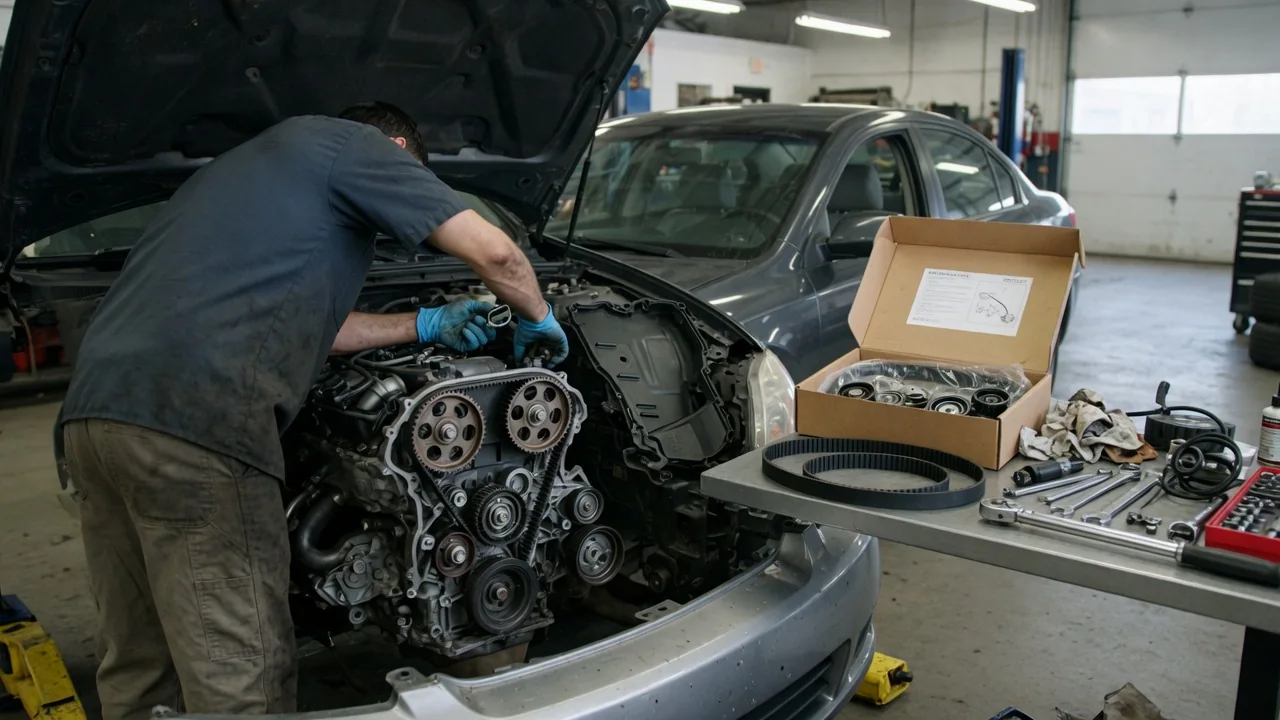
A timing belt looks like a simple rubber loop, but it has one of the most important jobs in an engine: keeping the crankshaft and camshafts turning in exact step. It rarely gives a warning before it fails. The reason a timing belt needs replacement comes down to three linked ideas. Its materials age, the engine depends on precise synchronization, and manufacturers set replacement schedules to stay ahead of failure.
Material Aging: Why Belts Wear Out Even When They Look Fine
Modern timing belts are made of several layers. The body is typically a synthetic rubber compound. Inside it are high-strength tensile cords, often fiberglass or similar fibers. A wear-resistant fabric covers the toothed face. Each layer has a role. The cords carry the load and resist stretch, the rubber holds the shape of the teeth, and the fabric protects the teeth as they mesh with the sprockets. All three degrade over time, and not necessarily at the same rate.
Heat is a major factor. The engine bay cycles between outside temperature and high operating temperature again and again. Over time, rubber compounds lose elasticity, harden, and can crack. Ozone and exposure to air also age the rubber, so a belt can deteriorate even in a vehicle that is rarely driven. Contamination makes things worse. Oil or coolant leaking onto a belt can soften or swell the rubber and weaken the bond between layers.
Mechanical work adds a separate kind of wear. Every engine revolution bends the belt around the sprockets, the tensioner, and the idler pulleys, and each tooth is loaded and unloaded repeatedly. The fabric facing wears, the teeth can lose their shape, and the tensile cords can weaken from fatigue. Much of this happens inside the belt or on its hidden face. A belt can look acceptable on the outside after much of its internal strength is gone. Looking at it alone is not a reliable way to judge how much life it has left.
Synchronization: What the Belt Keeps in Time
In a four-stroke engine, the crankshaft turns twice for every rotation of the camshaft. The timing belt maintains that fixed relationship. Its teeth lock the camshaft sprockets to the crankshaft sprocket, so the intake and exhaust valves open and close at the right moments relative to piston position. On many engines the same belt also drives other components, such as the water pump. On some diesel engines it drives the injection pump. Its condition affects more than valve timing alone.
The belt's teeth grip the sprockets directly instead of relying on friction, so a healthy timing belt cannot slip the way an accessory drive belt can. That precision is also why wear matters. If a belt stretches, loses tension, or has damaged teeth, it may jump one or more teeth on a sprocket. Even a small shift puts the valves out of step with the pistons. That can cause rough running, reduced power, or hard starting. On engines that monitor the cam and crank sensors, it can also set fault codes.
The more serious outcome is a complete break. When the belt snaps, the camshafts stop turning while the crankshaft keeps spinning from momentum. Some engines, often called non-interference engines, are designed so the valves and pistons never occupy the same space. In that case a broken belt usually just stalls the engine without major internal damage. In an interference engine, valves and pistons share space at different points in the cycle, so rising pistons can strike open valves. That can bend valves and damage other valvetrain or piston parts. A scheduled maintenance item becomes a major repair. Check the vehicle's service information to find out which design a particular engine uses.
Schedule: How Replacement Intervals Are Set
Wear is hard to see and failure can be severe, so manufacturers specify a replacement interval instead of relying on symptoms. The main timing belt service reason is prevention: replacing the part before its condition becomes a gamble. The interval is usually given two ways, as a mileage figure and an age limit, with replacement due at whichever comes first. The mileage figure covers wear from engine revolutions. The age limit reflects the fact that rubber deteriorates with time regardless of use. The numbers vary widely between engines and even between model years. For any particular vehicle, the only reliable figure is the one in its owner's manual or service schedule.
Many maintenance schedules also separate normal from severe operating conditions. Frequent short trips, long periods of idling, towing, very hot or very cold climates, and dusty environments all add stress to engine components, and some manufacturers shorten intervals for them. Check which schedule matches how the vehicle is actually used rather than assuming the standard one applies.
A timing belt service often covers more than the belt itself. Tensioners and idler pulleys contain bearings that wear along with the belt, and a failed pulley bearing can ruin a new belt. If the timing belt drives the water pump, the pump is commonly replaced at the same time, since reaching it requires the same disassembly. Leaking camshaft or crankshaft seals may also be replaced, because oil contamination shortens belt life. Which parts are included depends on the engine design and the manufacturer's recommendations.
Practical Implications and Limits
The most useful first step is finding out where the vehicle stands relative to its interval. For a used vehicle, look for service records or a dated label showing when the belt was last replaced. Without proof, many technicians treat the belt's history as unknown, and replacing it gives a known starting point. It is also worth confirming that the engine has a timing belt at all. Many engines use a timing chain instead, which is maintained differently and generally has no fixed replacement interval.
Warning signs exist, but they are unreliable. Possible signs of belt or tensioner trouble include: • ticking, whining, or squealing from the front of the engine; • oil leaks near the timing cover; • misfires or starting problems; Each of these can also have other causes, and many belts fail with no noticeable warning at all. Symptoms justify an inspection, but a lack of symptoms does not mean a belt past its interval is safe to keep.
General guidance also has limits. Labor time, the parts included in the job, and the consequences of a failure all depend on the engine layout, so cost and risk vary considerably between vehicles. Replacement also requires aligning the timing marks and setting the belt tension correctly. Mistakes there can cause the very damage the service is meant to prevent. Whether the job is done by a professional or an experienced owner, it should follow the manufacturer's procedure for that exact engine.