Why Does a Car's Range Change on Windy Days?
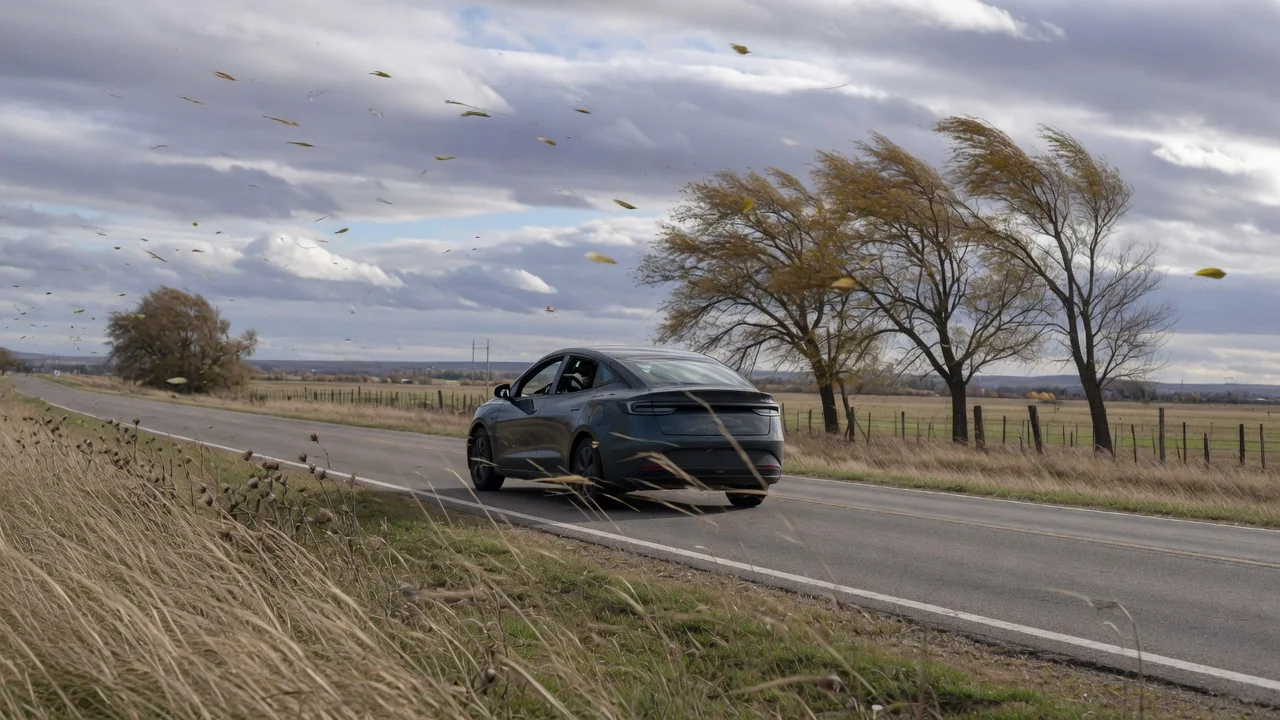
A car that easily covers a familiar route on a calm day can arrive with noticeably less fuel or battery charge after the same drive in strong wind. The road, the load, and the driver may be identical, but the energy used is not. Wind changes how much air the vehicle has to push through. This guide explains why a car's range changes on windy days, how speed magnifies the effect, and how to plan a sensible trip margin.
Aerodynamic load
Every moving vehicle spends part of its energy pushing air out of the way. That resistance, called aerodynamic drag, depends on the vehicle's shape, its frontal area, the density of the air, and above all the speed of the air flowing over the body. Drag responds to airspeed, not road speed. A speedometer reports how fast the tires are covering pavement, but the body only feels the relative motion between the car and the surrounding air. On a still day those two numbers match. When the wind blows, they diverge, and the energy needed to hold a steady road speed changes with them.
A headwind adds directly to the airspeed. Driving into a steady headwind is aerodynamically similar to driving faster through calm air, so the powertrain must deliver more force just to keep the same pace. A tailwind does the opposite, lowering the effective airspeed and reducing drag. On a round trip the two do not cancel out. Because drag rises with the square of airspeed, the extra energy spent heading into the wind is generally larger than the energy saved returning with it at the same road speed. An out-and-back drive on a consistently windy day therefore tends to use more energy overall than the same drive in calm conditions.
Crosswinds matter too, even though they push from the side. Wind arriving at an angle changes the direction of airflow across the body, often increasing turbulence around mirrors, wheel openings, and the rear of the vehicle. Vehicle shapes are typically refined mainly for air arriving from straight ahead, so angled flow can raise drag beyond what the headwind component alone would suggest. How much depends on the individual vehicle's design, which is why the same wind affects different body styles differently. Roof racks, cargo boxes, bike carriers, and open windows add frontal area or disturb airflow and can make any wind effect more pronounced. Gusty conditions also prompt small steering and throttle corrections, which add minor losses of their own.
Speed
Speed decides how much aerodynamic load matters in the first place. At low speeds, energy goes mostly to rolling resistance, accessories, and repeated acceleration from stops, so wind plays a modest role in town driving. As speed climbs, drag grows rapidly: the drag force rises with the square of airspeed, and the power needed to overcome it rises roughly with the cube. That is why highway driving is where wind shows up most clearly in range, and why a breeze that barely registers on a slow suburban road can be obvious on an interstate.
Wind interacts with this curve. A headwind effectively moves the car further up the steep part of the drag curve, so a given wind penalty grows larger the faster the vehicle is already going. The reverse also holds: slowing down reduces airspeed in a way the driver directly controls. Easing off modestly when driving into the wind usually recovers more range than the same reduction would on a calm day, because it trims a load that is already elevated. Cruise control holds road speed rather than airspeed, so on a windy stretch it keeps the set pace and quietly draws more power whenever the headwind strengthens.
The mechanism is the same for gasoline, diesel, hybrid, and electric vehicles, since all of them must overcome the same air. Electric vehicles often make the headwind car range effect more visible because they display remaining range and energy use in real time, and because their efficient drivetrains leave aerodynamic drag as a larger share of total highway consumption. Combustion vehicles experience the same added load, but the change can be less noticeable when the driver only watches a fuel gauge.
Trip margin
Range estimates are generally calculated from recent driving, not from the conditions ahead. If the last stretch was calm or downwind, the displayed figure can be optimistic for a leg that turns into a headwind. Conversely, after a long headwind segment, the estimate may look pessimistic once the route turns. Treat the number as a reflection of recent history and adjust it for what the wind is likely to do on the remaining route.
A practical trip margin accounts for wind direction relative to the route, not wind speed alone. A strong wind across a short urban trip may barely matter, while a moderate headwind on a long highway leg can consume a meaningful share of the reserve. Checking the forecast for direction, noting which legs face into it, and planning to refuel or recharge earlier on those segments keeps a comfortable buffer. For electric vehicles, choosing a charging stop that leaves extra charge on arrival matters more on windy days, because on some routes chargers are spaced farther apart and arriving low leaves fewer options if consumption rises further. Cold air is also denser than warm air, so a cold, windy day combines two conditions that both increase drag.
Practical implications and limits
In everyday use, the most effective responses are the ones the driver controls: a slightly lower cruising speed on exposed stretches, taking off carriers that are not needed for the trip, keeping windows closed at highway speed, and maintaining correct tire pressure so rolling losses do not add to the aerodynamic penalty. Watching the vehicle's instantaneous or trip consumption display during the first windy stretch gives a direct reading of how that particular car is responding, which is more useful than any general rule.
There are limits to how precisely wind effects can be predicted. Forecast wind speeds usually describe open terrain at a standard height, while the air near the road is shaped by hills, buildings, trees, and traffic. A large truck ahead can create a sheltered pocket or a turbulent wake. Wind direction and strength shift through the day, and gusts are irregular. Each vehicle's shape, size, and drivetrain also respond differently, so no single figure describes how much range a headwind will cost. The reliable takeaway is directional: headwinds and crosswinds generally increase consumption, higher speeds amplify the effect, and a larger margin is the prudent choice when the route and forecast point to sustained wind.