Why Does a Car's Cargo Cover Rattle?
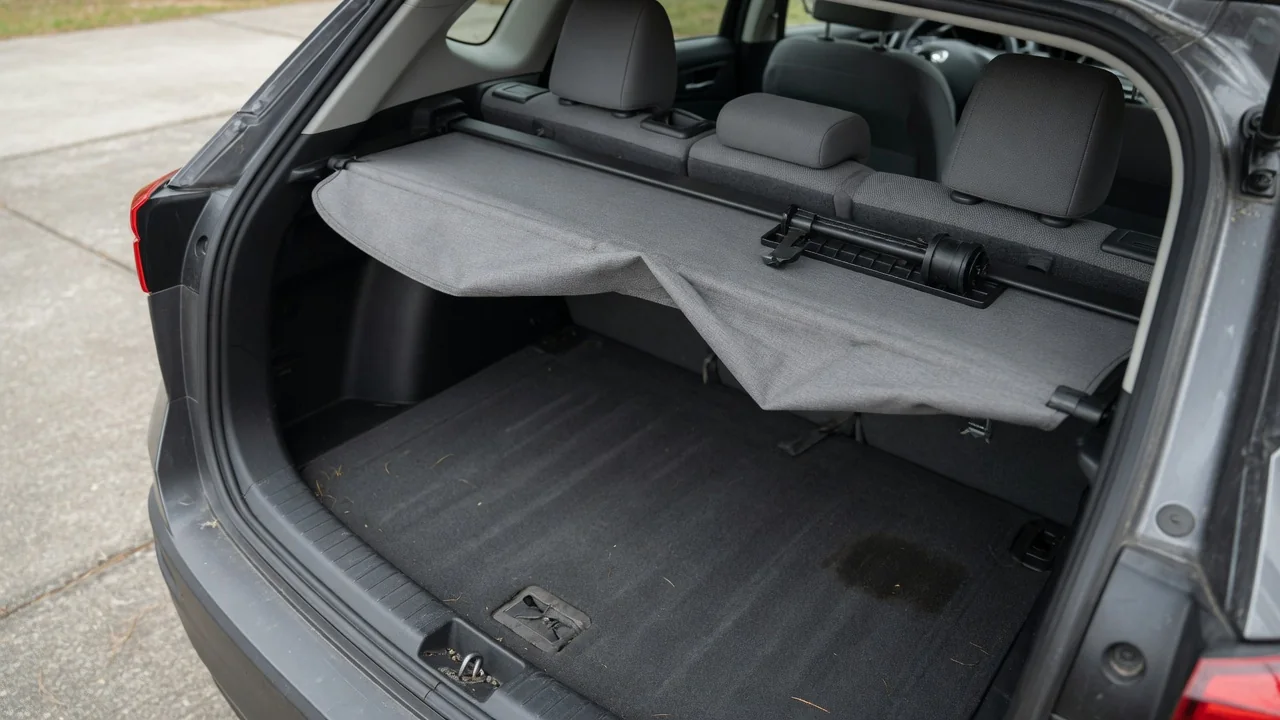
A cargo cover rattles when something that should be held firmly is free to move. So why does a car's cargo cover rattle on some roads and stay silent on others? The answer usually lies in how the cover mounts to the side trim, how its moving parts are tensioned, and what the luggage beneath it is doing. Working through those areas in order narrows the source quickly.
Check anchors
Most retractable covers sit in molded pockets in the side trim panels, held by spring-loaded end caps that press outward against each recess. Rigid parcel shelves in hatchbacks usually rest on side ledges and pivot on pegs, with cords lifting them as the tailgate opens. In both designs the anchor points carry the whole assembly, so a weak spring, a worn peg, or a cassette that is not fully seated leaves a small gap, and that gap lets plastic tap against plastic over every bump.
With the vehicle parked, grip the cassette or shelf near each end and try to move it up, down, forward, and back. A sound mount feels firm, while a loose one clicks or shifts visibly in its pocket. Look at the recesses themselves for shiny wear marks, cracks, or missing felt pads, and check that the lift cords and their hooks are attached and not swinging freely. Mounting layouts differ between wagons, crossovers, and hatchbacks, so the owner's manual is the best guide to how a particular cover locks in.
Adjust fit
Once the anchors look sound, attention turns to how the cover fits when extended. The pull bar at the trailing edge of a roller blind normally hooks into guide slots near the tailgate, and the blind's spring tension holds it there. If the bar sits loosely in its slots, or one side is hooked while the other rests on top of the trim, it can chatter on rough surfaces. A blind that has lost tension may also sag and flutter, slapping lightly against whatever sits below.
Reseating often cures the problem: retract the cover, release it, and install it again so both ends click home evenly. Some vehicles place the cassette in different positions depending on rear seatback angle, and a cover set in the wrong position can sit under strain or hang slack. Where a contact point is obviously bare, a small piece of felt or soft fabric tape between the touching surfaces can quiet it, provided nothing interferes with the latching action. Avoid bending tabs or forcing parts, because trim clips and pockets are easily damaged.
Remove for diagnosis
The most decisive test is also the simplest: take the cover out, leave it at home, and drive the same stretch of road that normally provokes the noise. If the rattle disappears, the cover or its mounts are confirmed as the source. If the sound remains, the search moves elsewhere, and the cargo area offers plenty of candidates, including the jack and tool kit, the spare wheel hold-down, the load floor panel, rear seat latches, the tailgate striker, and loose items in side bins.
Removal also allows a close inspection away from the vehicle. Shake the cassette gently and listen for a loose roller, a broken end cap, or a fragment of plastic moving inside the housing. Check the handle, any hinged flap, and the edges of a rigid shelf for cracks. Never leave the removed cover lying loose in the cabin or cargo area during the test drive, since an unsecured object of that size can become a hazard under hard braking. Many vehicles provide an under-floor storage slot, though not all do.
Everyday Use and Observations
Cargo interaction explains many noises that seem to come from the cover itself. Tall bags, boxes, or a folded stroller can press upward against the blind and lift the pull bar partly out of its slots, so it knocks with each bump. Hard items sliding around underneath may strike the cassette or the shelf's underside. An empty cargo area also behaves differently from a full one, because bare panels resonate more and soft luggage tends to absorb vibration that would otherwise be heard.
Patterns are worth noting before changing anything. A rattle that appears only on cold mornings suggests stiff plastic that quiets as the cabin warms, while one that follows coarse pavement or a particular speed points toward vibration finding a loose part. Compare the sound with the cover extended and retracted, with the rear seats upright and reclined, and with the cargo area loaded and empty. A passenger listening from the back seat can often place the noise on the left or right side far more accurately than the driver.
Limits and Next Steps
Home checks have limits. Broken end caps, a failed retraction spring, or cracked mounting pockets in the trim panel generally call for replacement parts rather than padding, and the availability of individual pieces versus a complete assembly depends on the manufacturer. Aftermarket covers may not match the original tolerances, which can itself explain a persistent noise. If the vehicle is under warranty, describing the conditions that trigger the rattle to the dealer is usually a better route than modifying the trim.
A noise that survives removal of the cover deserves a wider look, because sounds travel through the body structure and can seem to originate far from their real source. A technician can ride along, use listening equipment, and check items an owner cannot easily reach, such as tailgate adjustment, exhaust heat shields, or rear suspension components. Any knock that changes with braking, steering, or body movement should be inspected promptly, since that behavior points to something more significant than interior trim.