Why Does a Car Door Drain Water?
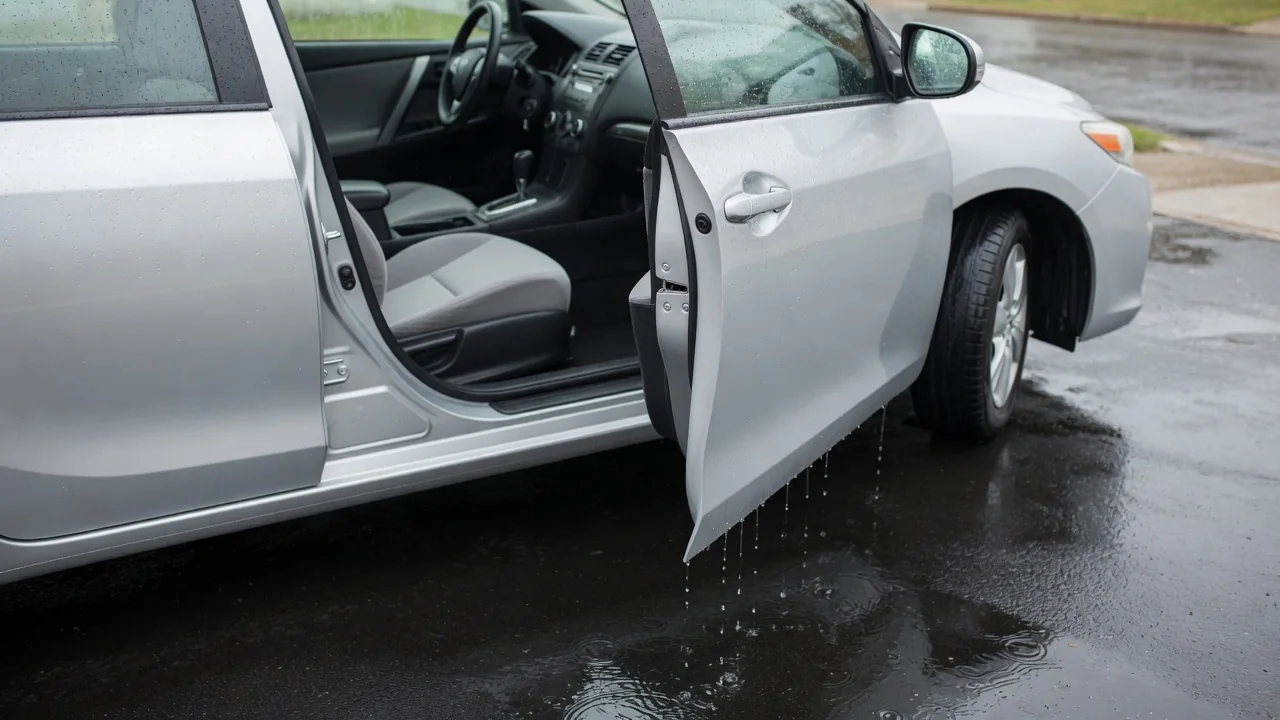
Anyone wondering why does a car door drain water is usually surprised to learn that the door was never meant to stay dry inside. Rain and wash water slip past the window glass by design, run down through the hollow door shell, and leave through small openings along the bottom edge. Understanding that path makes it easier to tell normal behavior from a real problem.
Window belt seal
The strip that runs along the base of the side glass, often called the belt seal, beltline weatherstrip, or window sweep, is where water first enters the door. It has to press against glass that moves up and down, so it works as a wiper rather than a watertight gasket. A seal tight enough to block every drop would drag on the glass, strain the window regulator, and wear quickly. Engineers accept that some water will slide past the outer lip and plan for it downstream.
On most vehicles you can see an outer sweep on the painted side and an inner one against the trim panel, with the glass riding between them. When the rubber or felt lining hardens, shrinks, or cracks with age and sun exposure, more water passes into the cavity, and the glass may come up streaked or scratched with grit. Frameless doors, convertibles, and vehicles with flush glass use different seal shapes, so the amount of water admitted in a heavy rain varies considerably from one design to another.
Internal barrier
Once water is inside the shell, it runs down the inner face of the outer skin and over the window mechanism, which is built to tolerate getting wet. What must stay dry is the cabin side of the door, where the trim panel, speaker, switches, and wiring connectors sit. A barrier separates these two zones. On many vehicles it is a sheet of plastic or foam bonded to the inner door frame with a bead of sticky sealant, commonly called a vapor barrier or water shield.
Other designs use a rigid molded carrier that holds the regulator and seals against the door frame with a gasket, doing the same job with a single module. Either way, the barrier directs water downward toward the bottom of the door instead of letting it wick through openings in the inner panel. It is normally hidden behind the trim, so owners rarely see it. If it has been torn, poorly resealed after earlier door work, or has come unstuck, the typical sign is a damp carpet or a wet lower edge on the interior door panel.
Drain outlets
The water collects at the lowest point of the door, where the inner and outer panels are joined along the bottom seam. Small holes or slots in that lower edge let it escape by gravity onto the sill or straight to the ground. They are deliberately modest in size and placed at the low spots so the cavity empties fully, since standing water against bare seams and folded metal is one of the main ways corrosion starts in a door.
Open the door and look along its underside to find them. Some are plain slots in the metal, some sit behind the lower weatherstrip, and some are fitted with small rubber flaps or plugs intended to let water out while limiting road noise, dust, and drafts coming in. Their number, shape, and position differ between manufacturers and even between front and rear doors on the same vehicle. Because they face the road and sit near the rocker panel, they can gradually fill with dirt, leaf fragments, wax, or underbody coating.
Everyday Use and Observations
In normal use the whole process goes unnoticed. After a storm or a car wash, a few drips falling from the bottom of an opened door, or a thin wet line along the sill, simply show that the drains are doing their work. Water beading out from the lower edge for a short while after rain is expected, particularly on a vehicle parked nose-up or nose-down on a slope, where the cavity empties toward one corner and takes a little longer to clear.
The signs that something has changed are different in character. A sloshing sound when the door is swung or when the car pulls away suggests water is trapped because the outlets are blocked. Persistent fogging of the windows, a musty smell, a crackling door speaker, or erratic window and lock switches can indicate moisture reaching the cabin side. Rust bubbles or staining along the bottom seam point to water sitting there over a long period. Parking under trees and driving on unpaved roads both increase how much debris reaches the door bottoms.
Limits and Next Steps
Drainage has limits. The outlets cope with rain and washing, but they are not designed for water driven in under pressure for a long time or for a door submerged in flood water. A blocked drain can often be recognized just by looking at the openings from below, and loose dirt at the surface can usually be cleared gently with something soft and non-metallic. Sharp tools are a poor choice, because scraping the paint and seam sealer around the hole exposes bare metal exactly where water passes.
When water appears inside the cabin, the source is not always the door. Sunroof drains, windshield seals, the cowl area, and body door seals can produce very similar wet carpets, so the pattern of where and when moisture shows up matters. If the drains look clear but dampness continues, or if electrical faults accompany it, an inspection behind the trim panel by a technician familiar with that vehicle is the sensible next step, since barrier construction, trim fasteners, and any side airbag components in the door vary by model.